• Welcome to Photrio!
    Registration is fast and free. Join today to unlock search, see fewer ads, and access all forum features.
    Click here to sign up

ECN-1 / original 'ECN' color process: which developing agent?

Filling In

H
Filling In

  • 1
  • 2
  • 39
Painted Hills # 3.jpg

H
Painted Hills # 3.jpg

  • 4
  • 0
  • 86

Recent Classifieds

Forum statistics

Threads
203,208
Messages
2,851,431
Members
101,725
Latest member
Eric35mm
Recent bookmarks
0
Everyone here is incredibly knowledgeable! May I ask a related question? What type of color coupler was used in the early ECN-1 process—was it CD-3, or something else?

No. As far as I know, ECN-1 was based on CD-2. Interesting detail is that the modern process ECP-2 for print film is also based on the older CD-2 developing agent.
 
Good question - I don't know! I'm sure you've searched for it as well as I have, and found...nothing. Well, some speculation, but nothing firm.
Perhaps @Rudeofus or @Lachlan Young knows.

I find it quite puzzling, too; Why not a google with an immediate answer? ECN-1 is not a rare process.....
I only located some older books and papers. These mention that Eastman Color Negative Safety Film, Type 5248 utilizes Kodak SD-30 as its color developer—which contains CD-3—while Eastman Color Print Safety Film, Type 5382 uses Kodak SD-31, containing CD-2. However, I still dont know whether this corresponds to ECN-1/ECP-1 process or not.
 
@laser (Robert Shanebrook) might be able to source that information for you if he is still active on here.
 
I find it quite puzzling, too; Why not a google with an immediate answer? ECN-1 is not a rare process.....
I only located some older books and papers. These mention that Eastman Color Negative Safety Film, Type 5248 utilizes Kodak SD-30 as its color developer—which contains CD-3—while Eastman Color Print Safety Film, Type 5382 uses Kodak SD-31, containing CD-2. However, I still dont know whether this corresponds to ECN-1/ECP-1 process or not.

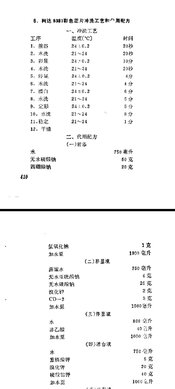
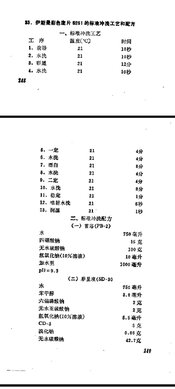
An old Chinese book actually contains the processing formula for Eastman 5251 Color Negative Film (which, according to other sources, was a motion picture color negative film used between 1962 and 1968). I believe this is the ECN process. The same book also includes a process for Eastman 5381 Color Positive Film, but it is labeled as a substitute, so I don't think this is the ECP process in the strict sense.
 

Attachments

  • Eastman5381-processing.jpg
    Eastman5381-processing.jpg
    105.9 KB · Views: 24
  • Eastman5251-processing.jpg
    Eastman5251-processing.jpg
    105.1 KB · Views: 23
An old Chinese book

Thanks for posting those scans; which book is this exactly and when was it published?
It gives a developer formula using CD-3, but I don't recognize the name (SD-30) and it's unclear to me whether this is a Kodak formula (perhaps listed under an alternative name) or a formula from a different source.

Here's the Claude translation of both documents:

This is for the 5381 print film pages:
6. Kodak 5381 Color Film Development Procedure and Alternative Formulas

A. Processing Procedure


Step Process Temperature (°C) Time
1. Pre-treatment 24 ±0.2 20 seconds
2. Water rinse 21~24 20 seconds
3. Color development 24 ±0.2 10 minutes
4. Water rinse 21~24 20 seconds
5. Stopping bath 24 ±0.2 4 minutes
6. Water rinse 21~24 4 minutes
7. Bleach 24 ±0.2 6 minutes
8. Water rinse 21~24 5 minutes
9. Fixing 24 ±0.2 5 minutes
10. Water rinse 21~24 8 minutes
11. Stabilization 21~24 1 minute
12. Drying
B. Alternative Formulas

(1) Pre-treatment Bath

  • Water: 750 milliliters
  • Anhydrous sodium sulfite: 50 grams
  • Sodium borate: 20 grams
(2) Color Developer Liquid
  • Distilled water: 750 milliliters
  • Anhydrous sodium sulfite: 4 grams
  • Anhydrous sodium carbonate: 20 grams
  • Silver bromide: 2 grams
  • CD-2: 5 grams
  • Water to make: 1000 milliliters
(3) Stop Bath
  • Water: 800 milliliters
  • Acetic acid: 40 milliliters
  • Water to make: 1000 milliliters
(4) Bleaching Solution
  • Water: 750 milliliters
  • Silver bromide salt: 6 grams
  • Silver bromide: 20 grams
  • Sulfuric acid salt: 40 grams
  • Water to make: 1000 milliliters

This is for the 5251 color negative recording film:
33. Standard Processing Technique and Formula for Eastman Color Sensitive Film 5251


A. Standard Processing Procedure


Step Process Temperature (°C) Time
1. Pre-treatment 21 10 seconds
2. Water rinse 21 10 seconds
3. Color development 21 12 minutes
4. Water rinse 21 10 seconds
[Middle section - continued steps]

Step Process Temperature (°C) Time
5. Stopping bath 21 4 minutes
6. Water rinse 21 4 minutes
7. Bleach 21 4 minutes
8. Water rinse 21 4 minutes
9. Fixing 21 4 minutes
10. Water rinse 21 8 minutes
11. Stabilization 21 1 minute
12. Drying/Final rinse 21 5 minutes
13. Drying 21 1 minute
B. Standard Processing Formulas

(1) PB-2 Bleaching Solution

  • Water: 750 milliliters
  • Hexametaphosphate: 15 grams
  • Anhydrous sodium sulfite: 100 grams
  • Sodium hydroxide (10% solution): 10 milliliters
  • Anhydrous sodium carbonate: 1000 milliliters
  • pH = 9.8
(2) Color Developer Liquid (SD-30)
  • Water: 750 milliliters
  • Methanol: 8.8 milliliters
  • Sodium hexametaphosphate: 2 grams
  • Anhydrous sodium sulfite: 2 grams
  • Sodium hydroxide (10% solution): 5.5 milliliters
  • CD-3: 5 grams
  • Sodium bromide: 0.86 grams
  • Anhydrous sodium carbonate: 42.7 grams
The PB-2 bleach formula looks a little odd to me; I would have expected a more powerful oxidizer in there; something like ferricyanide, or EDTA/PDTA in a mode modern bleach. I expect the PB-2 bath might work as a pre-bleach (also 'PB'!) bath that avoids massive rogue dye formation due to developer carry-over into a ferricyanide bleach.

As to the SD-30 developer, note it uses CD-3, but this does not yet definitively confirm that this is what Kodak prescribed in their ECN-1 process. However, it seems likely.
 
感谢你发布那些扫描件;这到底是哪本书,是什么时候出版的?
它给出的是用CD-3的显影剂配方,但我不认识这个名字(SD-30),也不确定这是柯达的配方(可能用了别的名字)还是其他来源的配方。

以下是克洛德对这两份文件的翻译:

这是针对5381页印刷胶片的:


这是针对5251彩色负片录制胶片的:

PB-2漂白剂配方对我来说有点奇怪;我本以为里面会有更强的氧化剂;类似铁氰化物,或者EDTA/PDTA的现代漂白剂模式。我猜PB-2浴液可以作为预漂白(也叫'PB'!)浴,避免因显影剂残留到铁氰漂白剂中而形成大量游染剂。

至于SD-30显影剂,请注意它使用CD-3,但这尚未能最终确认这是柯达ECN-1工艺中所规定的。不过,这似乎很有可能。
感谢你们帮忙把配方翻译成英文,科拉克斯。该书名为《摄影配方与化学品全集》,于1984年出版。然而,PB-2 意为“预浸”——它至今仍被柯达 ECN-2 工艺用作去除抗晕涂层的预浸浴。它绝对不是为预漂白设计的。😃
 
Last edited:
Thanks for posting those scans; which book is this exactly and when was it published?
It gives a developer formula using CD-3, but I don't recognize the name (SD-30) and it's unclear to me whether this is a Kodak formula (perhaps listed under an alternative name) or a formula from a different source.

Here's the Claude translation of both documents:

This is for the 5381 print film pages:


This is for the 5251 color negative recording film:

The PB-2 bleach formula looks a little odd to me; I would have expected a more powerful oxidizer in there; something like ferricyanide, or EDTA/PDTA in a mode modern bleach. I expect the PB-2 bath might work as a pre-bleach (also 'PB'!) bath that avoids massive rogue dye formation due to developer carry-over into a ferricyanide bleach.

As to the SD-30 developer, note it uses CD-3, but this does not yet definitively confirm that this is what Kodak prescribed in their ECN-1 process. However, it seems likely.
 

Attachments

  • Screenshot_2026-04-09-21-35-55-405_com.duokan.reader.jpg
    Screenshot_2026-04-09-21-35-55-405_com.duokan.reader.jpg
    179 KB · Views: 12
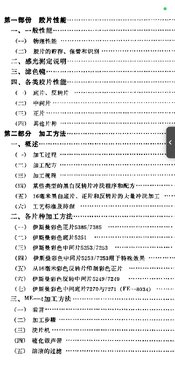
Additionally, I have another source—a 1974 translated document by the China National Chemical Information Center titled "American Eastman Film Processing Methods". Regrettably, it lists no references and doesn't even have a copyright page—this was not a publicly published book, but rather what was known as "internal material" . That said, judging by the level of detail in this document, it was almost certainly translated directly from Kodak's processing manuals—Chinese technicians themselves would not have used American standards and U.S. customary units of measurement. Nor would they have independently tested and produced such detailed Effects of Mechanical and Chemical Variations in Process data. It contains detailed processing procedures and control methods for Kodak Color Negative Film 5254, Color Positive Film 5385, and others—clearly intended for motion picture film laboratories.

The font used in this document is rather small, so even Google Translate might struggle with it.
If you would like to see it, I can translate it for you.
 

Attachments

  • Screenshot_2026-04-09-22-31-22-068_com.duokan.reader.jpg
    Screenshot_2026-04-09-22-31-22-068_com.duokan.reader.jpg
    246.8 KB · Views: 9
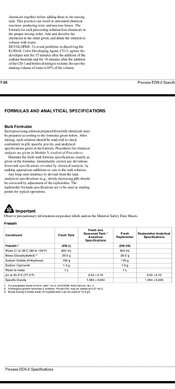
@Child Ship your post #36 gives the well-known ECN-2 formula. That's a substantially later variant. The question was about the preceding ECN-1 version (AFAIK just referred to as "ECN").
Edit: sorry, I see what you mean now - yes, it's the remjet softening prebath, you're right!

The table of context in #37 translates (Claude, Haiku 4.5 ex) as follows:
Table of Contents

Part One: Film Properties

  1. General Properties
    • (1) Physical Properties
    • (2) Film Storage, Preservation and Identification
  2. Explanation of Photographic Measurement
  3. Color Filters
  4. Properties of Various Types of Film
    • (1) Negative films, Reversal films
    • (2) Intermediate films
    • (3) Positive films
    • (4) Other film types
Part Two: Processing Methods
  1. Overview
    • (1) Processing procedure
    • (2) Processing formulas
    • (3) Processing specifications
    • (4) Processing procedures and formulas for certain types of black-and-white reversal film
    • (5) Large-scale processing of 16mm black-and-white negative, positive and reversal films
    • (6) Process standards and control
  2. Processing methods for various film types
    • (1) Eastman Color Positive Film 5385/7385
    • (2) Eastman Color Negative Film 5251
    • (3) Eastman Color Intermediate Film 5253/7253
    • (4) Eastman Color Intermediate Film 5253/7253 for special effects
    • (5) Making color positive prints from 16mm color reversal film
    • (6) Eastman Color Reversal Intermediate Film 5249/7249
    • (7) Eastman Color Intermediate Negative Film 7270 and 7271 (FF-2034)
  3. MF-4 Processing Method
    • (1) Preface
    • (2) Processing steps
    • (3) Film washing machine
    • (4) Silver sulfide sound track
    • (5) Filtration of solutions

That said, judging by the level of detail in this document, it was almost certainly translated directly from Kodak's processing manuals—Chinese technicians themselves would not have used American standards and U.S. customary units of measurement.

Yes, those are credible arguments. On the other hand, it's kind of odd that the formulas posted earlier don't refer to "ECN" as such. However, I really wouldn't know if perhaps in Kodak's vast range of product names (including possibly internally used ones) the ones from your source might occur.
 
Last edited:
An old Chinese book actually contains the processing formula for Eastman 5251 Color Negative Film (which, according to other sources, was a motion picture color negative film used between 1962 and 1968). I believe this is the ECN process. The same book also includes a process for Eastman 5381 Color Positive Film, but it is labeled as a substitute, so I don't think this is the ECP process in the strict sense.

Thanks, also mine sources.

1. 笹井明,水沢伸也。 “映画用伊士曼彩色胶片の性质と处理。” 日本摄影学会志16号,第1期。 3-4(1954):79-101。
Akira Sasai, and Shinya Mizusawa. "Properties and Processing of Eastman Color Film for Motion Pictures." Journal of the Photographic Society of Japan 16, no. 3-4 (1954): 79-101.

Its references:
1) W. T. Hanson Jr, and W. I. Kisner, "Improved Color Films for Color Motion Picture Production"
J. S. M. P. T. E., 61, 667 (Dec. 1953)
2) G. J. Craig, "Eastman Colour Films for Professional Motion Picture Work"
Brit. Kine., 22, 146 (May 1953)
3) F. Foster, "Eastman Negative-Positive Color Films for Motion Picrures"
Amer. Cine., 34, 322 (July 1953)
4) "Production of Motion Pictures in Color using Eastman Color Film"
Eastman Kodak Co.
5) W. T. Hanson Jr., "Color Negative and Color Positive Film for Motion Picture Use"
J. S. M. P. T. E., 58, 223 (Mar. 1952)
6) C. R. Anderson, N. H. Groet, C. H. Horton and D. Zwick "An Intermediate Positive-Internegative
System for Color Motion Picture Photography"
J. S. M. P. T. E., 60, 217 (Mar. 1953)
7) C. H. Evans and J. F. Finkle "Sound Track on Eastman Color Print Film"
J. S. M. P. T. E., 57, 131 (Aug. 1951)
8) E. Du Par "Warner Color-Newest of Color Film Processes"
Amer. Cine., 33, 384 (Sept. 1952)

2. 美国伊斯曼胶片加工方法 石油化学工业部科学技术情报研究所 北京:科学技术文献出版社, 1975
Eastman Film Processing Methods (USA), Institute of Scientific and Technical Information, Ministry of the Petroleum and Chemical Industries, Beijing: Scientific and Technical Literature Publishing House, 1975

3. 摄影配方药物大全 王文杰/ 战英民 / 远志忠 新华出版社, 1985
Comprehensive Compendium of Photographic Chemical Formulas Wang Wenjie / Zhan Yingmin / Yuan Zhizhong Xinhua Publishing House, 1985
 
Last edited:
Yes, those are credible arguments. On the other hand, it's kind of odd that the formulas posted earlier don't refer to "ECN" as such. However, I really wouldn't know if perhaps in Kodak's vast range of product names (including possibly internally used ones) the ones from your source might occur.

Several sources confirm the existence of SD-30 and SD-31 developer for early Eastman Color Film, but don't refer to "ECN/ECP"?

Incidentally, the ECN-2 formula can be found almost immediately.
The ECN-2 formula consists of Prebath PB-2, Developer SD-49(CD-3), Stop SB-14, Ferricyanide Bleach SR-29, Fixer F-34a, and Final Rinse FR-1.
Likewise, the ECP-2D formula consists of Developer SD-50(CD-2), Stop SB-14, First Fixer F-35d, Ferricyanide Bleach SR-27, Sound Track Developer SD-43b, Second Fixer F-35d, and Final Rinse FR-2.
 
Incidentally, the ECN-2 formula can be found almost immediately.
Yes, it was published by Kodak. I expect the reason for this was that Kodak wanted to nurture an ecosystem around its Vision3 products. In the absence of competition (since Fuji ceased production of Eterna), release of some of the technical documentation would have been relatively harmless. Just a guess as to their decision making, I don't know for sure.
 
CD-3 in original ECN-1 process, to the best of my knowledge.

There's articles & formulae in SMPTE journals by Hansen etc al.

CD-2 in the print developer.
 
@Yezishu I've taken the liberty of splitting this discussion off of its original thread; hope you don't mind.

I don't mind. I just need to learn how to use the functions of this forum (which is a bit difficult for a Gen Z who isn't exactly proficient in English).
Yes, the materials I screenshotted are exactly the second and third items listed by Yezishu: 2.《美国伊斯曼胶片加工方法》 and 3.《摄影配方药物大全》.
 
A while ago I had read somewhere that the original ECN process involves chemistry that is very close to todays formulas. However, it is still important to use a ferricyanide bleach with a relatively large amount of ferricyanide. The main difference is in the process temperature (around 25Ç degrees). Accordingly, the processing times are significantly longer…
 
@Yezishu I've taken the liberty of splitting this discussion off of its original thread; hope you don't mind.

I don't mind~

CD-3 in original ECN-1 process, to the best of my knowledge.

There's articles & formulae in SMPTE journals by Hansen etc al.

CD-2 in the print developer.

Thanks! So the formulae of Hansen has been in use for a long time. Perhaps for people of that time, "Eastman Color Negative Film"—or simply "Eastman color Film"—was clear, a fixed abbreviation like "ECN" is unnecessary. They should have realized that—within just a few years, the serial numbers of method had already reached C-22 and E3...
 
Last edited:
Thanks! So the formulae of Hansen has been in use for a long time. Perhaps for people of that time, "Eastman Color Negative Film"—or simply "Eastman color Film"—was clear, a fixed abbreviation like "ECN" is unnecessary. They should have realized that—within just a few years, the serial numbers of method had already reached C-22 and E3...

You need to be cautious with that comparison, because ECN has, I believe, only been used with respect to motion picture film stocks.
The motion picture film has always, I believe, been referred to as "Eastman" film, while the still films, with their different processes, have been Kodak films.
There certainly has been technology overlaps between the motion picture and still film processes, but their different output requirements have always mandated differences.
 
Photrio.com contains affiliate links to products. We may receive a commission for purchases made through these links.
To read our full affiliate disclosure statement please click Here.

PHOTRIO PARTNERS EQUALLY FUNDING OUR COMMUNITY:


Ilford ADOX Freestyle Photographic Stearman Press Weldon Color Lab Blue Moon Camera & Machine
Top Bottom