• Welcome to Photrio!
    Registration is fast and free. Join today to unlock search, see fewer ads, and access all forum features.
    Click here to sign up

Does paper developer dilution/temperature effect contrast?

Recent Classifieds

Forum statistics

Threads
201,727
Messages
2,829,163
Members
100,916
Latest member
mikenickmann99
Recent bookmarks
0

BetterSense

Member
Allowing Ads
Joined
Aug 16, 2008
Messages
3,151
Location
North Caroli
Format
35mm
Does paper developer dilution and temperature effect contrast? Or anything else? Do people generally develop prints for a fixed amount of time or try to watch it in the safelight and yank it when it looks good? If you have really underexposed print how long can you leave it in the developer in hopes that it will become a little bit darker?
 

Bob-D659

Member
Allowing Ads
Joined
Feb 10, 2008
Messages
1,273
Location
Winnipeg, Ca
Format
Multi Format
Always develop for a fixed time at a specific temp. If you use 1x4" test strips, you won't ever really underexpose a final print. :smile: some exceptions based on gross stupidity are allowed of course, and are easily fixed by turning on the inspection lamp while the print is still in the dev tray. :smile:
 

df cardwell

Member
Allowing Ads
Joined
Jul 16, 2005
Messages
3,358
Location
KY USA
Format
Multi Format
It all depends.

USUALLY:

Dilution only slows the time it takes to develop to a given contrast.

Some developer and paper combinations allow you to practice factorial development,
a way to move the midtone up and down while holding the highlight and shadow in place.
CAUTION: Subtle.

Some combinations don't change contrast as you add development time, only density.
Some change contrast.

Nearly all of photography is about the HOW, but seldom about the WHAT.

The tricky bit is that nearly all beginning printers vary their development time to try to make a great print,
and fail. Nearly ALL great printers vary the development time to make a great print and succeed --- but only after they go through a methodical progression of prints to get to the subtle stuff.

Its pretty much like learning to play a violin. Isn't that cool ?

The neat part is that if you DO stick to a set development time, you will improve, and as your work improves, so will your eye, and your work will improve faster. In time, you'll naturally pick up the subtleties.
 
Joined
Jan 21, 2003
Messages
15,715
Location
Switzerland
Format
Multi Format
Don, that's really interesting about factorial development - a concept I never knew existed, but an effect I've noticed while I print.

For some reason glycin based developers, such as Ansco 130, seem to have this abililty, VersaPrint II from FineArtPhotoSupply was another.

Yesterday I had a 9 hour darkroom session, and as I progressed through many prints, (finishing about 17 of them), I ran upstairs, in excitement, to show my wife two versions of the same print. Asking her which she liked best, and I asked her to look carefully, she said she couldn't tell a difference. So much for my excitement, but it proves Don's point. I'm hardly a master printer, but I do notice subtle differences in prints, and that I believe is down to practicing a lot.

To original poster. I would recommend using one dilution for a good long time before you start playing with it. There is so much you can do while the print is being exposed that needs to be exhausted before you start playing with your developer, if you ask me.
I think when we become experts at what we do, all those tricks yielding subtleties (that are barely visible on their own) add up and together make all the difference between a good and a really fine print.

- Thomas
 
OP
OP
BetterSense

BetterSense

Member
Allowing Ads
Joined
Aug 16, 2008
Messages
3,151
Location
North Caroli
Format
35mm
OK. So far my total adventures in chemical photography consist of developing paper negs from my pinhole camera, and one poor print from a BW400CN negative. I was starting to think that trying to develop by inspection was going to throw a wrench into the works of trying to nail down an exposure time both in the pinhole camera and on the enlarger. I've been using Dektol diluted 1 parts stock solution to 3 parts water at room temperature. The temptation to yank an overexposed pinhole negative early is great, but for enlargements I can see the merits of just developing for a fixed time. How long is long enough but not too long? Can you just leave it in there for a 'long time' to 'completely' develop? Perhaps I should use a 1-minute development time and stick with that for a while?
 
Joined
Jan 21, 2003
Messages
15,715
Location
Switzerland
Format
Multi Format
I use Ilford Multigrade developer currently at the 1+9 dilution for my prints. I use 2 minutes at about 70*F temperature. I stick to that.

When I used Ansco 130 as my main paper developer I diluted it 1+3 and developed for 3 minutes, sometimes 6 minutes to reach maximum contrast.

1 minute is probably too short, at least I find it is with fiber papers. They don't stay flat, and it takes about 30 seconds of constant agitation to get it flat enough to rest. Then after that I like to agitate gently, just lifting the corner of the tray once every 15-20 seconds. That would give me one agitation before the development time is up, so I go two minutes and adjust my exposures accordingly.

It is tempting to yank the print out of the developer a bit early, but it really isn't a good thing to do, since it usually isn't reproducible that way, and you never really learn what the effects are of what you do in the enlarger section of the process.

I don't know about RC papers since I don't really use them much, and when I do, I use them as I do fiber paper.

- Thomas
 

Lee L

Member
Joined
Nov 17, 2004
Messages
3,287
Format
Multi Format
What kind of paper is it? Most RC papers are well developed by about 90 seconds. For fiber based paper in Dektol about 2-3 minutes is good. Your exposure should determine print density, not development time. If you overexpose and pull the print early to save it, you'll just get a muddy looking print with no good blacks, at least with a regular print from a negative. Paper is pretty contrasty for straight in camera use on a regular contrast scene.

You're right that trying to save a bad exposure by developing the paper negative "by inspection" will throw you off the track if your exposure is well off the mark.

Lee
 
OP
OP
BetterSense

BetterSense

Member
Allowing Ads
Joined
Aug 16, 2008
Messages
3,151
Location
North Caroli
Format
35mm
It's Illford MGIV paper, sorry. I have noticed the contrast on paper negatives is pretty bizarre, which can be cool in certain ways, not so much in other ways.
 

dancqu

Member
Allowing Ads
Joined
Sep 7, 2002
Messages
3,649
Location
Willamette V
Format
Medium Format
It all depends. USUALLY: Dilution only slows the time it
takes to develop to a given contrast.

I believe that to be the case. I ordinarily use very dilute
chemistry one-shot. If I were using Dektol the dilution
would be 1:7 and I've read from posts this forum of
it being used at 1:8 and 1:9 by those who drum
process. I'm quite sure the papers I've used
have shown all the contrast they can
deliver with that developer.

On the matter of 'to completion': I've studied curves
generated by Phil Davis of density versus development
time. Maximum density precedes maximum contrast so
allowing for some varying of contrast at maximum
density. Dan
 

df cardwell

Member
Allowing Ads
Joined
Jul 16, 2005
Messages
3,358
Location
KY USA
Format
Multi Format
developing paper negs from my pinhole camera,

If I were making paper negatives in a pinhole camera,
then contact printing them, my problem would be to capture as much information as possible
and to be able to control the development as much as possible.

The whole idea of a negative is to make an image with a material whose contrast is lower than real life.
Then, you print it on a material whose contrast is greater than real life. You have control over the process this way.

But the problem of a paper original is that it has higher contrast than the subject !

There are two ways to get a little leeway:

•Shoot through a green filter. Your multigrade paper will hold more information, it will have lower contrast.

•• Dilute your Dektol as needed to get a development time of 1 1/2 ~ 2 minutes. You DON'T have much developer control with RC paper.
 
OP
OP
BetterSense

BetterSense

Member
Allowing Ads
Joined
Aug 16, 2008
Messages
3,151
Location
North Caroli
Format
35mm
•• Dilute your Dektol as needed to get a development time of 1 1/2 ~ 2 minutes. You DON'T have much developer control with RC paper.
I would have to further dilute then for sure. I don't have very bright safelights at the moment but it usually looks like the paper is fully developed after 20 seconds or so.
 

Lee L

Member
Joined
Nov 17, 2004
Messages
3,287
Format
Multi Format
Keep in mind that Ilford MG (and other variable contrast papers) will also have odd spectral responses compared to film. Red and orange, or the red/orange components of other colors, won't expose the paper very effectively. Green colors will be low contrast, blue colors will be high contrast. That's why df suggested a green filter. Whatever does get through a green filter will register on the low contrast layers of the paper's emulsion, making it a better match to the contrast range in the real world.

You mention MGIV, but don't say whether it's resin coated (RC) or fiber based. Fiber based papers usually take a bit longer to develop.

Lee
 

Bruce Watson

Member
Allowing Ads
Joined
Mar 28, 2005
Messages
497
Location
Central NC
Format
4x5 Format
Does paper developer dilution and temperature effect contrast?

As everyone says, dilution only effects time.

Temperature can however effect contrast. This happens with developers that more than a single agent, like hydroquinone and metol together (Dektol for example). If the temperature is too low, one agent can be more active than the other and can effect tonal balance and contrast. Usually higher temperatures have have little effect other than to shorten development time.

I found this out thousands of years ago when I was a high school intern at the local newspaper shooting high school sports. I came in early on a Sunday morning IIRC and found that one of the valves had become stuck and that water temperature was down around 16C. I ran some prints through anyway. When I got them into the light I was amazed at the increased contrast -- like going up a paper grade or even two. Freaky.

What I remember from my research is that lowering the temperature sort of takes the metol out of the equation. But like I say, it's been like forever.
 
OP
OP
BetterSense

BetterSense

Member
Allowing Ads
Joined
Aug 16, 2008
Messages
3,151
Location
North Caroli
Format
35mm
I've been using the RC illford paper. It's cheaper. I will consider the green filter idea, but I'm not sure what to use. I could just tape a green lens filter over my pinhole I guess, if I had one.

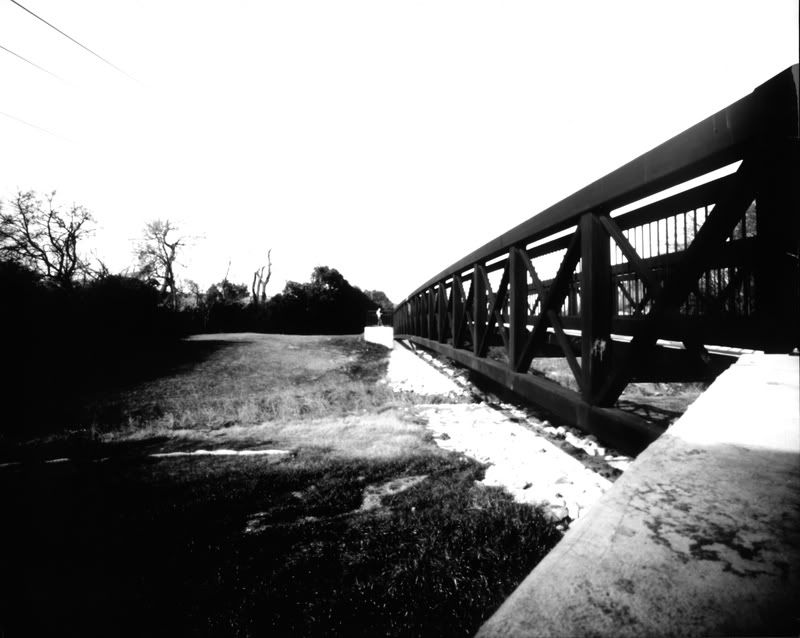
Here's an example of bizarre contrast. This scene would have been more or less normal on film I think, but the rusty bridge is very dark, while the rocks and sky are blown out, eating up the powerlines that added nice emphasis to the person.

bridgeneg.jpg
 

David Brown

Member
Allowing Ads
Joined
Feb 16, 2004
Messages
4,060
Location
Earth
Format
Multi Format
I don't have very bright safelights at the moment but it usually looks like the paper is fully developed after 20 seconds or so.

No, it's probably not. (unless you are grossly overexposing) What you are likely seeing is what is known as "emergence", when the image first starts to appear. With RC paper, this is 10-20 seconds. Generally, full development occurs at a factor of x times the emergence. For instance, if the factor is 4, and the image emerges in 15 seconds, it takes 60 seconds to fully develop the print.

What is the answer for your paper and developer? Have you read the instructions that come with the paper you're using? It will tell you. :wink:
 

Larry Bullis

Subscriber
Allowing Ads
Joined
May 23, 2008
Messages
1,265
Location
White Rock, B.C. Canada
Format
Multi Format
The problem with using a green (or any other color) filter with pinhole is that the filter must be perfectly clean, because any dust in the optical path will produce a VERY UGLY spot on the negative and print. If you have a long enough time, it would work to keep the filter moving during the exposure.

Back when knights rode their trusty steeds around rescuing fair damsels from dragons, I showed my beginning prints to Minor White. He advised me to turn the prints face down in the tray and develop for two minutes so I wouldn't be tempted to yank - because he could easily see that was what I was doing. I can see it, too, in student work. If you yank it soon enough, you will not only get un-dark "blacks" but you will get flow markings where the microcurrents in the tray give different development. (Yuk!)

The advice so far has been terrific. What I can add is that for beginners, especially, and for more advanced practitioners as a matter of discipline, it is a good idea to treat each print as if it were an experiment in a science lab. Only change one thing at a time. Constant time in the developer enables you to find your exposure time (1) and then your contrast (2) each in separate steps. If you want to see the effect of altering development time, the way to do it that would make the most sense is to find your exposure time and then your contrast, then vary only the development time. That way, you aren't committed to a confusion of variables. Df's mention of factorial development is good. He uses that, and so do I, and lots of other printers, too, but I certainly would encourage you, if you are beginning, to avoid that for now until you have made at least a few thousand prints. As he says, SUBTLE. So subtle that it is very doubtful that you, like Thomas' wife, would be able to see, let alone understand, the difference.

One thing at a time. If you make more than one change at a time, how can you know what actually produced the effect you see?

 
Joined
Jan 21, 2003
Messages
15,715
Location
Switzerland
Format
Multi Format
Would it work to get a gel filter and adhere it to the inside of the camera?
 

Larry Bullis

Subscriber
Allowing Ads
Joined
May 23, 2008
Messages
1,265
Location
White Rock, B.C. Canada
Format
Multi Format
Would it work to get a gel filter and adhere it to the inside of the camera?

Inside or out, it would be exactly the same. If I were going to filter with pinhole, I'd build a motorized filter spinner. It would be very hard with most of my cameras, too, because they are so incredibly wide angled that it would be difficult, if at all possible, to keep the apparatus out of sight of the hole. Almost have to make a "rim drive" using a round filter. That might work.
 
OP
OP
BetterSense

BetterSense

Member
Allowing Ads
Joined
Aug 16, 2008
Messages
3,151
Location
North Caroli
Format
35mm
If you yank it soon enough, you will not only get un-dark "blacks" but you will get flow markings where the microcurrents in the tray give different development. (Yuk!)

I already have a print that has that! I was wondering what caused it.

Thanks everyone for all the help. For the longest time I didn't think my paper came with any directions because I never found them in the package, it being dark and all. I found them a couple days ago but I forgot to leave them out and I don't want to open the package of paper up to get them right now.
 

Lee L

Member
Joined
Nov 17, 2004
Messages
3,287
Format
Multi Format
For the longest time I didn't think my paper came with any directions because I never found them in the package, it being dark and all. I found them a couple days ago but I forgot to leave them out and I don't want to open the package of paper up to get them right now.

You don't have to open the box. You can open these URLs instead:
http://www.ilfordphoto.com/Webfiles/20061301948131639.pdf
http://www.ilfordphoto.com/Webfiles/2006130200232336.pdf

All the major photo materials makers have their film, paper, and chemistry info online now, and many of the smaller companies do as well.

Lee
 

AlanC

Member
Allowing Ads
Joined
Feb 23, 2004
Messages
348
Location
North Yorksh
BetterSence,

Like DF Cardwell says, you need to find a way to reduce the contrast of the paper negative.
When I had a brief encounter with a home-made 10 x 8 pinhole camera, I used , like you, Ilford Mgd. 4 RC for a paper negative.
My first try had good exposure - shadow detail was OK . But the contrast was too high - highlight detail was full black.
So I immediately made a second exposure of the same subject, this time with a Multigrade 00 filter taped over the back of the pinhole. This really reduced the contrast to a useful level. Highlights were now no longer a deep black.

So you might try a Mgd. 00 filter. If you do, double the exposure time.
Oh yes, I used my normal paper developer, Neutol WA, diluted 1 +9, and developed for my normal RC time of 90 seconds.

Alan Clark
 

Lee L

Member
Joined
Nov 17, 2004
Messages
3,287
Format
Multi Format
A green filter and a #00 Multigrade filter will have about the same effect on contrast. Use whichever you already have on hand. If you don't have either, both would be useful items to have in the future. Do watch for dust, as bowzart has cautioned, it's very important when a dust speck could be about the size of your aperture. You could move a clean green glass or #00 printing filter around in front of the pinhole as a cheap trial.

Lee
 

AlanC

Member
Allowing Ads
Joined
Feb 23, 2004
Messages
348
Location
North Yorksh
Film is faster Thomas!
With a 00 filter and paper my exposure was 4 minutes on a sunny day!

Alan Clark
 
OP
OP
BetterSense

BetterSense

Member
Allowing Ads
Joined
Aug 16, 2008
Messages
3,151
Location
North Caroli
Format
35mm
A green filter and a #00 Multigrade filter will have about the same effect on contrast. Use whichever you already have on hand. If you don't have either, both would be useful items to have in the future.

I've been on the lookout for a cheap set of Multigrade filters, which I will eventually need for printing. Film would be nice, but 8x10 film is like $4 a sheet, and I don't have the stuff to develop it.

With a 00 filter and paper my exposure was 4 minutes on a sunny day!
I wonder if my pinhole is larger than yours, or my focal length different (mine is 150mm, .5mm pinhole). My exposure times in sunlight are only about 30 seconds, to 1 min if the sun goes behind the clouds. Of course I'm still figuring out the best time though, so I could be underexposing.
 
Photrio.com contains affiliate links to products. We may receive a commission for purchases made through these links.
To read our full affiliate disclosure statement please click Here.

PHOTRIO PARTNERS EQUALLY FUNDING OUR COMMUNITY:


Ilford ADOX Freestyle Photographic Stearman Press Weldon Color Lab Blue Moon Camera & Machine
Top Bottom