• Welcome to Photrio!
    Registration is fast and free. Join today to unlock search, see fewer ads, and access all forum features.
    Click here to sign up

Do you keep work prints or test prints?

Recent Classifieds

Forum statistics

Threads
202,920
Messages
2,847,608
Members
101,536
Latest member
takesama2001
Recent bookmarks
0

cramej

Member
Allowing Ads
Joined
Dec 29, 2009
Messages
1,235
Format
Multi Format
And how do you file them? Keep them with the contact sheet/ negatives or file them away in a folder somewhere else? And how do you reference the original negative of you want to go back and print it again 10 years later?

Lots of questions.... but I'm beginning to have a small stack of test prints with some notes and I'm interested in how others keep track.
 
On a short term basis, they are very useful when fine tuning my toning efforts.
 
I keep them more than I should, stored haphazardly on a pile on a shelf in the darkroom. When the pile topples over, I sort it out, discard lots (still not enough) and store away in plastic containers. Not much of a 'filing system'.

The rationale behind the lack of system has two parts:
1: The prints I make have no societal relevance. I enjoy making them, and that's pretty much where it ends for most prints.
2: What I need to learn from a print, I (try to) pick up immediately, adjust process, and move on. Hence, a test or work print doesn't have much value for me on a timescale longer than perhaps a couple of days.
Now you also understand why I mentioned keeping them around more than I should. I should really discard more of them right away.
 
I’m only really interested in the tiny percentage of my negatives that ultimately I consider ‘keepers’. I want to be able to produce further ‘final’ prints of those if needed. So I use paper worksheets on which I record exactly how I expose each test strip or full sheet. I tone, wash and dry everything from the session. When the prints are dried, and I am happy which one is best, I inducate that on the work sheet and discard the test strips and second-rate prints. It depresses me to keep them around because they represent such a lot of cost!

My negatives are all filed in Selco sheets, so every image can be referenced by film number and frame. The things I haven’t solved efficiently are:
- remembering to write exposure details on each test/work print, to match them up to the record sheet after drying.
- attaching the negative number to the visual image (print or on-screen image).
 
My filing system:

I will try to keep work prints if I am particularly pleased with the photograph I've made, so I don't have a lot of those, lol......I do not keep test strips. Negative filing: I Store my 4x5 negatives in a Printfile sheet, 4 negatives to a sheet. I simply number each sheet.......#1 and #2 the top two sleeves and #3 and #4 the bottom two sleeves. On the corner of each sleeve is placed a little white sticker where I indicate the date the negative was made and the development given, i.e., N, +1, -1, etc.. Each Printfile sheet is simply numbered and placed in a 3-ring binder, the sheets are in descending order. Work print/final print filing: The border of a work print is where I indicate where the negative is found and the date it's printed, ex: #5-3 (1-29-23)........that's Printfile sheet #5, 3rd sleeve; also I will indicate the toning i.e., selenium 1:10, 5 min. I place any work prints I wish to keep in a separate folder along with printing notes (enlarger height, base exposure, and dodge and burn notes, etc....) , the folder is noted with a short title, date printed, and the same negative location info.

This system helps me feel a bit organized as I participate in the hobby; it helps me to reflect. I enjoy seeing how I progressed with the printing from first unmanipulated work print to the final print.
 
Last edited:
Like Matt, I use/keep them to fine-tune toning but beyond that it's into the circular file.
 
I dumped all my colour print tests from the 1980-1990s a short time ago.
No use anymore as the chemicals and papers they refer to have long been out production.
I kept the hardback book of filter settings and times that I used though, as it had lots of extra notes scribbled in about the places and people I did some photography for.
All my Cibachrome tests gone as well.
My black and white tests go out shortly after printing. But I do scribble notes and sketches of dodging and burning etc in my darkroom print record book.
 
No, I do not keep working prints or printing notes. I rarely reprint an image. And papers change. Equipment changes. Everything changes. And hopefully my printing skills have improved in the interim.
 
Last edited:
I keep them more than I should, stored haphazardly on a pile on a shelf in the darkroom. When the pile topples over, I sort it out, discard lots (still not enough) and store away in plastic containers. Not much of a 'filing system'.

The rationale behind the lack of system has two parts:
1: The prints I make have no societal relevance. I enjoy making them, and that's pretty much where it ends for most prints.
2: What I need to learn from a print, I (try to) pick up immediately, adjust process, and move on. Hence, a test or work print doesn't have much value for me on a timescale longer than perhaps a couple of days.
Now you also understand why I mentioned keeping them around more than I should. I should really discard more of them right away.

This is where I am. The scrap prints can come in handy for other things. Prints that are keepers go in the keepers box(es) and the ones that are close go in the “close” boxes. The tests go in a stack and when it gets too big, I purge from the bottom. Having a collection of “close” prints was handy when I was teaching photography to a neighbor kid to illustrate progress in the process.

This reminds me of a similar issue I dealt with a few years ago when I got heavily into drawing and painting again. At first I felt like every piece, no matter how atrocious, was “precious,” and needed to be kept. Then, once I’d advanced beyond the “atrocious” I did a purge and tossed about 600 drawings. Letting go is healthy.
 
I usually toss them in a box and sort them once a year or so. A lot of times I'll grab one to test a new carbon transfer glop color and use the back for a final transfer.
 
Every photo I think is worth keeping/printing/showing gets printed as an 8x10, and I always start with a work print (no dodging or burning) just to get the exposure and contrast dialed in. I keep notes on the back of that work print that say everything I need to know to recreate it in one try - enlarger height, EL lens focal length and f-stop, contrast grade, developer, etc. etc. I'll also mark up the front of the work print using a blue sharpie to show the dodge and burn plan. Then when I'm ready to make a final print, I can go straight to the final print and usually get it right in one try with no test strips. The work prints and final prints get stored together in one of those Itoya portfolios. I can look at them whenever, scan them, and reference them if I want to make further prints. Even at a different size I can usually get where I want in one test strip, because all my dodging and burning is done in terms of stops.

If I have reject prints or intermediate prints, I keep those all together in a pile. They're good to have on hand if I have some nearly-exhausted selenium toner; I can just let a few prints soak in a big tray of it for a couple of days to leech as much selenium as possible out of the water before disposal.
 
This is where I am. The scrap prints can come in handy for other things. Prints that are keepers go in the keepers box(es) and the ones that are close go in the “close” boxes. The tests go in a stack and when it gets too big, I purge from the bottom. Having a collection of “close” prints was handy when I was teaching photography to a neighbor kid to illustrate progress in the process.

This reminds me of a similar issue I dealt with a few years ago when I got heavily into drawing and painting again. At first I felt like every piece, no matter how atrocious, was “precious,” and needed to be kept. Then, once I’d advanced beyond the “atrocious” I did a purge and tossed about 600 drawings. Letting go is healthy.
Referring to the painting and drawing part of your post, I read an old book on painting in watercolours.
The advice given was to keep your old paintings no matter how bad they looked. As time went by and you thought you had not improved and stagnated, look back at your earlier work and you should definitely see progress, thereby boosting your confidence.
 
There's a lot of useful information here. Since I haven't yet developed any formal filing system for my negatives, I decided to start labels with 00001 arbitrarily and whatever I put in the notebook will get the next number. As I process new film, it will essentially be chronological. At least I have some reference I can notate on the back of a print to find the negatives. I also started a "Revisit" folder - for work prints that I'm unsure if I really like enough to put the effort into making a nice print. I'll go back and look at these some day down the road and decide if they're worth keeping. Lastly, I ordered up a couple of drop front boxes and interleaving to house the 'keeper' prints along with the relevant work print if it's not getting framed. All this discussion really has me thinking critically about what to keep and what to toss!
 
I only keep work prints long enough to produce the finished product and then the work print go off to the trash can.
 
I sometimes keep a couple of test prints that are close just for reference or sometimes I will cut them up for collages or the like.

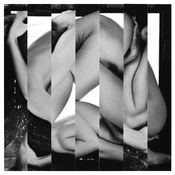
Abby_Reconstructed_1.jpg
 
I usually just keep them until the final print is done, then toss them. If I like one for some reason, I also might use them for collages or mixed media images, like Pieter 🙂

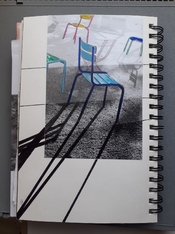
20230131_121304.jpg
 
I don't do a lot of printing, but when I work toward something for exhibition, I make some test prints at a smaller size. Most of my work in this millennium has been from 6x6, so the test prints are usually 5x5. (Putting that on 5x7 paper allows trimming a test strip or two off the end.) That gets me pretty close to doing a 10x10 on 11x14 just by removing the 2 stop ND filter I use on small enlargements.

I've done less of it lately, but earlier in this century, I made some "mini portfolios" putting the 5x5s in a ring binder. The prints are adhered to a piece of mat board fastened to a sheet of black paper to simulate the appearance and proportions of the framed larger prints. (Yeah, I know -- "Is anal retentive spelled with a hyphen?" 😁 )

Example:
_G4975_AMiniPortfolio_Open.jpg
 
I used to keep work prints. That's a better word than failed-print-that-hopefully-looks-better-next-time. I still do it occasionally, but its depressing. Just keep the ones that work, that is so much better for the ego. It's not like I'm going to put something like that on the wall (although I have, sigh). The keeper prints I scribble all over in the margins w/ pertinent info so I can find them later in the print files. Then they go back into the Ilford box that they came in. I could probably save a lot of time and money by just keeping them there and never opening the box in the first place.

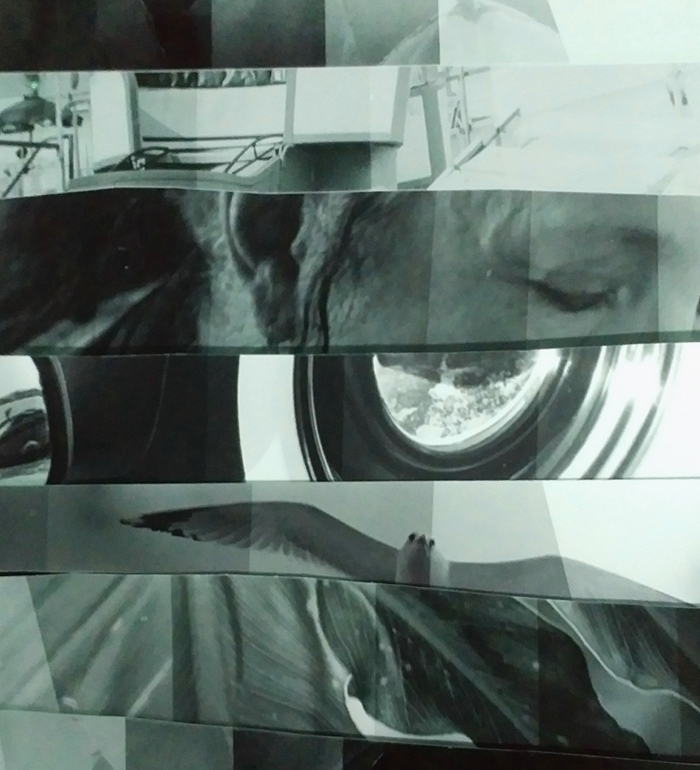
I do keep test strips though. That's for a little art project I have in mind. You know, the ones we think are just wonderful but everyone else thinks are just plain stupid. OK, if you insist, I'll show one off. But it's just a work print! No, it's something I want to turn into a painting. Something big, so the messed up tonal values will be all fixed up, at least at some point before I die. This is just my take, but the unrelated chopped up pieces of imagery sorta tell a story, but not in a linear manner.

6FeZswD.jpg
 
Last edited:
Oops, the file was too big. Maybe the story it tells is that it needs to go back in the box and stay there, but a story is a story.

77VWzgg.jpg
 
I keep a print record log and take one of the work prints with the exposure Record and dodging and burning marked in grease pencil. it is all in a binder I keep in the darkroom.
 
Sometimes test strip makes nice bookmarks. But mostly they end up in the trash... I don't fix them as much as they should anyway so they would be useless after a few weeks.
 
I don't do a lot of printing, but when I work toward something for exhibition, I make some test prints at a smaller size. Most of my work in this millennium has been from 6x6, so the test prints are usually 5x5. (Putting that on 5x7 paper allows trimming a test strip or two off the end.) That gets me pretty close to doing a 10x10 on 11x14 just by removing the 2 stop ND filter I use on small enlargements.

I've done less of it lately, but earlier in this century, I made some "mini portfolios" putting the 5x5s in a ring binder. The prints are adhered to a piece of mat board fastened to a sheet of black paper to simulate the appearance and proportions of the framed larger prints. (Yeah, I know -- "Is anal retentive spelled with a hyphen?" 😁 )

Example:
View attachment 328321

I don't know about the hyphen, but that's a great idea. So good I plan to steal it and work on creating such binders. Looks great!
 
Photrio.com contains affiliate links to products. We may receive a commission for purchases made through these links.
To read our full affiliate disclosure statement please click Here.

PHOTRIO PARTNERS EQUALLY FUNDING OUR COMMUNITY:


Ilford ADOX Freestyle Photographic Stearman Press Weldon Color Lab Blue Moon Camera & Machine
Top Bottom