• Welcome to Photrio!
    Registration is fast and free. Join today to unlock search, see fewer ads, and access all forum features.
    Click here to sign up

DIY "step wedge"/"projection print scale"?

Sentry

A
Sentry

  • sly
  • Dec 16, 2025
  • 1
  • 0
  • 0

Forum statistics

Threads
201,221
Messages
2,820,702
Members
100,596
Latest member
bosak
Recent bookmarks
0

Denis P.

Member
Allowing Ads
Joined
May 20, 2004
Messages
470
Location
Croatia
Format
Multi Format
... how to go about it?

I'd like to make my own version of the Kodak Print projection scale - you know, that transparency/film with a circle (like a "pie chart"), which you put onto paper, then expose for a full minute, and the segments show how long the exposure should be.... Just for fun, I don't expect spectacular results, like doing away with test strips :smile:

I thought about printing something on an inkjet printer on transparency material, but got a better idea from a friend who works in graphics industry, and works with professional printers, where they regularly print stuff like that, so he offered to get one printed "professionally" :smile:

You might ask why not just purchase one on eboy, but with the recent changes in Customs policies here, it's getting quite expensive to buy even worthless trinkets, as long as they are coming from abroad, so it's not an economical solution. And, since I can get one printed professionally (for free), I say, why not give it a try?

Now, my problem is how to prepare the "pie chart" in a graphics program. I've seen the Kodak print scale in several ebay auctions, and I don't think that the scale is linear - it has ten segments, numbered from 2 to 48 (seconds), with varying opacity. Now, I'm a total idiot when it comes to sensitometry, densitometry, etc., but I don't think that the scale should be linear (i.e. opacity should not progress in 10% opacity steps, but it should be analog to f-stop values, right?). I.e. each next wedge should halve the amount of light passing through...

So, in short - if anyone has an idea on how to reproduce this "print projection scale" in a graphics program, I'd be more than grateful. I was thinking about ten wedges, just like the original Kodak one.

Any ideas?

TIA,

Denis
 

Ray Rogers

Member
Allowing Ads
Joined
Aug 27, 2005
Messages
1,543
Location
Earth
Format
Multi Format
Johns idea was rather good and simple I would say.

Basically, you just need to make a density series increasing in density by say 0.5 stops (0.15 D I thnk) each section.
Your challange would be to hit equal Density increments for all the sectors, neutral in tone and sensitometric effect.

I think John's original used a 60 seconds exposure, which translated into 2,3,4,6,8,12,16,24,32,48 seconds of actual exposure... meaning that the 2 second exposure section reduced the exposure from 60..to what? something under 5 stops? I think so. Therefore since 5 x 0.3 D = 1.5D I guess that would mean the 2 second area was equall to a Density of about 1.5; subtract 0.15 from there to get each subsequent sector.

Also it is nice to have black on clear sector numbers so you will know what you are looking at.

I guess you could forget all the calculations and just go for broke. Try it and figure out the value of each SHOULD USE exposure for the one really used in the test.

Hummmm...
I have a few newish? ideas I would like to try if your friend can make accurate, finely-tuned density controlls and would be willing to take on some more free work...
(Now where did that smiley face go?)
 
Last edited by a moderator:

Ray Heath

Member
Allowing Ads
Joined
Dec 29, 2005
Messages
1,204
Location
Eastern, Aus
Format
Multi Format
why? what's wrong with test strips? why make make it unnecessarily technical?
 
OP
OP
Denis P.

Denis P.

Member
Allowing Ads
Joined
May 20, 2004
Messages
470
Location
Croatia
Format
Multi Format
why? what's wrong with test strips? why make make it unnecessarily technical?

Ray, indulge me... :smile:
Nothing wrong with test strips, I'm just fooling around... trying to cut some corners, if possible.

Besides, I'm suddently and unexpectedly stumped with some math... and being stubborn as I am, I won't let it pass.
 

Ray Rogers

Member
Allowing Ads
Joined
Aug 27, 2005
Messages
1,543
Location
Earth
Format
Multi Format
why? what's wrong with test strips? why make make it unnecessarily technical?
Actually, this is a test strip of sorts.

I do not currently use this aid myself,
but I have used it and it works pretty well.

As you will notice, however, there is still room for fine-tuning... so in a sense, you are right... there is not much advantage over conventional test strips, of which there are several.

I guess it is rather easier to give one exposure at one F/stop value to get 10 different test results than it is to keep changing/moving something or other to get the same results... in addition to reducing the possibility of a goof-up somewhere along the line.

Also,
Perhaps the shape of the sectors (triangular, slice of pie type) is more suited to certain subjects than others.

Ray
 

Jim Jones

Subscriber
Allowing Ads
Joined
Jan 16, 2006
Messages
3,740
Location
Chillicothe MO
Format
Multi Format
Even if you lay out the design in a graphics program, film may not have a linear enough response to make an accurate scale. Of course you could always assign arbitrary numbers or letters to each segment and determine the exposures by testing.
 

Bobby Ironsights

Member
Allowing Ads
Joined
Oct 14, 2007
Messages
127
Location
Thunder Bay,
Format
35mm
I have an exposure scale, projection print wedge, whatever.

It wasn't homemade, it was made by kodak.

It sucks,

Why make one at home?
 

PVia

Member
Allowing Ads
Joined
Oct 3, 2006
Messages
1,057
Location
Pasadena, CA
Format
Multi Format
I have a Stouffer step wedge and it's very helpful.

I've contact-printed it on each paper I use using the same enlarger height, lens, aperture, etc. The resulting print-scale shows me the differences in paper speed, length of contrast scale and what adjustments are needed in exposure time and/or aperture when changing grades.

It helps you to know the characteristics of your material and is a useful reference in the darkroom.
 

Ray Rogers

Member
Allowing Ads
Joined
Aug 27, 2005
Messages
1,543
Location
Earth
Format
Multi Format
It's a joke to take seriously!

I have an exposure scale, projection print wedge, whatever.

It wasn't homemade, it was made by kodak.

It sucks,

Why make one at home?
Yea, that DIY route is not always the way to go!
I know a guy who went to a museum once and saw some paintings.
They really impressed him a lot, so much so that soon thereafter, he enrolled in painting class.
Today I saw his work.
It sucks.

Same thing I guess.
 
OP
OP
Denis P.

Denis P.

Member
Allowing Ads
Joined
May 20, 2004
Messages
470
Location
Croatia
Format
Multi Format
Well, despite all the naysaysers, I went ahead with this project.

With the help of a friend, I devised a step wedge of a kind - well, more like a pie chart - my take on the "Kodak Print Scale". It has 10 segments, which I made by increasing density by 10% for each segment (more or less)...

The increments are in 2, 5, 10, 20, 30, 50, 65, 80, 90 and 95 percent of black...

The pie chart was printed on graphics film in a printing house (done professionally!), and today I did some tests. My time calculations are pretty close, and I did some test, exposing the pie chart for 20 and 30 seconds.
The segments came pretty close to actual test strips.
Another possible use is similar to what PVia above does - use it as a variant of Stouffer step wedge, to determine speed and characteristics of different papers...

In short, interesting exercise (in futility, perhaps, but still interesting...).

Could come in handy. The way I do test strips is rather slow - this might speed thing us just a litlle bit.

Attached is a PDF variant - it will make the concept easier to understand for visual types like myself :smile:

Denis
 

Attachments

  • Test3-Denis.pdf
    86.6 KB · Views: 433

craigclu

Subscriber
Joined
Sep 8, 2002
Messages
1,322
Location
Rice Lake, Wisconsin
Format
Multi Format
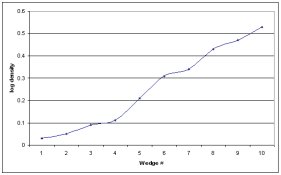
Denis, I printed onto some transparency film on my laser printer. The density didn't get as deep as it appears in the pdf file but I ran it through a densitometer so that you could at least see the relationships between the tones. The vagueries of equipment, etc make the numbers for comparison to standard printed materials not useful but the general relationship between the wedges might be interesting for you. They showed a slight hash pattern at 600 dpi that your professionally done sample likely doesn't display. Anyway, here's a plot in log scale.
 

Attachments

  • wedge.jpg
    wedge.jpg
    73.7 KB · Views: 209

Paul Verizzo

Member
Joined
Jan 20, 2008
Messages
1,648
Location
Round Rock, TX
Format
35mm
I always found the Kodak thingy better in theory than practice. I have also discovered that as they age, they get quite a bit of B+F, I think it's the plastic they use.

It seems that except on small prints, there just isn't enought area to get a reliable fix on exposure time. And then, ten second is underexposed and twenty is too much. OK, now we are back to a test strip, 10, 12, 14, 16, 18, seconds.

Oh well.
 
OP
OP
Denis P.

Denis P.

Member
Allowing Ads
Joined
May 20, 2004
Messages
470
Location
Croatia
Format
Multi Format
Craig, thans for the log scale!

If you want, I could send you a real one by mail (i.e. by snail-mail, in an envelope), so you can do an exact measurement/plot. You can keep the one I send you - I have three, and can make more without too much hassle :smile:

I'll PM you...

BTW, I tried "measuring" the densities/values using my EM-10, but it's not really very usable for this purpose (to be used as a densitometer....)

Denis
 

Ray Rogers

Member
Allowing Ads
Joined
Aug 27, 2005
Messages
1,543
Location
Earth
Format
Multi Format
Well, despite all the naysaysers, I went ahead with this project.

With the help of a friend, I devised a step wedge of a kind - well, more like a pie chart...

Could come in handy. The way I do test strips is rather slow - this might speed thing us just a litlle bit.

Denis

My method takes a long time too.

But Cool!
How many did you make?
I'd like to try one out!

Ray
 

Ray Rogers

Member
Allowing Ads
Joined
Aug 27, 2005
Messages
1,543
Location
Earth
Format
Multi Format
My method takes a long time too.

But Cool!
How many did you make?
I'd like to try one out!

Ray

Ooops!
I should have read the next page!
 
Last edited by a moderator:

craigclu

Subscriber
Joined
Sep 8, 2002
Messages
1,322
Location
Rice Lake, Wisconsin
Format
Multi Format
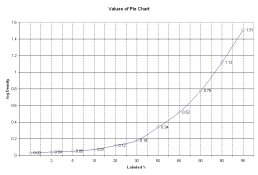
I rec'd the material today and ran a quick density test. I'm attaching a spreadsheet and a shot of the chart with the results. I ran each section twice and got the same reading each time. I found a very slight difference in the pie wedges and the rectangles. The black section around the labels gave a 2.45 result, by the way....

Denis sent some nice shots that he had done. Good subjects and interesting architecture, too!
 

Attachments

  • perc_dens.jpg
    perc_dens.jpg
    152.3 KB · Views: 186
  • perc_dens.xls
    14.5 KB · Views: 156

richard ide

Member
Allowing Ads
Joined
Nov 8, 2005
Messages
1,217
Location
Wellington C
Format
Multi Format
Denis,
I think that there is a difference between what you had made and a projection print scale. Yours, done on graphic arts film, is a halftone representation of a grey scale step wedge. Projection print scales and step wedges are printed on continuous tone film and the steps are varying densities. If you look at the one you had made with a magnifier, the steps are really high density film with varying hole sizes. It may work but I suggest you test it by making a contact print which just gives you maximum black and examine the steps with a magnifier. If you can see dots in the areas, then you are getting an approximation of a grey scale.
I don't want you to get misleading results. I think that you can make one yourself which although not balanced against a projection print scale as far as exposure times, would give you a very accurate and reproducable result. Photograph a grey card (or a sheet of white paper) at different time/aperature combinations in 1/2 or 1/3 stop steps using any BW film. What you end up with is a whole series of negatives of varying density. Using a light table or other source of backlight, choose negatives which come closest in appearance to your graphic arts scale. Look at them from normal reading distance. Then take portions of these and tape to a piece of clear film. You now have a very accurate duplicate of a print scale. If your friend can; ask him to measure densities for you and make your own step wedges.
In my business which involved photographing two dimensional originals of all kinds, a grey scale was always used in the image. If an employee made a negative, this scale allowed me to see in a second if it was of the high quality desired, or exposure/processing was the best possible.
 
OP
OP
Denis P.

Denis P.

Member
Allowing Ads
Joined
May 20, 2004
Messages
470
Location
Croatia
Format
Multi Format
...
It may work but I suggest you test it by making a contact print which just gives you maximum black and examine the steps with a magnifier. If you can see dots in the areas, then you are getting an approximation of a grey scale.

Yes, that's what it looks like.
However, the results are "close enough for the Government work", or, better said, those could be used for the intended purpose.

...
Then take portions of these and tape to a piece of clear film. You now have a very accurate duplicate of a print scale. If your friend can; ask him to measure densities for you and make your own step wedges.

As mentioned above, I just need something that's "close enough" to be used as an aid in the darkroom. I.e. instead of making 2-3 test strips, I'll make just one, which would (hopefully) give me a starting point.

But, I think I'm getting better in my darkroom work - I just have to force myself to record everything. Once I consult my notes, everything usually goes a lot faster :smile:
Yesterday I even managed to make a contact sheet (almost) on the first try - even though it was done on a paper I don't use much (very slow one).
I eyeballed it, and decided to try 30 seconds with a small test strip. It turned out it needed to be just a bit shorter - so I made the full contact sheet with 25 second exposure... just about right...
 
Photrio.com contains affiliate links to products. We may receive a commission for purchases made through these links.
To read our full affiliate disclosure statement please click Here.

PHOTRIO PARTNERS EQUALLY FUNDING OUR COMMUNITY:


Ilford ADOX Freestyle Photographic Stearman Press Weldon Color Lab Blue Moon Camera & Machine
Top Bottom