• Welcome to Photrio!
    Registration is fast and free. Join today to unlock search, see fewer ads, and access all forum features.
    Click here to sign up

DIY paper washer - enough flow?

Recent Classifieds

Forum statistics

Threads
201,764
Messages
2,829,759
Members
100,931
Latest member
zalapatax
Recent bookmarks
0

Jessestr

Member
Allowing Ads
Joined
Mar 31, 2014
Messages
399
Format
35mm
I made my own paper washer since I'm not sure that I will do enough fiber to get a real print washer like the washmaster eco...

I made a video where you can see the flow of the water. It's been running for an hour now and the blue is still not gone ... so I'm wondering if this is enough flow to actually wash the print? It's 27 liters / hour. So it needs about 3 hours to cycle the whole storage box.

I've heard that you may not use too much pressure on the water so I just let the water sip in slowly.. Could this work or do I need more pressure?

(still have to make the paper slots, but wanna make sure this is good first.. just a quick mockup of what I want to do, probably will add the hose with a real connection to the tap etc)


paul ron

Member
Allowing Ads
Joined
Jan 22, 2004
Messages
2,709
Location
NYC
Format
Medium Format
i don't think you're getting enough water changes. my washer gets at least 4 complete water changes an hour. im not sure what the newer water saving washers do.
 
OP
OP

Jessestr

Member
Allowing Ads
Joined
Mar 31, 2014
Messages
399
Format
35mm
i don't think you're getting enough water changes. my washer gets at least 4 complete water changes an hour. im not sure what the newer water saving washers do.

The washmaster eco does about 60 liters to 90 liters an hour. It's a huge tank I have, think it's about 90 liters. So in theory, there is enough fresh water in there already to wash a print? I'll try to get up the flow and pressure and see how it turns out. Thanks
 

David Allen

Member
Allowing Ads
Joined
Nov 6, 2008
Messages
991
Location
Berlin
Format
Med. Format RF

Neal

Subscriber
Allowing Ads
Joined
Dec 3, 2004
Messages
2,027
Location
Chicago, West Suburbs
Format
Multi Format
Dear Jessestr,

First, nice washer. If you rinse your prints after fixing, use hypo clearing agent (not needed for RC paper), rinse and place in your washer it is very unlikely that you will not wash sufficiently. If you are truly interested in finding out how good a job you are doing, try this test. If you do any toning, you will see stains where the washing is insufficient.

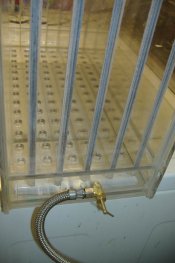
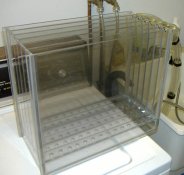
A suggestion. I would modify the design so that each print is in its own chamber and fed with it's own pipe, have it's own area for overflow and prevent cross contamination when a new print is added. I think your design can be modified to do this pretty easily. Attached are a couple of photos of the washer I built in 2008. To date, no stains after toning.

PrintWasher2.jpg PrintWasher1.jpg

I hope I added these correctly.:smile:

Neal Wydra
 
OP
OP

Jessestr

Member
Allowing Ads
Joined
Mar 31, 2014
Messages
399
Format
35mm
Before you do any further work, I would recommend that you read Martin Read's thorough research into washing prints. You will find that there are many factors to consider other than the rate of water flow.

Thanks!

Dear Jessestr,

First, nice washer. If you rinse your prints after fixing, use hypo clearing agent (not needed for RC paper), rinse and place in your washer it is very unlikely that you will not wash sufficiently. If you are truly interested in finding out how good a job you are doing, try this test. If you do any toning, you will see stains where the washing is insufficient.

A suggestion. I would modify the design so that each print is in its own chamber and fed with it's own pipe, have it's own area for overflow and prevent cross contamination when a new print is added. I think your design can be modified to do this pretty easily. Attached are a couple of photos of the washer I built in 2008. To date, no stains after toning.

View attachment 151850 View attachment 151851

I hope I added these correctly.:smile:

Neal Wydra

Nice washer! I was planning to make one out of plexi but I didn't find how I could attach everything together.. also a nice idea to have separate chambers, maybe I'll just make a new version like yours. Could you tell me how you cut and mounted the plexi? I will definatly use hypo, more ecological in terms of water, and faster workflow, so that's nice !
 

removed account4

Subscriber
Allowing Ads
Joined
Jun 21, 2003
Messages
29,832
Format
Hybrid
I would also recommend using a hypo clearing chemical. you will find you don't
need to wash regular prints as long. also look at what is written about soaking
prints and water changes rather than gallons and gallons and gallons of wash water.
nice washer btw!
 
OP
OP

Jessestr

Member
Allowing Ads
Joined
Mar 31, 2014
Messages
399
Format
35mm
I would also recommend using a hypo clearing chemical. you will find you don't
need to wash regular prints as long. also look at what is written about soaking
prints and water changes rather than gallons and gallons and gallons of wash water.
nice washer btw!

Thank you.. Will check out the documentation online!

Dear Jessestr,
If you do any toning, you will see stains where the washing is insufficient.

Neal Wydra

I had issues with the stains when I started toning, because a piece of the paper wasn't washed. But what I find odd is that using Ilford's method:

1. Fix
2. Tone (mixed with washaid)
3. Washaid rinse
4. Final wash

They tone directly after fixing, which makes me wonder, why won't it stain? it hasn't been washed ... and will the toner not get contaminated more quickly due to the fixer that gets in the toner?

Thanks
 
Last edited:

R.Gould

Member
Allowing Ads
Joined
Apr 22, 2010
Messages
1,752
Location
Jersey Chann
Format
Multi Format
Thank you.. Will check out the documentation online!


I had issues with the stains when I started toning, because a piece of the paper wasn't washed. But what I find odd is that using Ilford's method:

1. Fix
2. Tone (mixe
Thank you.. Will check out the documentation online!


I had issues with the stains when I started toning, because a piece of the paper wasn't washed. But what I find odd is that using Ilford's method:

1. Fix
2. Tone (mixed with washaid)
3. Washaid rinse
4. Final wash

They tone directly after fixing, which makes me wonder, why won't it stain? it hasn't been washed ... and will the toner not get contaminated more quickly due to the fixer that gets in the toner?

Thanks

d with washaid)
3. Washaid rinse
4. Final wash

They tone directly after fixing, which makes me wonder, why won't it stain? it hasn't been washed ... and will the toner not get contaminated more quickly due to the fixer that gets in the toner?

Thanks[/QUOTE
Assuming you are refering to Selinium toner the reason for hypo clearing after toning is because the toner contains fixer, so hypo clear after toning makes sense, I use the Kodak hypo clear, it is much cheaper than the Ilford product, comes in powder form so you have to mix it, then dilute it at 200ml to 1 litre but you get 3.8L which dilutes to 19 litres, and at around £5GBP per packet is very cheap
 
Last edited:

Ronald Moravec

Member
Allowing Ads
Joined
Jan 17, 2005
Messages
1,355
Location
Downers Grov
Thank you.. Will check out the documentation online!


I had issues with the stains when I started toning, because a piece of the paper wasn't washed. But what I find odd is that using Ilford's method:

1. Fix
2. Tone (mixed with washaid)
3. Washaid rinse
4. Final wash

They tone directly after fixing, which makes me wonder, why won't it stain? it hasn't been washed ... and will the toner not get contaminated more quickly due to the fixer that gets in the toner?

Thanks


Assuming selenium toner, two tray fix with rapid fix, 15 sec rinse, selenium tone to taste, now do archival wash. Been doing this for decades and no stains. The other choice is two archival washes, B/4 & after tone. Fred Picker of Zone VI come up with system.

As far as washing, you can not have any dead spots in a washer. The best wash is fill a tray with water, put in prints one at a time and interleave while filling a second tray. Transfer prints one at a time to second tray, and interleave while emptying and refilling first tray.

Repeat 4 times, 8 trays of fresh uncontaminated water. Economical water use. interleave 2/3 times through the stack and move them one at a time to next tray.

This works for me for around 50 years now and never lost a print. Also cheap, but labor intensive.
 

Neal

Subscriber
Allowing Ads
Joined
Dec 3, 2004
Messages
2,027
Location
Chicago, West Suburbs
Format
Multi Format
Could you tell me how you cut and mounted the plexi?

The actual material used was 1/4" thick polycarbonate (trade name Lexan). I used a table saw with a fine tooth blade to cut grooves for permanent joints and for sliding the separator pieces in and out. All the joints are held together using industrial RTV Silicone. The holes were drilled with a drill press but I think a hand drill would work just as well. Having said that, I really don't think you need to go that far. Your washer can be re-piped so that dividers can be added and each section gets its own flow. You are already so close. Besides, if it's already doing a good job it would be more fun to spend the time printing.

Good luck,

Neal Wydra
 
Joined
Sep 10, 2002
Messages
3,673
Location
Eugene, Oregon
Format
4x5 Format
The only way to really make sure your washer is doing the job is to test for residual hypo. You can use the Kodak HT-2 test. The original Kodak document is here: http://125px.com/docs/techpubs/kodak/j11-1985_04.pdf . You can get the "hypo-estimator" color patch strip from the UnblinkingEye website here: http://unblinkingeye.com/Articles/Archival/archival.html (scroll down to the bottom of the page).

Once you've figured everything out, simply set up your washer, fix as normal several sheets of unexposed paper. Put these in your washer and then pull them out and test them at intervals (e.g. 20, 30, 40, 50, 60, 70 minutes) for six sheets. Do full-sheet tests by immersing the whole sheet in a tray of the test solution. You should easily be able to see if 1) your washer is doing the job at all and 2) how long you need for an adequate wash.

Best,

Doremus
 

RalphLambrecht

Subscriber
Allowing Ads
Joined
Sep 19, 2003
Messages
14,917
Location
K,Germany
Format
Medium Format
I made my own paper washer since I'm not sure that I will do enough fiber to get a real print washer like the washmaster eco...

I made a video where you can see the flow of the water. It's been running for an hour now and the blue is still not gone ... so I'm wondering if this is enough flow to actually wash the print? It's 27 liters / hour. So it needs about 3 hours to cycle the whole storage box.

I've heard that you may not use too much pressure on the water so I just let the water sip in slowly.. Could this work or do I need more pressure?

(still have to make the paper slots, but wanna make sure this is good first.. just a quick mockup of what I want to do, probably will add the hose with a real connection to the tap etc)


I think, you'll be fine.The principle of washing FB-paper is based on diffusion. So, just keep the water below the fresh-water equilibrium.In other words as long as the fixer concentration is higher in the print than in the water you are washing.For that,you only need a low flow rate;eveb Niagra falls won't wash any faster or better.
 
OP
OP

Jessestr

Member
Allowing Ads
Joined
Mar 31, 2014
Messages
399
Format
35mm
My Versalab washer runs at 0.5 Gallons/minute, which is in their recommended range. I use a flow control valve to regulate it. That means I'm using something like 113 L of water per hour.

That's a lot!

I ended up getting a Washmaster Eco... Much smaller and more efficient then my DIY stuff
 
Photrio.com contains affiliate links to products. We may receive a commission for purchases made through these links.
To read our full affiliate disclosure statement please click Here.

PHOTRIO PARTNERS EQUALLY FUNDING OUR COMMUNITY:


Ilford ADOX Freestyle Photographic Stearman Press Weldon Color Lab Blue Moon Camera & Machine
Top Bottom