
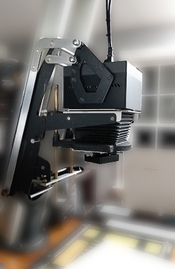
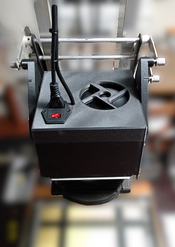
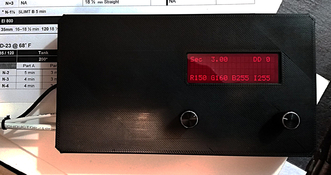
Here are some images of the LED head and timer/controller that a friend up the street built for me, using a 3-D printer and his knowledge of electronics and coding. He is not a photographer, so I specified what was needed and we worked out details. I work in B&W only and needed a new head to replace my dying coldlight head (I suspect there are quite a few of those out there; lamps for some can still be purchased but at a premium, and the rest of the "innards" will not last forever) and LED seemed clearly the way to go. Except, that I'm hopeless at building things and don't have the money to invest in a Rolls-Royce model like the Heiland.
This one is not as bright as those made from individual, larger white or other LEDs, but it's adequate, fairly close to what I got from my coldlight. It uses a 6x6-inch 256-LED RGB panel, which I adjusted to give white light of equivalent color to a tungsten bulb, hence Gr. 2 with my Ilford contrast filters. The panel idea came from a design offered in full detail by a poster using the name elgatosuizo over at largeformatphotography.info a couple of years ago, but my friend made many changes, including the coding language for the Arduino computer in the controller. The head incorporates the power supply; the fan (see top view) -- a relatively low-RPM computer case fan -- is vibration-free and extremely quiet.
The controller's two dials each perform multiple roles. The left one adjusts the exposure time in 500ths of a second (half a tenth) and goes up to 59 seconds. "Click on" the dial successive times to adjust, individually, the red, green, blue, and the overall intensity, then return to time adjustment. Push the right-hand dial to turn on the light for focusing; push again for off. In the off position, turning the dial adjusts the dry-down percentage subtracted from the exposure time, from 0 to 15%.
Light evenness gave us some headaches, with edge falloff accentuated by my 135mm, rather 150mm lens for 4x5. This was solved by an Excel program offered by another member over yonder, allowing adjustment of intensity of consecutive rectangles of LEDs, from the outside, in. Some playing around with this optimized evenness and overall intensity.
I had to add lead ingots weighing a total of about 6-7 lbs to counter the powerful band-springs that raise the head.


