
The idea is to make a fully manual Lomo LC-A 120, which has no control on exposure and tends to have issues with the film advance.
The lens is extracted from the Instax "Magellan" camera, which uses a glass 4.5/38 lens. It's safe to presume this is the same lens as the LC-A.
The Magellan is easy to disassemble, but the lens is glued + screwed into the shutter. I printed a holder to secure the shutter in a vise and used a nasty wrench to remove the lens. A custom circle clamp would have been better.

The tiny lens will go in front of this Seiko shutter from the 3.5/105 Mamiya TLR lens. It has threaded posts for the aperture ring that will be repurposed to hold the lens. By luck, the lens drops into the hole with its flange spacing the rear of the lens just shy of the shutter blades.

The shutter/lens combo was first adapted to a digital camera to check the image quality, estimate the back focus distance (approx. 29mm from shutter mount to image) and to recalibrate the aperture scale. Another lucky coincidence is that I can use the original scale, after dividing the numbers by 2.

The focusing helicoid is from a Bronica 2.8/50 that had a faulty shutter. It was substantially modified on a lathe to accommodate the short back focus.

I'll be using a Hasselblad A24 film back. The little hook that stops the counter at frame 1 was disabled. The film is advanced via the winder; you need to stop once the exposure flag triggers. The winding is not very smooth. A C12 back would be better I think. Here is the 3d-printed body. The lens is attached on the part on the right, which latches onto the back. The part on the left has the cold shoe and tripod mount, and is clamped to the other. It was remixed from https://www.printables.com/model/247783-hasselblad-film-magazine-mount-pinhole-camera-matt

Here is the camera: very compact!

For the nerds out there, I checked the lens parallelism with this flimsy jig. Within 0.07mm after accounting for the flex of the glass support.

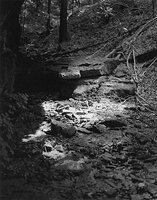
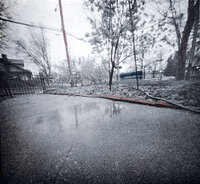
Here is the test film. I think there is a small light leak. Sharpness and coverage are good. There are small lines between the frames, caused by the acute cone of light that exits the lens and that exposes the film from under the film rollers in the back.

The lens is extracted from the Instax "Magellan" camera, which uses a glass 4.5/38 lens. It's safe to presume this is the same lens as the LC-A.
The Magellan is easy to disassemble, but the lens is glued + screwed into the shutter. I printed a holder to secure the shutter in a vise and used a nasty wrench to remove the lens. A custom circle clamp would have been better.
The tiny lens will go in front of this Seiko shutter from the 3.5/105 Mamiya TLR lens. It has threaded posts for the aperture ring that will be repurposed to hold the lens. By luck, the lens drops into the hole with its flange spacing the rear of the lens just shy of the shutter blades.
The shutter/lens combo was first adapted to a digital camera to check the image quality, estimate the back focus distance (approx. 29mm from shutter mount to image) and to recalibrate the aperture scale. Another lucky coincidence is that I can use the original scale, after dividing the numbers by 2.
The focusing helicoid is from a Bronica 2.8/50 that had a faulty shutter. It was substantially modified on a lathe to accommodate the short back focus.
I'll be using a Hasselblad A24 film back. The little hook that stops the counter at frame 1 was disabled. The film is advanced via the winder; you need to stop once the exposure flag triggers. The winding is not very smooth. A C12 back would be better I think. Here is the 3d-printed body. The lens is attached on the part on the right, which latches onto the back. The part on the left has the cold shoe and tripod mount, and is clamped to the other. It was remixed from https://www.printables.com/model/247783-hasselblad-film-magazine-mount-pinhole-camera-matt
Here is the camera: very compact!
For the nerds out there, I checked the lens parallelism with this flimsy jig. Within 0.07mm after accounting for the flex of the glass support.
Here is the test film. I think there is a small light leak. Sharpness and coverage are good. There are small lines between the frames, caused by the acute cone of light that exits the lens and that exposes the film from under the film rollers in the back.
Last edited:


