• Welcome to Photrio!
    Registration is fast and free. Join today to unlock search, see fewer ads, and access all forum features.
    Click here to sign up

Direct tannin process (no bleaching, no Potassium ferricyanide, just ferric oxalate/water and hydrogen peroxide + tannins)

Recent Classifieds

Forum statistics

Threads
201,763
Messages
2,829,726
Members
100,930
Latest member
WBM
Recent bookmarks
0

Igor Jansen

Member
Allowing Ads
Joined
Jan 3, 2026
Messages
6
Location
Czechia
Format
Multi Format
Hi everybody, I want to share a new process, which involves direct "iron gall ink" print without the bleaching of cyanotype etc.

Short process description:
1. Sensitize suitable paper with ferric oxalate [only ferric oxalate, nothing else...]
2. Expose the paper under negative and UV light [UV light produces insoluble Iron(II) oxalate]
3. Wash the paper in water for couple of minutes [this removes remaining soluble Iron(III) oxalate, but the insoluble Iron(II) oxalate remains on the paper]
4. Oxidize iron using hydrogen peroxide (1-3%), couple of minutes... [to oxidize Iron(II) to Iron(III) ==> Iron(II) gal ink is soluble in water, and would be washed out, Iron(III) gal ink is not soluble, stays in paper...]
5. Quickly wash the paper in water to remove peroxide
6. Develop image in tannic acid bath (I am using sumac leaves, but any source of tannic acid/tannins should work similarly to toning of cyanotype) [this step converts the Iron(III) ions to insoluble iron gal ink and full image appears].

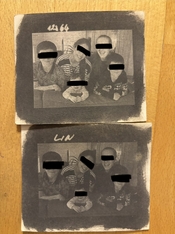
The attached photo shows result/test prints, on the top is the process described above (i.e. oxidation in step 4 using hydrogen peroxide, best result...), in the middle is step 4 oxidation performed using potassium permanganate (incomplete oxidation, manganese oxide stains etc...), and in the bottom the yellow/brown test print shows the iron oxidation using heat (in kitchen oven 30 minutes at 220 Celsius == does not work very well, the paper gives up before the iron... - this print is not yet developed in tannic acid bath show on the left).
 

Attachments

  • IMG_8796_small.JPG
    IMG_8796_small.JPG
    1,023.9 KB · Views: 34

FotoD

Member
Allowing Ads
Joined
Dec 15, 2020
Messages
428
Location
EU
Format
Analog
Nice! I've wondered if there was an Iron gall-process.

There seems to be a threshold in the highlights. Have you managed to make a more linear print?

Thanks for sharing!
 

johnwwyatt

Subscriber
Joined
Mar 12, 2010
Messages
108
Location
Connecticut
Format
Medium Format
This looks very promising. It would be interesting to see prints. Also, what concentration ferric oxalate are you using to sensitize your paper?
 

koraks

Moderator
Moderator
Joined
Nov 29, 2018
Messages
26,807
Location
Europe
Format
Multi Format
Wow, this is interesting for sure!

One thing that comes to mind is more of an amusing thought than anything serious for now - this reminds me of how paper is corroded/eaten away by iron gall ink. So I'd expect these prints over the course of a few centuries to disintegrate. Did you test that? Sorry - poor joke!

I really like that top print; it has good dmax, a fairly neutral black and shows very promising gradation indeed. Excellent work!
 

Raghu Kuvempunagar

Member
Allowing Ads
Joined
Jul 28, 2016
Messages
3,091
Location
India
Format
Multi Format
Very nice! Thanks for sharing your process.

Just a question on step #4 where insoluble Ferrous Oxalate is oxidised by Hydrogen Peroxide to Ferric Oxalate. But Ferric Oxalate is soluble and wouldn't the Peroxide bath as well as the subsequent wash (step #5) remove some Ferric Oxalate from the paper?

Welcome to Photrio!

p.s. how long does step #6 take?
 
Last edited:
OP
OP
Igor Jansen

Igor Jansen

Member
Allowing Ads
Joined
Jan 3, 2026
Messages
6
Location
Czechia
Format
Multi Format
Wow, this is interesting for sure!

One thing that comes to mind is more of an amusing thought than anything serious for now - this reminds me of how paper is corroded/eaten away by iron gall ink. So I'd expect these prints over the course of a few centuries to disintegrate. Did you test that? Sorry - poor joke!

I really like that top print; it has good dmax, a fairly neutral black and shows very promising gradation indeed. Excellent work!

My understanding is that the paper is (sometimes) corroded/eaten by the sulfuric acid in the real iron gall ink (remaining after using ferrous sulfate as source of iron...)
 
OP
OP
Igor Jansen

Igor Jansen

Member
Allowing Ads
Joined
Jan 3, 2026
Messages
6
Location
Czechia
Format
Multi Format
Very nice! Thanks for sharing your process.

Just a question on step #4 where insoluble Ferrous Oxalate is oxidised by Hydrogen Peroxide to Ferric Oxalate. But Ferric Oxalate is soluble and wouldn't the Peroxide bath as well as the subsequent wash (step #5) remove some Ferric Oxalate from the paper?

Welcome to Photrio!

p.s. how long does step #6 take?
Remaining ferric oxalate is washed out in step 3 == in water, similarly to cyanotype... You need to use ferric oxalate, which after exposure produces insoluble Iron(II)oxalate. Other xxx ferric oxalates (e.g. potassium ferric oxalate, AFO etc) produce soluble iron(II) salts, and therefore cannot be used == everything would be washed out in step 3.
 

NedL

Subscriber
Allowing Ads
Joined
Aug 23, 2012
Messages
3,415
Location
Sonoma County, California
Format
Multi Format
Very nice!

I think Raghu's question still remains... not sure why the ferrous oxalate isn't dissolving in the hydrogen peroxide solution. Or maybe "develop" tannins come before oxidation? Not sure.
 
OP
OP
Igor Jansen

Igor Jansen

Member
Allowing Ads
Joined
Jan 3, 2026
Messages
6
Location
Czechia
Format
Multi Format
Very nice!

I think Raghu's question still remains... not sure why the ferrous oxalate isn't dissolving in the hydrogen peroxide solution. Or maybe "develop" tannins come before oxidation? Not sure.

There are two points:
1) ferrous oxalate is not soluble in water
And 2) it is actually questionable, whether the UV light produces ferrous oxalate at all == ferric oxalate has ideal formula Fe2Oxalic3, ie there is just 1.5 molecule of oxalic acid per 1 atom of Iron. After the UV destroys 1 molecule of oxalic acid only 0.5 oxalate ion remains per one iron == not enough to form ferrous oxalate (so ideally just 1/2 of the iron will be in the form of ferrous oxalate).

Similarly after you oxidize the iron(II) to iron(III) there is not enough oxalate ions to form (soluble) ferric oxalate.
 

NedL

Subscriber
Allowing Ads
Joined
Aug 23, 2012
Messages
3,415
Location
Sonoma County, California
Format
Multi Format
There are two points:
1) ferrous oxalate is not soluble in water
And 2) it is actually questionable, whether the UV light produces ferrous oxalate at all == ferric oxalate has ideal formula Fe2Oxalic3, ie there is just 1.5 molecule of oxalic acid per 1 atom of Iron. After the UV destroys 1 molecule of oxalic acid only 0.5 oxalate ion remains per one iron == not enough to form ferrous oxalate (so ideally just 1/2 of the iron will be in the form of ferrous oxalate).

Similarly after you oxidize the iron(II) to iron(III) there is not enough oxalate ions to form (soluble) ferric oxalate.

That's starting to make sense. I almost wrote my post differently and wondered if the hydrogen peroxide was making something other than ferric oxalate. :smile: Thanks!

Now I need some ferric oxalate to try this... going to go re-read Raghu's post about making it....
 
OP
OP
Igor Jansen

Igor Jansen

Member
Allowing Ads
Joined
Jan 3, 2026
Messages
6
Location
Czechia
Format
Multi Format
This looks very promising. It would be interesting to see prints. Also, what concentration ferric oxalate are you using to sensitize your paper?
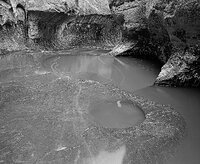
I have just couple, see attached, not a good negative (laser printer, there are spots, where the toner did not adhere well etc.), but it can give you an idea…
 

Attachments

  • IMG_8870.jpeg
    IMG_8870.jpeg
    1.6 MB · Views: 1
Photrio.com contains affiliate links to products. We may receive a commission for purchases made through these links.
To read our full affiliate disclosure statement please click Here.

PHOTRIO PARTNERS EQUALLY FUNDING OUR COMMUNITY:


Ilford ADOX Freestyle Photographic Stearman Press Weldon Color Lab Blue Moon Camera & Machine
Top Bottom