
• Welcome to Photrio!
    Registration is fast and free. Join today to unlock search, see fewer ads, and access all forum features.
    Click here to sign up

Developing Hp5 plus with Xtol... Conflicting development times?

Recent Classifieds

Forum statistics

Threads
202,825
Messages
2,846,027
Members
101,548
Latest member
Underexposed
Recent bookmarks
0

remjet5219

Member
Allowing Ads
Joined
Jul 19, 2023
Messages
48
Location
Los Angeles
Format
35mm
Hey all!

In my research I noticed that Kodak's Xtol documentation lists the development time for HP5 plus longer than what Ilford (or Massive Dev Chart) lists it for. I am about to develop an important roll and I want to get it right.

For example,

At 68 degrees Kodak says to develop the film for 8 1/2 minutes while MDC/Ilford says 6 mins. I fear that difference is pretty significant.

I am creating this chart to have next to me while I develop (I'll release it for anyone to use once I get it right), feel free to give me any comments on it too.

Thank you so much in advance!
 

Attachments

  • Screenshot 2023-07-29 at 11.32.54 p.m..png
    Screenshot 2023-07-29 at 11.32.54 p.m..png
    489.5 KB · Views: 287
I fear that difference is pretty significant.

But not massive. I'd give it 7 minutes and call it good.

I've done quite a bit of HP5+ in Instant Mytol (XTOL clone), but I don't think I've actually kept notes of the times I used. Must have been 6-7 minutes for the most part; don't recall having gone as long as 8. Came out fine.

Don't sweat it; it ain't brain surgery.
 
The development time in HP5's datasheet in stock Xtol is 8'. The one in the Xtol datasheet is 8:30. Pick either of these and you'll be fine.
 
I would suggest X-Tol diluted at 1+1 for Hp5+/120 and 13 to 15 min. (according to the taking circumstances) at 20°C and 5 sec agitation each 1 min...
 
Actually I just found out the agitation spec for the dev chart is continuous, but I'm doing 5 inversions every 30 secs, hence the difference.
 
I found that HP5+ in XTOL needs 1 minute added to the 20°C [68°F] temperature to have the proper development.
 
I found that HP5+ in XTOL needs 1 minute added to the 20°C [68°F] temperature to have the proper development.

Thanks! Could you explain what you found? My only real concern with possibly overdeveloping is loosing detail in the highlights.
 
Actually I just found out the agitation spec for the dev chart is continuous, but I'm doing 5 inversions every 30 secs, hence the difference.

Just out of curiosity which chart says the agitation is continuous? The one you showed us is for 5 inversions every 30 secs which for 68C the correct development time is 8-8.5 mins not the 6 mins you chart shows so I am puzzled about where the continuous agitation which can account for about 10-15 % decrease in time difference accounts for the difference.

Thanks

pentaxuser
 
Just out of curiosity which chart says the agitation is continuous? The one you showed us is for 5 inversions every 30 secs which for 68C the correct development time is 8-8.5 mins not the 6 mins you chart shows so I am puzzled about where the continuous agitation which can account for about 10-15 % decrease in time difference accounts for the difference.

Thanks

pentaxuser
Hey pentaxuser,

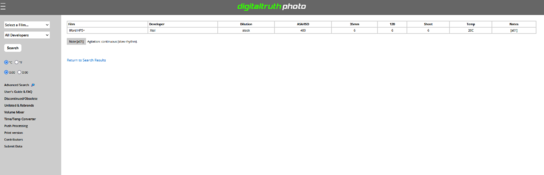
Massive dev chart lists continuous agitation for 6 minutes for Xtol Hp5 plus at 400 on their site (https://www.digitaltruth.com/devchart.php?devrow=9625). And you are correct, the chart I showed you above is incorrect because I am choosing to do agitation every 30 seconds which would mean I need an 8 or 8 1/2 minutes of development. I am curious about that time difference compensation as well. Interested in hearing your thoughts.

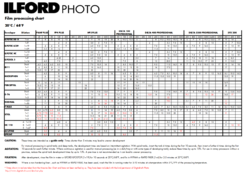
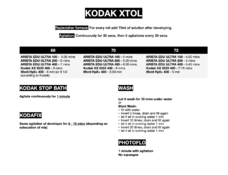
I have also attached Ilford and Kodak's development time tech sheets for HP5 plus for reference. Kodak lists it for 8 1/2 minutes and Ilford for 8 minutes.

Kodak: https://imaging.kodakalaris.com/sites/default/files/wysiwyg/pro/chemistry/J-109_Feb_2018.pdf

Ilford: https://www.ilfordphoto.com/wp/wp-content/uploads/2017/03/Film-processing-chart-.pdf
 

Attachments

  • Screenshot 2023-07-30 122851.png
    Screenshot 2023-07-30 122851.png
    32.2 KB · Views: 161
  • Screenshot 2023-07-30 122915.png
    Screenshot 2023-07-30 122915.png
    169.1 KB · Views: 276
  • Screenshot 2023-07-30 123052fghfgdfgdfgdfg.png
    Screenshot 2023-07-30 123052fghfgdfgdfgdfg.png
    28.3 KB · Views: 166
The MDC is full of both reliable data and unreliable data, and it can be extremely difficult to differentiate between the two.
The difference between the Kodak datasheet and the Ilford datasheet may reflect one or all of the differences in Kodak vs. Ilford agitation schemes or differences in Kodak vs. Ilford target contrast or the (minor) differences in how contrast is measured by Kodak and how contrast is measured by Ilford.
 
Certainly the MDC reduction for continuous agitation suggest a greater percentage reduction than Ilford suggests but the key to suggestions on reduction for continuous agitation is the word "suggests" There is a range involved

If you want to get the next roll right then the only sure way is to use the Ilford/ Kodak times and the inversion agitation suggested. Longer term you'd have to experiment with continuous agitation to see what reduction in time is right for your negatives

Frankly I'd cut a film into 3 and start with say 15% as recommended by Ilford for the first third then increase or reduce the percentage according to taste for the second third and if still not exactly right increase or reduce again for the final third

pentaxuser
 
Massive dev chart sometimes is a "massive mess"...
Datasheet from reliable companies like Kodak and Ilford are more accurate
HP5 in XTOL is a good and well tested combo.
XTOL in 1+1 one-shot diluition produces more reliable and repeatable results than stock solution (reusing stock solution you don't kwow the level of developer exhaustion).
In XTOL 1+1 both Kodak and Ilford recommend 12 min @400 (68F/20C)
HP5 to me is a low-contrast film with a wide latitude; it's difficult to loose details in highlights with it. What it's difficult with HP5 is to obtain a compact and sharp grain; XTOL is suitable for that result
 
The MDC is full of both reliable data and unreliable data, and it can be extremely difficult to differentiate between the two.
The difference between the Kodak datasheet and the Ilford datasheet may reflect one or all of the differences in Kodak vs. Ilford agitation schemes or differences in Kodak vs. Ilford target contrast or the (minor) differences in how contrast is measured by Kodak and how contrast is measured by Ilford.
Certainly the MDC reduction for continuous agitation suggest a greater percentage reduction than Ilford suggests but the key to suggestions on reduction for continuous agitation is the word "suggests" There is a range involved

If you want to get the next roll right then the only sure way is to use the Ilford/ Kodak times and the inversion agitation suggested. Longer term you'd have to experiment with continuous agitation to see what reduction in time is right for your negatives

Frankly I'd cut a film into 3 and start with say 15% as recommended by Ilford for the first third then increase or reduce the percentage according to taste for the second third and if still not exactly right increase or reduce again for the final third

pentaxuser

Great points here! Thank you! And yes the agitation routine is different between Kodak and Ilford.

Kodak:
Privide initial agitation of up to 5 cycles. let the tank sit for the remainder of the first 30 seconds. After the first 30 seconds, agitate for 5 seconds at 30-second intervals. Agitation should consist of 2 to 5 cycles.

Ilford:
With spiral tanks, invert the tank 4 times during the first 10 seconds, then invert a further 4 times during the first 10 seconds for each further minute.

I'm curious why Kodak's development time is longer when agitation is more frequent than Ilford's.
 
Massive dev chart sometimes is a "massive mess"...
Datasheet from reliable companies like Kodak and Ilford are more accurate
HP5 in XTOL is a good and well tested combo.
XTOL in 1+1 one-shot diluition produces more reliable and repeatable results than stock solution (reusing stock solution you don't kwow the level of developer exhaustion).
In XTOL 1+1 both Kodak and Ilford recommend 12 min @400 (68F/20C)
HP5 to me is a low-contrast film with a wide latitude; it's difficult to loose details in highlights with it. What it's difficult with HP5 is to obtain a compact and sharp grain; XTOL is suitable for that result

I am set up to use the replenishing method of replacing 70ml per film roll on my working solution. Do you find this method very unreliable?

Thanks!
 
Thanks! Could you explain what you found? My only real concern with possibly overdeveloping is loosing detail in the highlights.

The Kodak listed times for XTOL and HP5+ produced thin negatives with low contrast. Increasing the develop solved those two problems.
 
The MDC is full of both reliable data and unreliable data, and it can be extremely difficult to differentiate between the two.
The difference between the Kodak datasheet and the Ilford datasheet may reflect one or all of the differences in Kodak vs. Ilford agitation schemes or differences in Kodak vs. Ilford target contrast or the (minor) differences in how contrast is measured by Kodak and how contrast is measured by Ilford.

The MDC database has just enough corrupt data, that while I have gotten good development times on occasion, I learned the hard way that one cannot touch it. In the database world once a database has been corrupted, it is considered too corrupt to use and should be abandoned. MDC fits in that realm.
 
Use Rodinal 50:1 for ten minutes. Gentle agitation for the first minute then three inversion every minute. I figure every time a thread comes up with someone asking about Rodinal or HC-110 the answer always seems to be use Use XTOL.
 
Use Rodinal 50:1 for ten minutes. Gentle agitation for the first minute then three inversion every minute. I figure every time a thread comes up with someone asking about Rodinal or HC-110 the answer always seems to be use Use XTOL.

Because it is a better developer. :laugh:
 
I am set up to use the replenishing method of replacing 70ml per film roll on my working solution. Do you find this method very unreliable?

Thanks!

I have enjoyed excellent reliability and consistency with X-Tol (and before then, HC-110) and replenishment. Some have had more challenges.
 
Massive dev chart sometimes is a "massive mess"...
Datasheet from reliable companies like Kodak and Ilford are more accurate
HP5 in XTOL is a good and well tested combo.
XTOL in 1+1 one-shot diluition produces more reliable and repeatable results than stock solution (reusing stock solution you don't kwow the level of developer exhaustion).
In XTOL 1+1 both Kodak and Ilford recommend 12 min @400 (68F/20C)
HP5 to me is a low-contrast film with a wide latitude; it's difficult to loose details in highlights with it. What it's difficult with HP5 is to obtain a compact and sharp grain; XTOL is suitable for that result

I have to fully agree with the four last statements (except that 13 min. is better after a good pre-wash), the first is, in my opinion, not that bad as a chart is only a starting point, less a goal and not the finish...

BTW, when there is no (more) X-Tol then there is still ADOX's XT-3...
 
My only real concern with possibly overdeveloping is loosing detail in the highlights.

With negative film, it's really hard to actually lose highlight detail. It may be dense and it can take some more time to print through this density under the enlarger, and the highlights may be more grainy as a result. But the detail will be there, nonetheless. Likewise, scanners generally don't have much trouble seeing through this additional density either since they're also capable of scanning (far denser) slides. So don't sweat it.

I figure every time a thread comes up with someone asking about Rodinal or HC-110 the answer always seems to be use Use XTOL.

Every time a thread comes up about "how should I X", some people will chime in and say "do Y instead". Sometimes there's a good reason for this, because X doesn't make much sense. In this case, however, it's a bit like asking "how do I get to Paris" and then giving instructions on how to get to London instead. It's not what's asked.
 
remjet5219, on a more serious note about the replenishment method and its reliability, it was my impression that while it drew a lot of discussion ( when does a thread on Photrio never draw a lot of posts?) there was a remarkable degree of agreement that properly done it was a reliable method

pentaxuser
 
Photrio.com contains affiliate links to products. We may receive a commission for purchases made through these links.
To read our full affiliate disclosure statement please click Here.

PHOTRIO PARTNERS EQUALLY FUNDING OUR COMMUNITY:


Ilford ADOX Freestyle Photographic Stearman Press Weldon Color Lab Blue Moon Camera & Machine
Top Bottom