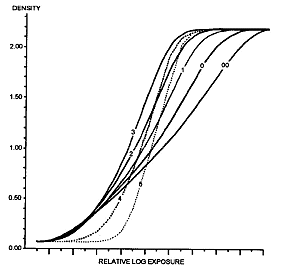
While it won’t work on a Rollieflex, one possible benefit to all the medium format cameras with interchangeable backs (Hasselblad, Mamiya RB67, various Bronicas, etc.) is you could have an N back, and N+1 back, and N-1, and so on, and just attach the back appropriate to the shot. It does mean that it would probably take longer to finish out a roll and get to developing.
As far as cutting the film before developing. Take a look a several rolls of processed film from your camera and look at how consistent spacing is from frame to frame, and from the beginning of the film to the first frame. Then look at the existing frame spacing and consider that your margin of error. If frame spacing is very very consistent (lay several uncut film strips over each other, and remember spacing errors are cumulative, so look closest at the last few frames) then what you could do is to shoot and develop a test strip. Then after developing rather than cutting the frames apart, just cut a small wedge on one side where the gap between frames is. Then use that as a cutting template to tape it flat to a table or flat surface with the freshly exposed roll beneath it. Feel for the wedges in the dark and with a razor start a marker cut at each wedge, remove the template and finish each cut, then develop each.
Realistically, there is probably a 1 in 1000 chance your camera is that accurate and a 1 in 100 chance you could do all that in the dark without messing things up (the gaps on my medium format cameras are always around 5-7 mm). Add in the fact that undeveloped, 120 film is tightly coiled, so processing flat in a tray probably wouldn’t work, and it seems like a hopeless quest.