
- Joined
- Oct 11, 2006
- Messages
- 2,193
- Format
- Multi Format
I have lots of questions about developer theory. Let me start with one, presenting a hypothesis for discussion.
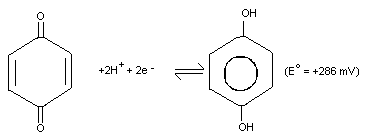
I suggest that the purpose of alkali is mainly to pull of a proton from the developer, leaving a negative charge on certain groups. For example, p-aminophenol would lose a proton from the phenol group, leaving a negatively charged oxygen atom attached to the ring, and this would then reduce the silver halide. Of course, not all negative ions would act as reducers. For example, caboxylic acids would not act as reducers. However, some would.
This theory makes sense if one considers tylenol vs. p-aminophenol. Tylenol, being esterified at the phenol position, is not able to ionize and can't act as a developer, whereas if the ester is hydrolized you get p-aminophenol, which can ionize by losing a proton and then (presumably) act as a developer.
If this theory is right then one should see little development at pH much below the pKa of the relevant ionizable group, a rapid change with pH when pH is near the pKa of the compound, and a plateau as pH climbs much higher than the PKa. In other words, developer activity would correlate strongly with pKa when examined over a series of compounds.
Am I on the right track with this thinking?
Thanks.
I suggest that the purpose of alkali is mainly to pull of a proton from the developer, leaving a negative charge on certain groups. For example, p-aminophenol would lose a proton from the phenol group, leaving a negatively charged oxygen atom attached to the ring, and this would then reduce the silver halide. Of course, not all negative ions would act as reducers. For example, caboxylic acids would not act as reducers. However, some would.
This theory makes sense if one considers tylenol vs. p-aminophenol. Tylenol, being esterified at the phenol position, is not able to ionize and can't act as a developer, whereas if the ester is hydrolized you get p-aminophenol, which can ionize by losing a proton and then (presumably) act as a developer.
If this theory is right then one should see little development at pH much below the pKa of the relevant ionizable group, a rapid change with pH when pH is near the pKa of the compound, and a plateau as pH climbs much higher than the PKa. In other words, developer activity would correlate strongly with pKa when examined over a series of compounds.
Am I on the right track with this thinking?
Thanks.