
Hello guys and gals. I want to build 4x6 pinhole camera. And I have a question. If a focal lenght is lets say 6cm (its just an example) it means, that edges of film are further away and out of focus (considering that focal plane is flat). What are my options if I want to make pictures as sharp as posible? Can I bring film closer to the hole? Lets say put it 5cm away from the hole. Would it make bigger area on the film focused? Thank you
-
Welcome to Photrio!Registration is fast and free. Join today to unlock search, see fewer ads, and access all forum features.Click here to sign up
You are using an out of date browser. It may not display this or other websites correctly.
You should upgrade or use an alternative browser.
You should upgrade or use an alternative browser.
Designing a Pinhole camera
-
A
- Thread starter Sowulo
- Start date
Recent Classifieds
-
For Sale Nikon FE (blk) w/ 35-70 f/2.8 (Read)
- Started by Acere
-
For Sale FS: Horseman Long Loupe 6X
- Started by B.S.Kumar
-
For Sale FS: Linhof Master GTL / AMS 4x5 Camera
- Started by B.S.Kumar
-
For Sale Four H&Y Magnetic 4" Filter Holders and Four Cokin B&W Contrast Filters
- Started by Steve Goldstein
-
Sold Schneider Kreuznach Super-Angulon 165mm - 8x10
- Started by Guivd
Forum statistics

Do a bit of trigonometry and just work out how much the very furthest edge of the film is.
Then consider the depth of focus of a pinhole.
Then consider whether a pinhole camera can be said to "focus"at all.
Or, rather, consider these questions in reverse order.
Lots and lots of online references for pinhole (try Googling "Stanford pinhole" for some good detail)
Then consider the depth of focus of a pinhole.
Then consider whether a pinhole camera can be said to "focus"at all.
Or, rather, consider these questions in reverse order.
Lots and lots of online references for pinhole (try Googling "Stanford pinhole" for some good detail)
Changing the distance between the film and pinhole will change the angle of view, so you can have wide-angle or "telephoto". There will be exposure implications. Check out the Lensless Camera website when doing the essential homework recommended by Mr Pdeeh.

There are a few pinhole design websites that can help you determine the "optimal" focal length and pinhole size.

as to sharpness -- actually, a pinhole picture is never what you would call sharp, but the physics of the situation also say that the entire image is going to be equally "sharp" across its entire area, whether near or far from the pinhole -- the size of the circle of confusion is determined by the size of the pinhole, and that doesn't change even if the hole is farther away from the film -- think of a beam of light going through the hole -- it doesn't spread out as it travels from the hole to the film since light travels in straight lines.
however, light fall-off is much more noticeable and overwhelms any sharpness issues because the edges of the film are farther away from the film, so vignetting will be more extreme, the wider the angle of view of the camera (which is to say, how close the pinhole is to the film.)
I have noticed, when using my 4 by 5 inch ZeroImage camera at its most wide angle -- 25mm! -- that the outer areas of the image look a bit smeared because the light is hitting at such an acute angle way out there.
however, light fall-off is much more noticeable and overwhelms any sharpness issues because the edges of the film are farther away from the film, so vignetting will be more extreme, the wider the angle of view of the camera (which is to say, how close the pinhole is to the film.)
I have noticed, when using my 4 by 5 inch ZeroImage camera at its most wide angle -- 25mm! -- that the outer areas of the image look a bit smeared because the light is hitting at such an acute angle way out there.
That's Lord pdeeh to you, Mr Shawecommended by Mr Pdeeh

DWThomas
Subscriber
"Focal length" is a handy way to express what is actually "film plane to pinhole distance" but a pinhole does not actually focus, it is more of an exercise in ray tracing. The Worldwide Pinhole Photography Day website has a tab up at the top for 'Resources' which will get you to a bunch of information on design and construction. (Perhaps your inquiry is in anticipation of participating in the WPPD event for this year on April 30th?)
There are some calculators, one is online, at a website called Mr. Pinhole which is handy because being web based it can be used with any OS that has a script-enabled browser. I find it to be a little pessimistic as to what it thinks you can do and it makes a number of assumptions for calculation that I have never found described on the site. Another calculator is Pinhole Designer, which downloads and installs to run on Windows. I know it works on Windows 7, but it has not been updated in a long time. It does show what it is doing, and allows user configuration of one magic constant in the calculations.
The various optimizations are relatively broad in numerical terms, so a wide range of design variation will still produce results that are satisfactory and usable.
There are some calculators, one is online, at a website called Mr. Pinhole which is handy because being web based it can be used with any OS that has a script-enabled browser. I find it to be a little pessimistic as to what it thinks you can do and it makes a number of assumptions for calculation that I have never found described on the site. Another calculator is Pinhole Designer, which downloads and installs to run on Windows. I know it works on Windows 7, but it has not been updated in a long time. It does show what it is doing, and allows user configuration of one magic constant in the calculations.
The various optimizations are relatively broad in numerical terms, so a wide range of design variation will still produce results that are satisfactory and usable.
Last edited:

I think that there are two things that affect sharpness in terms of pinhole cameras: (1) the relation between the size of the pinhole and the focal length, and (2) variation in the focal length across the film plane (as a side note: variation in the focal length across the film plane also causes variation in the f/stop across the film plane, so it actually affects exposure as well as sharpness!). For determining (1), I would recommend reading this page: [http://www.wesjones.com/pinhole.htm]. For dealing with (2), I think that the only option is a curved film plane. Say the focal length was 6 cm. The film plane would fall along the circumference of the circle with the pinhole at its center and having a radius of 6 cm. Now, if you divide the film into a series of parallel horizontal lines, every point on one of these lines is the same distance from the pinhole, but if you divide the film into a series of parallel vertical lines, every point on one of these lines is a different distance from the pinhole. This is because the film plane is curved and not spherical. But it's the best one can do.If a focal lenght is lets say 6cm (its just an example) it means, that edges of film are further away and out of focus (considering that focal plane is flat). What are my options if I want to make pictures as sharp as posible?
Last edited:
Pinhole camera's don't focus. A pinhole camera will give the same (un)sharpness corner to corner. Take a look at the websites mentioned above and... have fun!
Why do you want 4x6? Isn't 4x5 much more convenient since that is a standard size for sheet films and direct positive paper?
Why do you want 4x6? Isn't 4x5 much more convenient since that is a standard size for sheet films and direct positive paper?
And FWIW there are at least a couple of pinhole cameras out there with curved film planes.

- Joined
- Jul 31, 2012
- Messages
- 3,407
- Format
- 35mm RF
Since you are dealing with a circle cut into a material that has a thickness, you can't get even exposure across your neg unless you move your neg farther away from the pinhole, nor get even sharpness. The circle of confusion is relative to the size of the pinhole and the distance of the pinhole from the film. Technically, if the pinhole was the size of a photon of light, had no thickness, and there was no diffraction, you could get a perfectly sharp image across the entire neg, and everything would be perfectly in focus as well. Physics be damned. Obviously, that won't happen, so pinholes are a compromise, as are lenses....
I picked up a pinhole for six euros from Reality So Subtle/Au Premiere Plan (Dead Link Removed) to replace the pinhole in my Holga Panoramic camera. It was an improvement. He has a table to get the right size hole relative to the focal length (distance from film). If I was going to start again with a pinhole camera, I would just buy one of his. I may still.
I hope that helps you in some way.
I picked up a pinhole for six euros from Reality So Subtle/Au Premiere Plan (Dead Link Removed) to replace the pinhole in my Holga Panoramic camera. It was an improvement. He has a table to get the right size hole relative to the focal length (distance from film). If I was going to start again with a pinhole camera, I would just buy one of his. I may still.
I hope that helps you in some way.

This is very true. Have fun building your camera and don't worry too much about it! Then have fun using it!The various optimizations are relatively broad in numerical terms, so a wide range of design variation will still produce results that are satisfactory and usable.

If you don't like the results with one pinhole, just try another.... You might just find that the one you like the best isn't the one that's "optimal".

Even some "experts" have mistakenly claimed that pinhole images can't resolve detail finer than the pinhole diameter (they can), that they have no aberrations (they have some chromatic aberration and considerable off-axis astigmatism), and that they have infinite depth of field (really wrong). To get the most out of pinhole photography, ignore such experts and just take photographs. Experiment. Our mistakes educate us better than mere textbooks.
pinhole is simple enough to just learn by trial and error, that is one of the reasons it is so much fun.

define what you mean by sharp;there is an optimal pinhole diameter for resolution and one for contrast.most viewers prefer contrast over resolution because it makes for better image clarity.I suggest to go for a pinhole did for for optimum contrast and assume hole to film plane distance as your focal length.Hello guys and gals. I want to build 4x6 pinhole camera. And I have a question. If a focal lenght is lets say 6cm (its just an example) it means, that edges of film are further away and out of focus (considering that focal plane is flat). What are my options if I want to make pictures as sharp as posible? Can I bring film closer to the hole? Lets say put it 5cm away from the hole. Would it make bigger area on the film focused? Thank you
pinhole resolution is limited by diffraction only;airy disc and raleigh criterion apply. You can count on getting up to 7 lp/mm,which makes pinholes ideal for contact prints because that's also the resolution limit of the human eye at closest comfortable viewing distanceEven some "experts" have mistakenly claimed that pinhole images can't resolve detail finer than the pinhole diameter (they can), that they have no aberrations (they have some chromatic aberration and considerable off-axis astigmatism), and that they have infinite depth of field (really wrong). To get the most out of pinhole photography, ignore such experts and just take photographs. Experiment. Our mistakes educate us better than mere textbooks.
Resolution in an image from an oversize pinhole image is limited by geometric optics. Resolution in an image from an undersize pinhole is limited by diffraction. If the pinhole size is optimum, diffraction actually increases sharpness rather than degrade it. At that point, more detail can be recorded than either geometric optics or diffraction theory claim. Ah, the magic of pinhole photography!

Use a lens.What are my options if I want to make pictures as sharp as posible?
Sorry, couldn't resist. I like for my pinhole images to be sharp'ish when held at arms length but upon closer inspection, I like to be able to recognize that it is in deed a pinhole image.
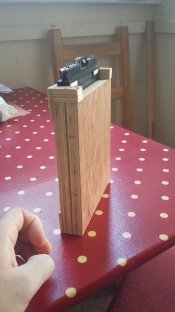
Thank you all for sharing links and opinions. I feel obliged to report to you on my work progress. That is my holder of film holder (sounds like oxymoron). It's not finished yet. I will remove some of the staples as they were just to hold parts together for gluing. Shall I put hinges in order to be able to open camera? O there is no need for that? I also ordered set of pinholes from Dead Link Removed .
Attachments

DWThomas
Subscriber
The need for hinges could depend on what your overall design is. I came up with a 4x5 using a standard filmholder that was pretty simple in concept and used a pair of rubber bands to hold the filmholder in place. I later expanded that idea to an 8x10. I had passing thoughts about making some sort of hinged lid with perhaps a strip or two of foam to maintain pressure on the filmholder, but have not concluded it is necessary. (Although while the concept is simple, a bit of detailed craftsmanship is required to produce the physical object -- especially the compound miters in the 8x10!)
There are many different philosophies one can pursue with pinhole; I tend toward the functional basics, others may go for fancy.
There are many different philosophies one can pursue with pinhole; I tend toward the functional basics, others may go for fancy.
Aaand it is done. Thanks a lot to you all for your advice and support. The next update will be with pictures, taken with my new camera. But until then you probably will find me asking questions in Chemistry section.


Resolution in an image from an oversize pinhole image is limited by geometric optics. Resolution in an image from an undersize pinhole is limited by diffraction. If the pinhole size is optimum, diffraction actually increases sharpness rather than degrade it. At that point, more detail can be recorded than either geometric optics or diffraction theory claim. Ah, the magic of pinhole photography!
Pinholes are not magical. They're just another type of optic!
Pinholes are explicitly studied at universities with undergraduate optical engineering programs. Good optical engineers then tinker, and gain the practical knowledge after learning the physical foundations. Pinholes are thus very well understood at both an academic and practical level, and both aspects track each other very well. So I'll have to disagree that the performance cannot be predicted. In fact, the full imaging system from sun to the retina of the eye could be accurately modeled -- with insight as well into the brain's image processing, if the need arose. Like any optical system, the accurate mathematical model without approximation is (relatively) complex but is, in fact, predictable. Of course--as is true with most physical sciences -- the full model is rarely used outside of classwork or academia, so I can understand why your type of misconception came to be.
That in no way should be construed to detract from how nice and unique the results from pinhole imaging can be. It is admired academically for its simplicity.
Not that I'm an academic. I actually work for a living.
Last edited:

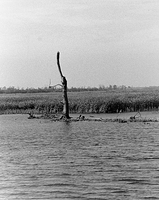
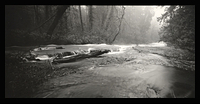
 So the first pancake got burned. Nevermind. It was 0.4mm pinhole f225. Fomapan 100 film developed in 22C Ilfosol 3 for 5 minutes. The gate was exposed for about 8 seconds and tricycle for about 6 seconds. The third shot failed completely with 3 seconds exposure. I can see something on negative but when i scan it it just black. Please advise. Is it over exposure or over development. Both pictures shot in a shadow.
| Photrio.com contains affiliate links to products. We may receive a commission for purchases made through these links. To read our full affiliate disclosure statement please click Here. |
PHOTRIO PARTNERS EQUALLY FUNDING OUR COMMUNITY:  |