


• Welcome to Photrio!
    Registration is fast and free. Join today to unlock search, see fewer ads, and access all forum features.
    Click here to sign up

Darkroom Ventilation

Recent Classifieds

Forum statistics

Threads
201,760
Messages
2,829,659
Members
100,929
Latest member
WBM
Recent bookmarks
0

NorthAtlantic

Member
Allowing Ads
Joined
Aug 8, 2019
Messages
13
Location
London
Format
35mm RF
Hello,

Apologies, another darkroom ventilation post. Ive read though several threads on the subject and got some useful tips but just wanted to clarify a few details as my location options are limited.

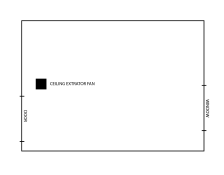
Ive recently acquired a very basic darkroom set up to use at home after my open access darkroom closed due to covid. I have a small windowless room (no ventilation options) i've set my enlarger up in which is all lightproof but ill have to use my bathroom which is next door for the wet side. Its no big deal moving between the two rooms. Ive attached a diagram of the room. It has an normal bathroom extractor fan near the entry door and a window the other side. Is the normal bathroom ceiling fan sufficient ventilation? If I create a light proof Louvre in the open window to allow air in and I guess the extractor fan will do its thing - only issue is when I walk through the door the chemicals are being drawn that way. I did think maybe I could limit the fumes by placing my trays inside a shallow clear plastic storage box and put the lid on when im not in the room, anyone doing something like that? Not 100% convenient but would rather keep fumes to a minimum.

The only other alternative I have is a small garden shed with 1 window (obviously weather would dictate print times- not too hot or cold). Id caulked the gaps last year as I occasionally do work there but thought could work as a temp darkroom. Again extraction is an issue and its quite stuffy already. Had one idea to make something like a diy fume cupboard (plywood box with plexiglass top and extractor fan mounted in back with outlet to exterior of shed. In my mind that would work but haven't seen anyone else doing similar whilst researching.

Is the general rule with chemicals that if you can smell it you're being exposed and if you can't you're fine?

Any thoughts on either of these two scenarios would be helpful. Aware neither is a premium easy option for a swanky darkroom but I only print every few months.

Cheers Ben
 

Attachments

  • Screenshot 2021-03-29 at 11.59.02.png
    Screenshot 2021-03-29 at 11.59.02.png
    34.1 KB · Views: 153

Paul Howell

Subscriber
Allowing Ads
Joined
Dec 23, 2004
Messages
10,091
Location
Scottsdale Az
Format
Multi Format
There are only a few darkroom chemistry that are toxic, of course there are folks who report to be sensitive to some ingredients so unless you have had issues its generally an issue of how pleasant your space is to work in. Here in the states there is low oder products. I assume that you can similar products in the U.K.
 

Paul Howell

Subscriber
Allowing Ads
Joined
Dec 23, 2004
Messages
10,091
Location
Scottsdale Az
Format
Multi Format
BTW, you can get a air purifier with activated charcoal which will reduce some of the smell.
 

grahamp

Subscriber
Allowing Ads
Joined
Mar 2, 2004
Messages
1,771
Location
Vallejo (SF Bay Area)
Format
Multi Format
For printing, use a citric acid stop bath instead of acetic acid. Fixer is less of a problem, and developer is rarely noticeable. I used to put a cover on top of each tray when I had a small space. I wouldn't use one cover for all trays.

Extraction of the air is only as good as the air supply (which may mean a partly opened window in an adjacent room). If the fan is doing any good there should be no leakage back into the rest of the building if the door is open a little. So you may just have to limit your actual printing time to 40 minutes in every hour, or whatever works to clear any fumes.

Aside: Years ago when I was in college, the atomic absorption machine used a high temperature flame to analyze chemical solutions. This used a fume extraction system. If the big chemistry lab at the other end of the floor turned on all the fume hoods, the AA machine would be unable to vent. Essentially the building air inlets for the floor were fine for normal use, but under specified for the newer fume hoods.
 

mrosenlof

Member
Joined
Feb 25, 2010
Messages
631
Location
Colorado
Format
Multi Format
A typical bathroom air extractor should be fine for a bathroom sized darkroom. For B/W at least the "fumes" aren't particularly nasty. Yes, extraction does require an air supply as a bathroom fan is normally a pretty poor vacuum pump. Mostly your ventilation is going to pull out humid air and replace it with less humid air. The main smell I associate with a darkroom is acetic acid stop bath, and I've used citric acid for years.

My permanent basement darkroom has a bathroom style extraction fan, and a couple of intake vents made from black ABS pipe and some elbows. After 25 years, its time to replace the fan, but the general setup has worked well.
 

Wayne

Member
Allowing Ads
Joined
Jul 8, 2005
Messages
3,622
Location
USA
Format
Large Format
You might pull the cover on the fan and see if it needs cleaning. They can get pretty gunked up which reduces efficiency. Otherwise it should work fine. If you find that there's a strong chemical smell then its not working fine, but smell isn't a terribly meaningful test on its own.
 

gone

Member
Allowing Ads
Joined
Jun 14, 2009
Messages
5,504
Location
gone
Format
Medium Format
I've used a bathroom for a darkroom my very first time and was concerned about the fumes, but the only thing that really smelled strong was the stop bath. As mentioned, going to a citric stop bath took care of that. I had no ventilation at all, but wasn't in there making 20 prints either.

Then one day a light bulb went off (incandescent in those days), and I thought, why am I putting myself through all this? So I went to our spare bedroom, blocked off the windows, and used that for the darkroom. Once the trays were full and the enlarger was setup (w/ a plastic storage container full of water for a holding tank), I laid a plastic drop cloth on the bed, and then a 4x4 piece of plywood on top of that. This is what the trays set on, and the enlarger was on a built in night stand nook that was already there. When I was finished I took the prints in the holding tank to the bathroom for washing in the built in print washer (bathtub). Worked perfectly, and it was very fast to set up and take down. You could to this in an apt too.

A long time later, I again thought, 'why deal w/ blocking out the windows?' From then on I just waited until it got dark :smile:
 
Last edited:

Maris

Member
Allowing Ads
Joined
Jan 17, 2006
Messages
1,594
Location
Noosa, Australia
Format
Multi Format
14432614805_8cd505ac54_c.jpg

I specifical deliberately built my third and best darkroom with no fume extraction system at all. Why?

Because I have a split system reverse cycle air-conditioner installed to keep the darkroom comfortable at all times of the year; mainly cooling but occasionally heating for a few days in June/July. Conditioned air costs money and if an extraction system pulls air out faster than it can be "conditioned" then I'm on a total losing path: uncomfortable again, hot in summer, cold in winter, and finding excuses not to go into the darkroom and do good work.

The answer to the fume problem is to not bring the fumes into the darkroom in the first place. The primary villain is acetic acid stop bath - don't use it.
I use Fotospeed SB-50 Odourless stop bath, costs more, doesn't smell, but there are other citric acid based products out there.
I use Fotospeed FX-30 Odourless fixer, costs more, doesn't smell, and there are other odourless fixers out there.
Developers are Xtol and Dektol neither of which is a source of fumes.
Smelly toners like sepia or selenium? Not in the darkroom at all but rather outdoors with the wind at my back.

My partner is a very sensitive person and a figure in the Australian Allergy and Environmental Sensitivity Support and Research Association (AESSRA) . She does hundreds of hours of "no fume" darkroom work a year with no ill effects. The "no fume" approach works if done conscientiously.
 

logan2z

Subscriber
Allowing Ads
Joined
Jan 11, 2019
Messages
3,980
Location
SF Bay Area, USA
Format
Multi Format
I've also split my darkroom into separate wet and dry spaces - the dry space is in a spare bedroom and the wet space is in an adjacent bathroom that has the typical bathroom extractor fan. I also use a Nova print processor instead of open trays. Since I spend the majority of my darkroom time in the dry space and the Nova only exposes a small volume of chemistry to the air, my exposure to fumes is relatively low. The fan seems to deal pretty well with whatever does get into the air in the wet space.

I think your separate wet/dry space with the fan should work fine.
 

RalphLambrecht

Subscriber
Allowing Ads
Joined
Sep 19, 2003
Messages
14,917
Location
K,Germany
Format
Medium Format
Hello,

Apologies, another darkroom ventilation post. Ive read though several threads on the subject and got some useful tips but just wanted to clarify a few details as my location options are limited.

Ive recently acquired a very basic darkroom set up to use at home after my open access darkroom closed due to covid. I have a small windowless room (no ventilation options) i've set my enlarger up in which is all lightproof but ill have to use my bathroom which is next door for the wet side. Its no big deal moving between the two rooms. Ive attached a diagram of the room. It has an normal bathroom extractor fan near the entry door and a window the other side. Is the normal bathroom ceiling fan sufficient ventilation? If I create a light proof Louvre in the open window to allow air in and I guess the extractor fan will do its thing - only issue is when I walk through the door the chemicals are being drawn that way. I did think maybe I could limit the fumes by placing my trays inside a shallow clear plastic storage box and put the lid on when im not in the room, anyone doing something like that? Not 100% convenient but would rather keep fumes to a minimum.

The only other alternative I have is a small garden shed with 1 window (obviously weather would dictate print times- not too hot or cold). Id caulked the gaps last year as I occasionally do work there but thought could work as a temp darkroom. Again extraction is an issue and its quite stuffy already. Had one idea to make something like a diy fume cupboard (plywood box with plexiglass top and extractor fan mounted in back with outlet to exterior of shed. In my mind that would work but haven't seen anyone else doing similar whilst researching.

Is the general rule with chemicals that if you can smell it you're being exposed and if you can't you're fine?

Any thoughts on either of these two scenarios would be helpful. Aware neither is a premium easy option for a swanky darkroom but I only print every few months.

Cheers Ben
I believe the bathroom fan will do if run permanently which they are designed to do.
 

tezzasmall

Member
Allowing Ads
Joined
Dec 29, 2013
Messages
1,176
Location
Southend on Sea Essex UK
Format
Plastic Cameras
I've recently purchased a small circular (secondhand) air purifier, which filters chemicals from the air specifically.

As said it's only the stop bath that smells really, but I also want to try and do a bit more lith and some of the chemicals used for this are a bit scary, hence buying the air purifier.

Terry S
 

henpe

Subscriber
Allowing Ads
Joined
Mar 13, 2008
Messages
106
Location
Sweden
Format
Multi Format
...but I also want to try and do a bit more lith and some of the chemicals used for this are a bit scary...

Terry, which ones of the lith chemicals are you referring to? I have never heard that lith developer should be more nasty than any other standard paper developer. Have I missed something?

Best regards
Henrik
 

fgorga

Member
Joined
Aug 31, 2015
Messages
844
Location
New Hampshire
Format
Multi Format
Is the general rule with chemicals that if you can smell it you're being exposed and if you can't you're fine?

A couple of comments from a retired chemist...

The above statement is most definitely NOT true. If you can smell something all that that means is that you can smell it... period.

There are many volatile compounds that have little if any odor and are certainly toxic at levels below which the average person can detect them. I would put the various phenols used in developers in this category. These compounds are not very volatile at room temperature and are not generally a problem in terms of air borne exposure in a darkroom setting, but some are quite toxic and may have little, if any odor.

Additionally there are many compounds that have strong odors but are not really toxic. The acetic acid in stop baths falls in this category. It's odors are unpleasant but not toxic. (One would have to get huge amounts in the air to cause acute health issues.)

There is also a large variation in how sensitive different people are to specific odors. Thus your nose may or may not detect a particular compound at levels which are cause for concern.

Lastly, a number of responses mention air purifiers/activated carbon. These devices need to be used with much care.

First and foremost is that these devices are not meant for use in a darkroom/lab. These devices are generally meant to remove particulates and nuisance odors not toxic compounds.

The load of volatile chemicals is likely much greater in a darkroom than the typical household/office environment. This means that the charcoal filters in these devices reach capacity much more quickly in a darkroom than in a typical environment and will be need to replaced at much more frequent intervals. Whatever directions the manufacturer provides in this regard are useless if the device is used in a darkroom but, to be safe, you should change the filter more frequently than the directions specify. How much more frequently? Your guess is as good as mine!

Second, these devices could, depending on how/where you set them up, actually increase your exposure. For example, if you stand between the source of a chemical and the intake of a fan driven device, one could well increase your exposure as the device draws a plume of air from the source across you on the way to the device . The device needs to be placed as close to the source of the chemical as practable.
 

Pieter12

Member
Allowing Ads
Joined
Aug 20, 2017
Messages
8,171
Location
Magrathean's computer
Format
Super8
I have an exhaust fan in my darkroom, but only use it when I am mixing chemicals. Since I don't have a fresh air intake and that is done with the door open anyway. I use a Nova slot processor that leaves a very small area of the solutions exposed to the air, and can be easily covered when not in use. Otherwise when the darkroom is not in use I leave the door open for fresh air circulation, hoping fumes won't accumulate that way. And for processing film, after loading in the dark it is all done with the lights on, door open and exposed to fresh air.
 

M Carter

Member
Allowing Ads
Joined
Jan 23, 2013
Messages
2,149
Location
Dallas, TX
Format
Medium Format
Terry, which ones of the lith chemicals are you referring to? I have never heard that lith developer should be more nasty than any other standard paper developer. Have I missed something?

Not Terry, but I do lots of lith - many lith developers have formaldehyde, and over the years it's been found to be one nasty chemical. And lith printers usually warm the developer up, to 30-40°c, which is just short of steamy. So very good ventilation is a very good health investment with those chemicals. Formaldehyde is in about every manufactured product and off-gases over the years. You can suddenly become sensitized to it, and then the slightest bit will throw you into a hellish allergic reaction. Moersch lith developer doesn't use it though. (Source: client of 20 years is an air quality service, I've had to read reams of health dept. docs about the stuff - it's one of the most common causes of mystery health problems.)
 
Photrio.com contains affiliate links to products. We may receive a commission for purchases made through these links.
To read our full affiliate disclosure statement please click Here.

PHOTRIO PARTNERS EQUALLY FUNDING OUR COMMUNITY:


Ilford ADOX Freestyle Photographic Stearman Press Weldon Color Lab Blue Moon Camera & Machine
Top Bottom
