• Welcome to Photrio!
    Registration is fast and free. Join today to unlock search, see fewer ads, and access all forum features.
    Click here to sign up

Darkroom Sink Pad or Rack

Recent Classifieds

Forum statistics

Threads
203,287
Messages
2,852,410
Members
101,766
Latest member
Onetrick
Recent bookmarks
0

ahgreenhill

Member
Allowing Ads
Joined
Jul 12, 2004
Messages
14
Location
Pittsburgh,
Format
Medium Format
I have a wood home built dark room sink. In order to keep equipment stationery while water flows by I have them above the floor of the sink, they sit on metal racks supported on plastic 35mm film cases. Smaller objects frequently fall through or tip over. I am starting to print up to 16x20 and even this almost 8' sink isn't long enough for all the trays. I would like to get tray ladders rather than an additional sink. These racks on the bottom of the sink are going to be an obstacle. What do other people use to stop trays and other things floating downstream in the sink?
 
ahgreenhill said:
I have a wood home built dark room sink. In order to keep equipment stationery while water flows by I have them above the floor of the sink, they sit on metal racks supported on plastic 35mm film cases. Smaller objects frequently fall through or tip over. I am starting to print up to 16x20 and even this almost 8' sink isn't long enough for all the trays. I would like to get tray ladders rather than an additional sink. These racks on the bottom of the sink are going to be an obstacle. What do other people use to stop trays and other things floating downstream in the sink?

I'm not sure why you have water running by your trays in the first place. If the ambient room temperture is close to 68F. the chems will be fine....at least mine have been fine for as many years as I've been printing. It's been my experience, in fact, that even when the chems are NOT at or about that temperature the results have still been okay.
 
I currently use two 6' long 3/4" square aluminum tubes which I purchased at my local ACE Hardware from the Reynolds Do-It-Yourself line. Painted square wood moldings would also work, but would need to be replaced more often.

Another option would be to use square solid plastic rods. Modern Plastics has retail stores all over the USA for this. Their scrap pile is a goldmine. Also a website at http://modernplastics.com/.

There is also a restaurant supply in town which carries plastic open floor grid material which comes in snap-together tiles.

Perhaps the white plastic egg-crate grid panels for drop-ceiling fluorescent lights at Home Depot might work as well.
 
When I first used the sink, trays and other objects would flow downstream while I was running water to prepare things. Also I didn't want to contaminate the bottom and sides of trays when cleaning up and pouring out chemicals. That is why I raised things off the bottom of the sink so the water would run off underneath the rack.
 
I print 16x20's in my 2ft x 7ft sink and use the last empty space in the sink for a water wash tray. I don't elevate my trays but just wash the bottoms when you wash the rest. I mix my chemicals in milk jugs in the trays before printing. When cleaning up i stagger the trays i'm not emptying on top of each other and use the end of the sink for pouring the stuff out.
 
ahgreenhill said:
I have a wood home built dark room sink....What do other people use to stop trays and other things floating downstream in the sink?
They are called "duck boards" and are vital to allow water and staining chemicals to flow past all the stuff that gets into a sink--some of which you don't want stained or contaminated.
I made mine out of wood, according to the plans in a Building Your Home Darkroom book, the exact name of which escapes me.
I bought 1 in. half round molding cut to a length just under the width of the sink (short dimension). I took some lengths of 1x2 and drilled 1" holes at 3" intervals. Then I used a jigsaw to cut right down the middle of the holes. Now I had two boards with "half holes" 1 in. diameter into which the half round molding lays, giving a flat surface. Nail and glue in the molding and paint the whole rack with waterproof paint.Voila! Duckboards.
 

Attachments

  • Duckboards1.JPG
    Duckboards1.JPG
    89.1 KB · Views: 277
A quick easy duckboard can be had from plexi-glass grid light diffusers raised off the sink floor. Water won't splash and the water flows easily underneath, and the trays have a level smooth surface. Side-cut plyers can nip and shape to fit.
 
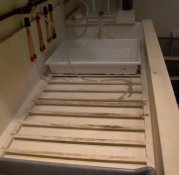
My "Duckboards", I made out of Redwood lath coated with a good varnish. Has worked fine for years.
 
Looks like a gold sluice. Sure those laths are running the
right way? Dan
 
Photrio.com contains affiliate links to products. We may receive a commission for purchases made through these links.
To read our full affiliate disclosure statement please click Here.

PHOTRIO PARTNERS EQUALLY FUNDING OUR COMMUNITY:



Ilford ADOX Freestyle Photographic Stearman Press Weldon Color Lab Blue Moon Camera & Machine
Top Bottom