
• Welcome to Photrio!
    Registration is fast and free. Join today to unlock search, see fewer ads, and access all forum features.
    Click here to sign up

D-76 Problem?

Manners street Lads

A
Manners street Lads

  • 2
  • 0
  • 25
Arkansas Ent

A
Arkansas Ent

  • 4
  • 2
  • 55

Recent Classifieds

Forum statistics

Threads
203,048
Messages
2,849,136
Members
101,623
Latest member
Ohio in Photography
Recent bookmarks
0

jgwetworth

Member
Joined
Jul 31, 2012
Messages
39
Location
Arizona
Format
Medium Format
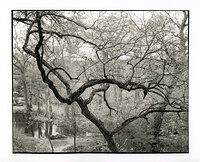
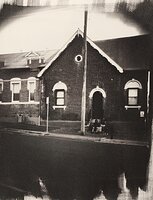
Hey guy's just developed my first roll with D-76 and It came out purple, with little to no blacks and grey's. I used the same film in the same camera, developed with T-Max Developer came out Perfect using Ilford HP5 Plus both times, developing in T-Max for 6:30 and In D-76 for 8:30. Examples.

T-Max
317ejrl.jpg

D-76
oz3tc.jpg

Note: That blur at the bottom was there when i took the picture its not the Developer's fault.

Does it need more developing time? Or New Fixer? Thanks!
 
Put it back in the fix.
 
On your d-76 processed film, is the rebate (where the sprocket holes are) clear or milky? If it is NOT clear, you have not completely fixed that film. Stick it back in the fix or use new fixer if it's old. It is pretty much impossible to tell if your film is under processed (needing more dev time) from a digital scan.
 
Yeah, what tkamiya said. If the film appears milky (opaque or translucent white) anywhere, you haven't fixed long enough. A good rule of thumb is to always fix for at least five minutes.
 
It doesn't seem milky anywhere
351fvnk.jpg
 
you don't say what kind of film this is...When I do my Tri-X, and also fuji acros, they both have a kind of color base on the film in addition to the emulsion -- it is not anti-hilation backing, it seems to be in the film itself.

tri-x is purple-ish, fuji acros is a bit pink. After the film has fixed thoroughly -- all the milky white is gone and you've let it sit in the fix a couple of minutes longer -- then you need to thoroughly wash the film -- some manuals say 10 minutes, but I've found if you let it wash for half an hour or so that purple color also comes off/out and you get a clearer base. I often just let the film sit in the can of water half an hour after I've washed it for a while and when I pour it out the water has turned purple.

rule of thumb -- always fix the film for twice as long as it takes that white/milky stuff to clear. If it takes longer than 5 minutes to get to that point, your fixer is dead and you need to mix new.

the color on the film base doesn't affect making prints, i hasten to add -- at least I don't think so. Washing it out does make it easier to see the things to focus the enlarger.
 
For the pink tint: fix a bit longer/mix new fixer if exhausted (I usually use the same batch of fixer for not more than 2/3 rolls, but that's me).
For the tonality, it could be several things plus one. The second you posted does seem to suffer from severe underexposure, which the scan software tried to salvage by raising the gain, hence the "milkiness". But -as somebody pointed out- it's difficult to judge from scans.
Another factor could be agitation: in fact maybe I can see some unevenness in the first frame. How are you agitating the tank?

Edit: Forgot to mention that some of the purplish tint usually stays there. As far as the info I've gathered goes, I've come to think this is normal with certain film/dev combination and, if not milky or opaque, it's nothing to worry about; the negs will print normally anyways.
 
  • Deleted member 2924
  • Deleted
Tri X does have a heavier than usual anti-halation backing and I think this is what you are seeing. It isn't normally as dark as this though and is largely washed out in the processing. I have had samples (A long while ago) that were not far off what we have here. It will print as normal, but if using multigrade paper it will increase printing times and affect the filtration.

About the only film I know of that didn't have this anti-halation backing was the old Kodak High Speed Infra red which was one of the reasons there used to be that diffused 'glow' around highlights and sometimes the pattern off the pressure plate in the camera. Olympus OM range were quite bad in this respect.
 
Last edited by a moderator:
Question, what film were you using and how long were you fixing and by extension how old is the fix? If it's T-max film it needs a good 10 min in fix to get rid of the pink/purple hue and that particular film beats up fix really bad.
 
S*A*F*E*T*Y fILM....Well, is it about 30 years since that was labeled on the rebate? How fresh is the film you used:smile:?

My film doesn't expire for 4 years :tongue: And thanks all, Fixed for 10 minutes and a pre-wash made it almost impossible to see but I think i'm just going to start using T-Max dev exclusively just seems to make my negatives come out nicer.
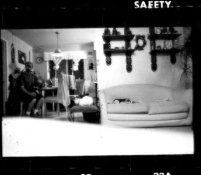
 
It doesn't look like there is anything wrong with your film.... Rebate and deep shadow are perfectly clear. Highlight as seen on right side is perfectly dense. It kind of look as if it's a little underexposed but not badly. Some of that blue/purple tint will come out if you wash it for really long time, like an hour. D76 is a perfectly good developer. Other than potential scanning issues, I have no idea now, what's going on.
 
My film doesn't expire for 4 years :tongue: And thanks all, Fixed for 10 minutes and a pre-wash made it almost impossible to see but I think i'm just going to start using T-Max dev exclusively just seems to make my negatives come out nicer.


By all means stick to the T-Max if you like it - it's meant to be decent stuff. But seriously don't discard D76 on the basis of this test because it hasn't shown any failing of D76 whatsoever. That negative is fine but your scan is broken.

351fvnki.jpg

PS if you want the cheapness of D76 with a bit more speed and resolution, try Xtol.
 
Last edited by a moderator:
The purple tint is nothing to worry about. The proof is always in the pudding, however. D76 is a great film developer, and can be made to work well with any film, same as TMax can. There are differences between them, but nowhere near as large as your initial post shows, where I think the scan got messed up somehow.
 
I use D76 as my main developer, it can develop almost any film to great standards. Give D76 another chance, it is a standard around many other developers are based and is a very old formula, and cheap. I won't ever ditch D76 as a primary developer, I do sometimes use others but D76 is the main.

Ilford ID11 is virtually identical to D76. Tmax is a very dense film usually that many scanners need their exposure upping to get a good scan, at least in my experience, I usually print and have noticed very few problems with Tmax. Your negs look fine

Do wash film well, at least 10 minutes with running water, it is crucial! Under washing can damage negatives over time, sometimes within a year.
Jacob
 
Photrio.com contains affiliate links to products. We may receive a commission for purchases made through these links.
To read our full affiliate disclosure statement please click Here.

PHOTRIO PARTNERS EQUALLY FUNDING OUR COMMUNITY:


Ilford ADOX Freestyle Photographic Stearman Press Weldon Color Lab Blue Moon Camera & Machine
Top Bottom