• Welcome to Photrio!
    Registration is fast and free. Join today to unlock search, see fewer ads, and access all forum features.
    Click here to sign up

D-76 Gradation @ 1:3

Forum statistics

Threads
203,265
Messages
2,852,072
Members
101,751
Latest member
Wildfire
Recent bookmarks
0

Richard Jepsen

Member
Allowing Ads
Joined
Jul 1, 2006
Messages
877
Location
Oklahoma, US
Format
Multi Format
Last week I shot landscape images under a bright overcast (soft shadows) using 120 Tri-X rated at 200 and FP-4 rated a 64. I am using dilute developer to enhance sharpness. The FP-4 was developed in Rodinal 1:75, 20C for 11 min. The Rodinal developed negatives have mid tones which seem a touch flat. My extra 60s of development failed to avoid flat mid-tones.

If I developed the Tri-X in D-76 at 1:3 will mid-tones be depressed similar to the Rodinal negatives?
 
With Rodinal, my old notes indicate your film is probably underdeveloped. For low to mid contrast with Tri-X, 14.5 minutes would be about right, assuming 68 F temp, and ASA standard agitation. In flat light, , probably box speed would be better, also.
 
In addition to many successes with Rodinal and large format in general, I often have the problem you describe with Rodinal, with smaller formats in particular. Any individual section of the print looks very good, but when I look at the whole print I can't quite define the problem, but put it down to "compressed mid-tones.

Recently I did a shoot with FP4+ in 35mm with a wide light latitude that printed well. I exposed at ei 50 with an averaging meter, and developed in Rodinal 1:50 agitation continuous for 30 seconds, then two agitations at the to of every minute up to 12 minutes, with a coast to 14-1/2—so, a little longer coast.

For flatter scenes where I want to add contrast, I have been using dilutions of 1:25 with greater success.

As for FP4+ in D-76 1:3, this looks great. I use 18 minutes at 68° for small format, and 20 minutes for large format. Make sure you use enough stock solution so that your developer doesn't exhaust. The shot of the barrels in my gallery was developed this way. (there was a url link here which no longer exists)
 
"Will diluting D-76 1:3 result in compressed midtones? I'm thinking it has too."

I think it will compress, as it is a compensating dilution. FP4+ developed in D-76 or Xtol stock solution glows, I think, especially in comparison to the 1:1 dilution. I favor tone over ultimately sharp grain. With the scene you describe above, overcast with soft shadows, I don't think you need much if any compensation. Perhaps there is another developer that would give you great tone and sharp grain?
 
Lately I've been developing FP4 (120) in Rodinal 1:25 in overcast light at EI100 and developing for 9 1/2 minutes. Very very sharp! I never realized FP4 could be so sharp! And beautiful tonality.

I have developed FP4 in ID-11 1:3 and Xtol 1:3 in the past. I couldn't seem to get enough shadow detail to my liking and the sharpness was not great enough for me (in 35mm this may not be as much of an issue).
 
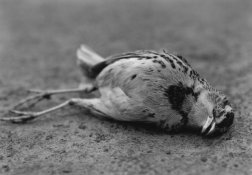
Here is a shot with FP4+ in overcast light. The light was quite soft so I went to ei 200 with a general reading, and developed in Rodinal 1:25 for 11 minutes at 68°. Of course, different eyes like different tones.
 

Attachments

  • fallen beauty.JPG
    fallen beauty.JPG
    93.8 KB · Views: 178
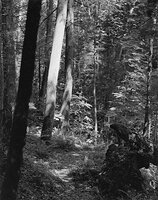
I printed a FP-4 120 neg (EI 64) in Rodinal (1:75) on EMAKS Grade 3 using a condenser light source. The image is of a historic mission site with picnic table with tree branches forming a cathedral. Trees are just budding out. The tree bark has detail. Rodinal made the image very sharp and works well with the sky not blowing out. I've read folks who talk about a Rodinal Glow. Perhaps that description is because mid tones are slightly depressed and there is a quick transition from zone 4 to zone 6. The zone 6 highlights stand out from the darkness and do seem to glow.
 
Here is a shot with FP4+ in overcast light. The light was quite soft so I went to ei 200 with a general reading, and developed in Rodinal 1:25 for 11 minutes at 68°. Of course, different eyes like different tones.

When scanning, you need to set you black, white, and gamma levels, you dont really get to change your scanner sensor, like you can choose paper, or printer filters, exposure and development time.. so you really need to set your contrast, rather than just letting the scanner set black and white points for you.
 
Photrio.com contains affiliate links to products. We may receive a commission for purchases made through these links.
To read our full affiliate disclosure statement please click Here.

PHOTRIO PARTNERS EQUALLY FUNDING OUR COMMUNITY:


Ilford ADOX Freestyle Photographic Stearman Press Weldon Color Lab Blue Moon Camera & Machine
Top Bottom