
I was experimenting with tea toning yesterday and today and decided to try belaching with either bleach or ammonia. Rather than mess up some good prints, I started with some badly overexposed prints that had been printed from a negative with too little density range for a Cyanotype. And I couldn't find the ammonia bottle, so I grabbed some window glass cleaner (containing ammonia and isopropyl, plus ingredients unknown) and mixed it roughly 1:3 with water. Shortly after I put the prints in, I noticed that the lighter areas were bleaching out faster than the darker, restoring the contrast to normal. I think I have recovered several prints this way now, though all have gone a bit purple. Will post some scans when they dry.
-
Welcome to Photrio!Registration is fast and free. Join today to unlock search, see fewer ads, and access all forum features.Click here to sign up
You are using an out of date browser. It may not display this or other websites correctly.
You should upgrade or use an alternative browser.
You should upgrade or use an alternative browser.
Cyanotypes - Happy Accidents
-
A
- Thread starter DBP
- Start date
Recent Classifieds
-
For Sale Canonet QL17 Rangefinder
- Started by davela
-
For Sale 85mm F2 Olympus Zuiko for OM 35mm System - Bargain!
- Started by davela
-
Want to Buy Clean Zeiss Ikon ZM
- Started by NortheastPhotographic
-
Want to Buy WTB FM3a Black
- Started by samuelphoto
-
For Sale FS: Lomo LC-Wide, 35mm point and shoot w/ 17mm f/4.5
- Started by dirkfletcher
Forum statistics

Great stuff, I look forward to seing the results. I never throw 'failed' prints, they're always good for experimenting with.
J
J
DBP,
I also use household ammonia cleaner as a bleach for cyanotypes. Just like you, I figured that - what the heck - since I don't have any "real" ammonia on hand and wouldn't know where to buy any, I just diluted some Windex and put a little bit in a tray of water. Works wonders. Other alkalines work just as well, since bleaching cyanotypes is basically immersion in alkaline solutions. While activity is correlated with Ph, temperature, agitation, dilution, and that sort of thing, it boils down to bleaching the print to some visually acceptable level.
Very dilute developer (paper or film developer) works. Baking soda too. TSP the laundry additive is another. I've tried a number of household items, and you probably can come across other things as well. I work with these in a rather imprecise way, sprinkling this and that by guesswork. After all, I can watch the bleaching process closely and then pull the print at the approximate time. My wife, needless to say, frowns on all my experiments, since I use up all her kitchen stuff.
I also use household ammonia cleaner as a bleach for cyanotypes. Just like you, I figured that - what the heck - since I don't have any "real" ammonia on hand and wouldn't know where to buy any, I just diluted some Windex and put a little bit in a tray of water. Works wonders. Other alkalines work just as well, since bleaching cyanotypes is basically immersion in alkaline solutions. While activity is correlated with Ph, temperature, agitation, dilution, and that sort of thing, it boils down to bleaching the print to some visually acceptable level.
Very dilute developer (paper or film developer) works. Baking soda too. TSP the laundry additive is another. I've tried a number of household items, and you probably can come across other things as well. I work with these in a rather imprecise way, sprinkling this and that by guesswork. After all, I can watch the bleaching process closely and then pull the print at the approximate time. My wife, needless to say, frowns on all my experiments, since I use up all her kitchen stuff.
I recently used weak household bleach on a cyanoprint I inadvertantly exposed for just over 2 hours (I forgot it while I was watching football). After bleaching it produced a suprisingly useable print.
Phill
Phill
The purple produced by alkali bleaching is reputedly not stable. I think it turns to regular cyanotype blue, but it may just fade with time.

DBP said:I was experimenting with tea toning yesterday and today and decided to try belaching with either bleach or ammonia. Rather than mess up some good prints, I started with some badly overexposed prints that had been printed from a negative with too little density range for a Cyanotype. And I couldn't find the ammonia bottle, so I grabbed some window glass cleaner (containing ammonia and isopropyl, plus ingredients unknown) and mixed it roughly 1:3 with water. Shortly after I put the prints in, I noticed that the lighter areas were bleaching out faster than the darker, restoring the contrast to normal. I think I have recovered several prints this way now, though all have gone a bit purple. Will post some scans when they dry.
Do not mix household bleach or any hypochlorite containing product with ammonia containing products. Anything with the potential to generate chlorine mixed with ammonia generating materials will produce a very toxic gas.
PE
Photo Engineer said:Do not mix household bleach or any hypochlorite containing product with ammonia containing products. Anything with the potential to generate chlorine mixed with ammonia generating materials will produce a very toxic gas.
PE
Thanks for the warning, but I haven't forgotten that much chemistry. The two trays were even spaced a fair distance apart to prevent splashes.
The color had migrated to a slightly green tinted blue by the time things were dry. Here's the example I promised:
Attachments
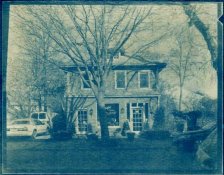

That resembles and un- or under-washed cyanotype -- I'd be strongly tempted to give it another wash in slightly acidified water to see if the yellow washes out (if it does, you want it to, because it'll be an iron-ammonia complex or salt that is likely to be very bad for your print over the medium to long term -- based on your description of the bleaching process, possibly ferric ammonium chloride).
Thanks, I'll give that a try. Some of the other prints don't have the yellow cast.
A little vinegar and water cleared up the yellow cast. Thanks again. I'll post the latest version after it dries.
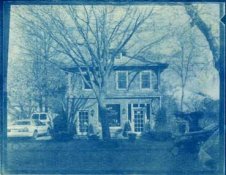
That looks much healthier, and close to "normal" for a cyanotype (at least as closely as I can judge without seeing the negative it was made from). Nice save!
Thanks. Not my best negative, needless to say.
| Photrio.com contains affiliate links to products. We may receive a commission for purchases made through these links. To read our full affiliate disclosure statement please click Here. |
PHOTRIO PARTNERS EQUALLY FUNDING OUR COMMUNITY:  |