
-
Welcome to Photrio!Registration is fast and free. Join today to unlock search, see fewer ads, and access all forum features.Click here to sign up
You are using an out of date browser. It may not display this or other websites correctly.
You should upgrade or use an alternative browser.
You should upgrade or use an alternative browser.
Cross processing... BW slides?
-
A
- Thread starter EASmithV
- Start date


Recent Classifieds
-
Want to Buy Clean Zeiss Ikon ZM
- Started by NortheastPhotographic
-
Want to Buy WTB FM3a Black
- Started by samuelphoto
-
For Sale FS: Lomo LC-Wide, 35mm point and shoot w/ 17mm f/4.5
- Started by dirkfletcher
-
For Sale SPRING CLEANING! (doing some deep cleaning)
- Started by dirkfletcher
-
Sold Kodak Step Tablets
- Started by Jon Shiu
Forum statistics


You develop it as normal, rinse/wash, then bleach it, then rinse, then pull it ou and hang it up to dry in light, then get it back onto the reel, develop again (no times for this, process to completion, ie you cant overdo it, just underdo it) and fix.

I have often wondered if E-6 Reversal Bath will chemically fog a piece of b/w film, instead of pulling it out in the light. I have also wondered if plain-ol' pot. ferricyanide bleach would do the job of the Ilford bleach recipe.
Last edited by a moderator:
- Deleted member 2924
- Deleted

I have often wondered if E-6 Reversal Bath will chemically fog a piece of b/w film, instead of pulling it out in the light. I have also wondered if plain-ol' pot. ferricyanide bleach would do the job of the Ilford bleach recipe.
The separate E6 reversal bath should work fine after all all colour films are essentially B&W until developed in a colour developer.
The Ferricyanide bleach won't work as the Silver/Ferricyanide complexes formed are partially insoluble so don't wash out and the negative would partly re-develop along with the positive.
Ian
You should be able to use a colour bleach on it.
Hanging it to dry is easier, as you dont have to hold the reel and worry about re-exposing it to light for the correct time and making sure all the film gets enough.
Hanging it to dry is easier, as you dont have to hold the reel and worry about re-exposing it to light for the correct time and making sure all the film gets enough.
You can't use a colour bleach as that will also remove the remaining un-processed silver halide as that you need to re-expose chemically or with light & develop to form the positive.
Ian
Ian

You can't use a colour bleach as that will also remove the remaining un-processed silver halide as that you need to re-expose chemically or with light & develop to form the positive.
Ian
You're thinking about a combined bleach and fix or when there is a bleach after last developing (followed by a subsequent fix)
The bleach doesn't remove silver halide, it converts metallic silver into bromide, (ie: the developed silver from the first bath), then second developer, develops the exposed silver (which is everything, bar what was developed in the first hence reversal).
The fix wont remove the second developed silver, but it will remove the first converted by the bleach silver.

- Joined
- Sep 20, 2002
- Messages
- 3,699
Farmer's Reducer does remove the negative image. A ferricyanide bleach followed by a sulfite clearing bath also removes the negative image. The first development should be to high contrast. After the bleaching and clearing, the second development must be to completion, and Dektol or similar may be used.
That is the process in general, but I am not an expert at using it. There are some among us who are expert, aren't there, Jordan?
That is the process in general, but I am not an expert at using it. There are some among us who are expert, aren't there, Jordan?
We make reversal chemicals for this process including chromate bleach.
A an image bleached in Fericyanide on it's own can be redeveloped even when no halide is added which is why it's not used in B&W reversal processes.
That's exactly what you don't want, the bleach needs to convert the silver into soluble silver salt that washes out of the image, If you convert the silver back to a bromide or chloride it will get re-exposed and re-develop with the positive.
Ian
The bleach doesn't remove silver halide, it converts metallic silver into bromide, (ie: the developed silver from the first bath), then second developer, develops the exposed silver (which is everything, bar what was developed in the first hence reversal).
That's exactly what you don't want, the bleach needs to convert the silver into soluble silver salt that washes out of the image, If you convert the silver back to a bromide or chloride it will get re-exposed and re-develop with the positive.
Ian
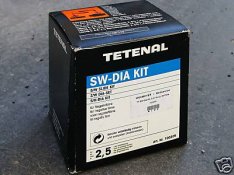
Our local photographic shop has a Tetenal kit for doing this. It's amongst a bunch of sale items and is going quite cheap. Does anyone have any experience of these kits?
Steve.
Tetenal chemistry is extremely good, it should be worth buying.
Ian
How do I take negative BW film and develop it as a positive BW slide?
The technique is called "reversal processing" and there are dozens of threads about it here and around the Net. A search will turn up lots of useful information here.
Ian Grant said:That's exactly what you don't want, the bleach needs to convert the silver into soluble silver salt that washes out of the image, If you convert the silver back to a bromide or chloride it will get re-exposed and re-develop with the positive.
Agreed with Ian here -- for a bleach to be usable in B&W reversal, it must be able to completely solubilize the metallic Ag negative image without affecting the AgX positive image. This is not possible with iron(III) based bleaches, AFAIK. In practice the only commonly used bleaches for B&W reversal are dichromate- or permanganate-based.
Ok, a slightly different thing now-
Can you please look over this and tell me where I go wrong?
I'm going to reverse process Plus-X negative film in 16mm
First dev: HC-110 for 5 minutes
Stop bath for 3 minutes
Bleach in normal room light until it looks good (Farmer's reducer?)
Hold about 10 cm under a 60 watt incandescent light and re-expose on each side for about 30 seconds
Re-develop in normal room light with HC-110 until it looks proper
(I eventually want to try using Caffenol for the second developer)
Fix 5 min
Can you please look over this and tell me where I go wrong?
I'm going to reverse process Plus-X negative film in 16mm
First dev: HC-110 for 5 minutes
Stop bath for 3 minutes
Bleach in normal room light until it looks good (Farmer's reducer?)
Hold about 10 cm under a 60 watt incandescent light and re-expose on each side for about 30 seconds
Re-develop in normal room light with HC-110 until it looks proper
(I eventually want to try using Caffenol for the second developer)
Fix 5 min
Last edited by a moderator:
Ok, a slightly different thing now-
Can you please look over this and tell me where I go wrong?
I'm going to reverse process Plus-X negative film in 16mm
First dev: HC-110 for 5 minutes
Stop bath for 3 minutes
Bleach in normal room light until it looks good (Farmer's reducer?)
Hold about 10 cm under a 60 watt incandescent light and re-expose on each side for about 30 seconds
Re-develop in normal room light with HC-110 until it looks proper
(I eventually want to try using Caffenol for the second developer)
Fix 5 min
A few problems I notice, with my limited knowledge of photo chemistry:
1. You want to bleach before re exposing, not while re exposing.
2. Mr. Grant has pointed out that ferricyanide bleach will not work for this, as it does not remove the bleached silver of its own accord like the permanganate bleach listed in the Ilford recipe, but instead "marks" it for removal by fixer. If it is not removed before you re expose and re develop, the process will not work.
3. Farmer's reducer is ferricyanide bleach mixed with the main ingredient in fixer. If you use Farmer's Reducer as your bleach, it would make sense that you will also remove silver that you intend to re expose.
4. How are you going to handle the remjet layer?
Finally, what are you aiming to achieve? Saving about 18 cents per foot in processing costs ($18 per $100 feet)? If this is all, consider the volume you will be shooting and the time, chemical costs, and such that you will spend on this to determine if it is really worth while. If this is just a fun experiment, have at it, but if you intend to save a whole bunch of money, I would not count on it.
Last edited by a moderator:
A few problems I notice, with my limited knowledge of photo chemistry:
1. You want to bleach before re exposing, not while re exposing.
2. Mr. Grant has pointed out that ferricyanide bleach will not work for this, as it does not remove the bleached silver of its own accord like the permanganate bleach listed in the Ilford recipe, but instead "marks" it for removal by fixer. If it is not removed before you re expose and re develop, the process will not work.
3. Farmer's reducer is ferricyanide bleach mixed with the main ingredient in fixer. If you use Farmer's Reducer as your bleach, it would make sense that you will also remove silver that you intend to re expose.
4. How are you going to handle the remjet layer?
Finally, what are you aiming to achieve? Saving about 18 cents per foot in processing costs ($18 per $100 feet)? If this is all, consider the volume you will be shooting and the time, chemical costs, and such that you will spend on this to determine if it is really worth while. If this is just a fun experiment, have at it, but if you intend to save a whole bunch of money, I would not count on it.
Remjet? Is that like anti-Halation dye? If so, doesn't that wash out with the first developer?
The clearing bath removes the bleach (or makes it possible to be washed away, perhaps). The Ilford data sheet talks about this. You really need to read some data sheets on the process to understand it better, IMO.
The remjet coating is put onto the base side of motion picture film. It works as a shield for the base side; to absorb the minor abuse of being run over the camera internals at high speed. It also works as an anti-halation layer and to cut down on static electricity due to the motion of the film. The base side of your film will not be glossy if your film has this coating. When processed at a movie film lab, I believe that the coating is removed prior to development. It does not come off with a simple presoak. There are ways to remove it if processing at home, though I have never looked that deeply into it myself.
The remjet coating is put onto the base side of motion picture film. It works as a shield for the base side; to absorb the minor abuse of being run over the camera internals at high speed. It also works as an anti-halation layer and to cut down on static electricity due to the motion of the film. The base side of your film will not be glossy if your film has this coating. When processed at a movie film lab, I believe that the coating is removed prior to development. It does not come off with a simple presoak. There are ways to remove it if processing at home, though I have never looked that deeply into it myself.
Last edited by a moderator:

Remjet? Is that like anti-Halation dye? If so, doesn't that wash out with the first developer?
According to Kodak:
• Remjet, a removable jet black layer, is the coating of carbon black particles in a water-soluble binder on the bottom of the film. It has four purposes: antihalation, antistatic, lubrication, and scratch protection. The remjet carbon layer is also conductive and prevents the build-up and discharge of static charges that can fog film. This is especially important in low relative humidity environments. Remjet also has lubricating properties. Like the supercoat on top of the emulsion, remjet resists scratching on the base side and helps transport the film through cameras, scanners, and printers.
Remjet is typically found on motion picture film which must go through the camera at a high rate of speed. I don't think Ilford uses it, even on their Motion Picture films. Kodak does use Remjet on Kodachrome, the only still film that uses it today.
Last edited by a moderator:
The Ilford website has (or had) a useful PDF about reversal processing, and there are many websites that describe the process as well (not to mention books). B&W reversal isn't nearly as "tolerant" as regular B&W processing and the usual mix-and-match that we can do when developing negatives doesn't usually work out with a reversal process. If you want to do it at home, it's best to start with a tried and tested process and then go from there.
Using Farmer's Reducer as a bleach will remove both your negative image (developed silver) and incipient positive image (undeveloped silver halide) and you'll be left with blank film.
Using Farmer's Reducer as a bleach will remove both your negative image (developed silver) and incipient positive image (undeveloped silver halide) and you'll be left with blank film.
| Photrio.com contains affiliate links to products. We may receive a commission for purchases made through these links. To read our full affiliate disclosure statement please click Here. |
PHOTRIO PARTNERS EQUALLY FUNDING OUR COMMUNITY:  |