• Welcome to Photrio!
    Registration is fast and free. Join today to unlock search, see fewer ads, and access all forum features.
    Click here to sign up

Correcting convergence

Forum statistics

Threads
203,139
Messages
2,850,454
Members
101,692
Latest member
eviosl
Recent bookmarks
1

mr rusty

Member
Joined
Sep 7, 2009
Messages
827
Location
lancashire,
Format
Medium Format
I have an enlarger where I can swing the whole head, which in theory I guess I can use to correct convergence in shots of buildings. I haven't tried this yet, but obviously the focus will get mucked up a bit between the near and far points on the image from the enlarger lens. What are peoples thoughts? is this practical? or is the depth of field of the image never good enough for it to really work?
 
Thanks Steve! I do have a tilting lens board as well, so in due course I will try this. Thanks for the article link which answers all the questions.
 
I have made slight corrections by tilting the easel. Stop down and make test prints to see if burning or dodging part of the print is needed. Don't try to do too much. You didn't mention the size of the negative which might make a difference.

http://www.jeffreyglasser.com/
 
Always remember that when you do this to modify the shapes of things like buildings, you will also be modifying the shapes of everything else in the scene.

People, cars and signs can look really strange when they are "modified for convergence".
 
Correcting convergence with the enlarger has some advantages over front rise.
1) You use the center of the taking lens
2) The actual angle of view is greater when pointing up, compared to a front rise
3) You can use smaller, more compact, more inexpensive lenses.

Pictures show:
1) a modest Durst enlarger that does a correct baseboard tilt and lens tilt.
2) Durst 8x10 enlarger, again with baseboard and lensboard tilt.
3) my Durst used to make the following picture
4) 8x10 negative from a lowly Symmar-S 210mm pointed up. Notice that there is no light falloff at the top of the image, as one would get with a wide field lens with a lot of front rise.

M600perspective.jpg

Durst.jpg

DSCF4801.jpg

corrected.jpg
 
Last edited by a moderator:
Always remember that when you do this to modify the shapes of things like buildings, you will also be modifying the shapes of everything else in the scene.

People, cars and signs can look really strange when they are "modified for convergence".

I guess it is in the eye of the beholder. I find uncorrected leaning signs, people, wine-bottles and cars odd, unless you want the special effect.

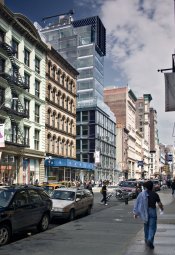
Attached image (from http://images.nikonians.org) showing pretty normal-looking people, signs and cars in a highly corrected image.
nouvel_b.jpg
 
Last edited by a moderator:
Correcting convergence with the enlarger has some advantages over front rise.

3) my Durst used to make the following picture
4) 8x10 negative from a lowly Symmar-S 210mm pointed up. Notice that there is no light falloff at the top of the image, as one would get with a wide field lens with a lot of front rise.

DSCF4801.jpg

corrected.jpg

Nice demo!
 
I knew all the old hands would have all the answers! This forum is great. For those who have read my other posts, I am in the process of setting up a dark room. Until very recently I had never made a print before in my life - so it's all one huge learning curve. The darkroom is nearly finished - I ordered some epoxy for the sink today. I still haven't ever developed a film (only prints so far from existing negs), but my supplies from silverprint came yesterday so it won't be long. My family think I am slightly mad investing in something which most people think is obsolete!
 
Photrio.com contains affiliate links to products. We may receive a commission for purchases made through these links.
To read our full affiliate disclosure statement please click Here.

PHOTRIO PARTNERS EQUALLY FUNDING OUR COMMUNITY:


Ilford ADOX Freestyle Photographic Stearman Press Weldon Color Lab Blue Moon Camera & Machine
Top Bottom