• Welcome to Photrio!
    Registration is fast and free. Join today to unlock search, see fewer ads, and access all forum features.
    Click here to sign up

Componon-S 135mm - optimal range?

A long time ago...

A
A long time ago...

  • 0
  • 0
  • 26
Boy and teddy, 1920's.jpg

A
Boy and teddy, 1920's.jpg

  • 2
  • 2
  • 44

Recent Classifieds

Forum statistics

Threads
201,202
Messages
2,820,399
Members
100,582
Latest member
v1photos
Recent bookmarks
1

M Carter

Member
Allowing Ads
Joined
Jan 23, 2013
Messages
2,147
Location
Dallas, TX
Format
Medium Format
Recently got a like-new 135 Componon-S. Just getting around to testing it, took a bit to find the right mounting ring.

I can't find published specs on the enlarging range and optimal ratio - anyone know if this was established or published? The Rodagon 135 specs say 2x to 10x (6x optimal); The Nikkor 135 specs are 2x to 10x, 5x optimal. I'd have to guess the Componon is in the same range, though I've heard chatter that the Componon beat the others a bit in big-print quality with a longer range.

Just curious how far to push into testing.
 

AgX

Member
Allowing Ads
Joined
Apr 5, 2007
Messages
29,972
Location
Germany
Format
Multi Format
I got no data for yours, but the predecessor Companon was stated as being optimized for 1/10, and being proven for 2/1 to 1/20.

In case of doubt test lenses against each other at the scale you require.

EDIT:
It must be 1/2 to 1/20 !
 
Last edited:
OP
OP
M Carter

M Carter

Member
Allowing Ads
Joined
Jan 23, 2013
Messages
2,147
Location
Dallas, TX
Format
Medium Format
Thanks - it's my only 135mm, but should be easy to find the optimal aperture at, say 5x, and I could just lay out 5x7 or 8x10 paper in the center and at the corners vs. a 20x24 print - even make a 4x5 test neg that labels each sector so the prints would be self-explanatory as far as position. Then try 10x and maybe up to 12 or so and see where rendering takes a hit, and see if other apertures improve things. (I have no idea for enlarging lenses if aperture affects things differently at different scales). Would take an afternoon and a pack of RC paper I imagine. Really more out of curiosity, but would be interesting to see when a quality dropoff hits, how severe it is, and how it manifests as size increases.
 

Ian Grant

Subscriber
Allowing Ads
Joined
Aug 2, 2004
Messages
23,370
Location
West Midland
Format
Multi Format
I had two 135mm Compon for years. I gave the newest away with an old Johnsons V45 enlarger about 10 years ago (I now have it back), I also nave the Componon S version.

I've used the plain Compon lenses for very large prints 15/16 ft and and they were superb performers. Optimal aperture - I just count click stops and never really check - f11 - f16, but these are flat field lenses so should be very good wider open or stopped down. I've never had a problem and I'm very critivcal about sharpness.

Ian
 

Lachlan Young

Member
Allowing Ads
Joined
Dec 2, 2005
Messages
5,057
Location
Glasgow
Format
Multi Format
See if you can locate the work by CTEIN called Post Exposure it lists tests of a number of lenses.

Just checked & the 135mm Componon-S is not in there - the 150 is , but only Nikkor & Rodagon 135's. Optimum aperture for all is stated to be f8.

I got no data for yours, but the predecessor Companon was stated as being optimized for 1/10, and being proven for 2/1 to 1/20.

In case of doubt test lenses against each other at the scale you require.

Dug out a recent-ish catalogue - states 2-20x optimised for Componon-s - without stating if this was for the shorter lenses only or not. I'd not be surprised if the optimisation has largely remained the same over time, with only coatings & barrels changing over the last few decades. The big thing they say in favour of the APO-Componon-HM glass is that it'll give better correction down to 1:1.

M Carter - I think you'll be surprised at how difficult a time you'll have telling one from another at decently big enlargements. And anyway, how many 40x50" or larger prints are you going to be making? There will be plenty of other things that kill sharpness & resolution at that size before the enlarging lens will. Film flatness in the camera for a start...
 

AgX

Member
Allowing Ads
Joined
Apr 5, 2007
Messages
29,972
Location
Germany
Format
Multi Format
Interesting that now they state a quite different range than decades ago.

I assume it is rather a matter of evaluation or even wording than a change of optics.
 

Lachlan Young

Member
Allowing Ads
Joined
Dec 2, 2005
Messages
5,057
Location
Glasgow
Format
Multi Format
Interesting that now they state a quite different range than decades ago.

I assume it is rather a matter of evaluation or even wording than a change of optics.


or 1/magnification? ie 1/2=0.5, 1/25=0.04 - thus 2x-25x?
 

MattKing

Moderator
Moderator
Joined
Apr 24, 2005
Messages
54,714
Location
Delta, BC Canada
Format
Medium Format
That data sheet is for a lens that is designed for taking images, not printing images. It is even called a macro lens.
I'm not saying that it isn't perfectly suitable for use as an enlarging lens, but rather that its specifications and other information are worded differently.
 

AgX

Member
Allowing Ads
Joined
Apr 5, 2007
Messages
29,972
Location
Germany
Format
Multi Format
Lachlan, You are right!

0.5 - 0.04 = 1/2 -1/25 = 2x - 25x


In my preceeding post I mixed up taking and projecting within one equation!
 
Last edited:

AgX

Member
Allowing Ads
Joined
Apr 5, 2007
Messages
29,972
Location
Germany
Format
Multi Format
Matt, it does not matter.

A lens can be used for taking or projecting the same optical-wise, as long as the ratios are the same.
( In this case 1/2-1/25 or 2x-25x, depending on point of view.)

Schneider just took their enlarging lenses and, by lack of enlarging customers, put them into their industrial taking lens range.

Technically issues as heat-resistance or stray light via the aperture scale have to be considered though in the respective uses. Image wise a matter as bokeh may be consdidered too as projection lenses handle only flat fields. With taking lenses the image of out of focus areas matters in addition, though not in industrial use.
What they show in their photos looks identical to the old enlarging lenses: preset lever, illuminated aperture scale. Perhaps they light tightened that scale.
 
Last edited:

jjphoto

Member
Allowing Ads
Joined
Oct 9, 2010
Messages
402
Location
Melbourne, A
Format
Multi Format
That data sheet is for a lens that is designed for taking images, not printing images. It is even called a macro lens.
I'm not saying that it isn't perfectly suitable for use as an enlarging lens, but rather that its specifications and other information are worded differently.

It's the same lens, ie an enlarging lens and not a different lens designed for macro, it's just being marketed through a different selling channel so the terminology used is different. Rodenstock and Schneider both sell enlarging lenses as 'machine vision' lenses for use in industrial applications, and yes, often with specially designed lenses but they often sell just the normal enlarging lenses too because they work well for the purpose.

Here's another example from the same source as the previous link for the 5.6/135 to illustrate my point which in this case is the normal APO-Componon HM 4.5/90:

http://www.schneiderkreuznach.com/f.../Lenses_with_Leica_Thread/Componon_4.5-90.pdf

Point is, these are enlarging lenses and not specially designed and therefore different 'macro' lenses.
 
Last edited:

MattKing

Moderator
Moderator
Joined
Apr 24, 2005
Messages
54,714
Location
Delta, BC Canada
Format
Medium Format
The last two posts state in much clearer detail what I was trying to say about the data sheet linked to.
 
OP
OP
M Carter

M Carter

Member
Allowing Ads
Joined
Jan 23, 2013
Messages
2,147
Location
Dallas, TX
Format
Medium Format
And anyway, how many 40x50" or larger prints are you going to be making? There will be plenty of other things that kill sharpness & resolution at that size before the enlarging lens will. Film flatness in the camera for a start...

I hope to make a lot of them, for a specific project. And yes, I know how many people post here "just got my first enlarger and want to do house-sized prints" and so on. And, I'll be doing these as liquid emulsion on canvas... masochist for sure. Mamiya RB negs, 11x14 or 16x20 bromoil prints, those duplicated on 4x5 film and enlarged on canvas.

Anyway, my RB negs have dynamite sharpness corner to corner - even with my old Beseler 67c enlarger, I was able to mod it (ceiling bracket, glass carrier, besalign board) and do really snappy prints up to 28" or so. I now have an MXT and use the versalign with it, and made a registered carrier. I will need to wall mount it for really large work, but years ago I did a lot of duping E6 slides to large E6 film by fitting a camera flash to the enlarger (the lab said "you can't dupe on Velvia!" - I proved them quite wrong), and I may experiment with that for exposure on the finals. So I've given a tremendous amount of thought to every step of the process (including a baseboard-tray with plumbing setup), and the bromoil and emulsion work I've evolved by starting small and working my way up.

And (thanks fellow APUG user) I recently obtained a Rodagon G 150mm, and I'll do plenty of testing at any give size to see which lens delivers the best image. But I can see scenarios where the Componon or the G would be proper focal lengths, and it will come down to testing at a given project's size to suss out which one to use and at which stop. My main curiosity was how far into "G" territory (size-wise) the Componon might go, and is being at the large scale end of one lens different than the smaller scale of another (say I'm right at 10x, where neither lens is optimal if the Componon is similar to Nikkors/Rodagons).

All easily established by testing I suppose, overall I was curious about the manufacturer's stated range for the Componon and does it happen to be superior to a Nikkor/etc. at larger sizes?
 

Lachlan Young

Member
Allowing Ads
Joined
Dec 2, 2005
Messages
5,057
Location
Glasgow
Format
Multi Format
I hope to make a lot of them, for a specific project. And yes, I know how many people post here "just got my first enlarger and want to do house-sized prints" and so on. And, I'll be doing these as liquid emulsion on canvas... masochist for sure. Mamiya RB negs, 11x14 or 16x20 bromoil prints, those duplicated on 4x5 film and enlarged on canvas.

Anyway, my RB negs have dynamite sharpness corner to corner - even with my old Beseler 67c enlarger, I was able to mod it (ceiling bracket, glass carrier, besalign board) and do really snappy prints up to 28" or so. I now have an MXT and use the versalign with it, and made a registered carrier. I will need to wall mount it for really large work, but years ago I did a lot of duping E6 slides to large E6 film by fitting a camera flash to the enlarger (the lab said "you can't dupe on Velvia!" - I proved them quite wrong), and I may experiment with that for exposure on the finals. So I've given a tremendous amount of thought to every step of the process (including a baseboard-tray with plumbing setup), and the bromoil and emulsion work I've evolved by starting small and working my way up.

And (thanks fellow APUG user) I recently obtained a Rodagon G 150mm, and I'll do plenty of testing at any give size to see which lens delivers the best image. But I can see scenarios where the Componon or the G would be proper focal lengths, and it will come down to testing at a given project's size to suss out which one to use and at which stop. My main curiosity was how far into "G" territory (size-wise) the Componon might go, and is being at the large scale end of one lens different than the smaller scale of another (say I'm right at 10x, where neither lens is optimal if the Componon is similar to Nikkors/Rodagons).

All easily established by testing I suppose, overall I was curious about the manufacturer's stated range for the Componon and does it happen to be superior to a Nikkor/etc. at larger sizes?


Any particular reason for the duping stage? Or is it for reasons of mass production of prints from a master bromoil?

I'd strongly suggest Ilford's Ortho+ film for the dupe - grain is only just starting to come in at about 10x (in ID-11 1+1) if you get exposure, process etc nailed. Easy to contrast control & great for masks too.

Best of luck with it etc - I've been doing some experiments with liquid emulsion on lightweight Kozo paper - quite a nice material, even if a little unnerving to handle when wet - you have to trust its wet strength.
 
OP
OP
M Carter

M Carter

Member
Allowing Ads
Joined
Jan 23, 2013
Messages
2,147
Location
Dallas, TX
Format
Medium Format
Any particular reason for the duping stage? Or is it for reasons of mass production of prints from a master bromoil

The end result I'm after is sort of a transformed/timeless look - I wanted something that had no sense of "time" to it, like it could have been from the birth of photography or today, with the texture of canvas and the look of a large stretched canvas vs. a panel - which could be tinted by using oil glazes, which - after a final varnish - give a lot of depth. Doing a huge bromoil (my testing has gone up to about 18x28" or so) would be problematic, and bromoil on canvas I'm thinking would look very "dirty". So it's a way to get the pictorialist look of bromoil and the transformative effect onto very large canvas. Prepping the canvas is time consuming and the emulsion is pricey, etc., so dialing in the image in a less costly way is really paramount to me.

Thanks for the duping advice, I haven't tried ortho films - my initial tests were duped with Ilford Pan-F plus, which gave me good contrast control in development (the emulsion I use is about grade 3+). So a lot of testing to determine the contrast and speed of the emulsion vs. an affordable paper (so initial exposure tests could be done on regular photo paper). As I move up to larger sizes, I'll try to have two images ready for canvas, prep 2 large canvases, and also make some canvas test strips (which are handy for testing and dialing in the tinting colors down the line). So if I blow one print I can take another shot (seeing how I'll have gallons of chems mixed up) or if it's good get a 2nd image within a day or so.

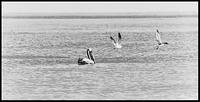
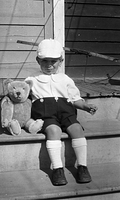
Here's a so-so phone shot of where my testing is at - about a 28" print that included some of the props and style, though my finals will be complete "settings" with a sort of allegorical take, props and so on (not the best neg either, learned I'll need some harder focus, deeper DOF and so on). I plan to create the actual settings as small models, photograph those, and merge them with the model at the bromoil stage (gotten good at darkroom masking, sky replacement and so on, no photoshop allowed!) This gives me two opportunities for any minor retouch, as both bromoil and the final canvas are larger scale (than negs) and are ink or paint based. I have decades of illustration and photoshop work that's given me a good idea of what "reality" looks like when created from multiple images or sources - perspective, lighting, etc.

So, a nutty overall process that uses virtually every artistic discipline I've tried my hand at, from dealing with models and sets and props and lighting, model making, darkroom processes, and oil paints, with lots of technical/mechanical stuff. My goal is to make some fine-art, symbolic/allegorical work than any gallery owner would see and go "what the hell?!?!" - Scale, subject and color that stops you in your tracks, makes you think or question or fill-in-your-own blanks and reactions, and uses my creative side, my desire to sort of "say" some specific things with imagery and not words, and do it with a lot of cool process involved. Major goal being do work that hits a lot of my tech and creative obsessions, that I'd want to own myself, and could actually sell for significant $$. We will see!

 

Lachlan Young

Member
Allowing Ads
Joined
Dec 2, 2005
Messages
5,057
Location
Glasgow
Format
Multi Format
The end result I'm after is sort of a transformed/timeless look - I wanted something that had no sense of "time" to it, like it could have been from the birth of photography or today, with the texture of canvas and the look of a large stretched canvas vs. a panel - which could be tinted by using oil glazes, which - after a final varnish - give a lot of depth. Doing a huge bromoil (my testing has gone up to about 18x28" or so) would be problematic, and bromoil on canvas I'm thinking would look very "dirty". So it's a way to get the pictorialist look of bromoil and the transformative effect onto very large canvas. Prepping the canvas is time consuming and the emulsion is pricey, etc., so dialing in the image in a less costly way is really paramount to me.

Thanks for the duping advice, I haven't tried ortho films - my initial tests were duped with Ilford Pan-F plus, which gave me good contrast control in development (the emulsion I use is about grade 3+). So a lot of testing to determine the contrast and speed of the emulsion vs. an affordable paper (so initial exposure tests could be done on regular photo paper). As I move up to larger sizes, I'll try to have two images ready for canvas, prep 2 large canvases, and also make some canvas test strips (which are handy for testing and dialing in the tinting colors down the line). So if I blow one print I can take another shot (seeing how I'll have gallons of chems mixed up) or if it's good get a 2nd image within a day or so.

Here's a so-so phone shot of where my testing is at - about a 28" print that included some of the props and style, though my finals will be complete "settings" with a sort of allegorical take, props and so on (not the best neg either, learned I'll need some harder focus, deeper DOF and so on). I plan to create the actual settings as small models, photograph those, and merge them with the model at the bromoil stage (gotten good at darkroom masking, sky replacement and so on, no photoshop allowed!) This gives me two opportunities for any minor retouch, as both bromoil and the final canvas are larger scale (than negs) and are ink or paint based. I have decades of illustration and photoshop work that's given me a good idea of what "reality" looks like when created from multiple images or sources - perspective, lighting, etc.

So, a nutty overall process that uses virtually every artistic discipline I've tried my hand at, from dealing with models and sets and props and lighting, model making, darkroom processes, and oil paints, with lots of technical/mechanical stuff. My goal is to make some fine-art, symbolic/allegorical work than any gallery owner would see and go "what the hell?!?!" - Scale, subject and color that stops you in your tracks, makes you think or question or fill-in-your-own blanks and reactions, and uses my creative side, my desire to sort of "say" some specific things with imagery and not words, and do it with a lot of cool process involved. Major goal being do work that hits a lot of my tech and creative obsessions, that I'd want to own myself, and could actually sell for significant $$. We will see!

I take it that you're using the Foma liquid emulsion from your description of the contrast grade? Good stuff - but watch the safelight, even red ones...

Big advantage with the O+ is that you can dev by inspection under a 906 or equivalent safelight & can bump the contrast with paper dev, or pull it back with film dev.

Anyway, have fun!
 
OP
OP
M Carter

M Carter

Member
Allowing Ads
Joined
Jan 23, 2013
Messages
2,147
Location
Dallas, TX
Format
Medium Format
Yes, Foma. Lovely stuff, deep and silky blacks, Liquidol loves it I've found those popular LED red bulbs are great with it though, I can angle the light fairly close and really check for even coating - no fog!
 
Photrio.com contains affiliate links to products. We may receive a commission for purchases made through these links.
To read our full affiliate disclosure statement please click Here.

PHOTRIO PARTNERS EQUALLY FUNDING OUR COMMUNITY:


Ilford ADOX Freestyle Photographic Stearman Press Weldon Color Lab Blue Moon Camera & Machine
Top Bottom
