• Welcome to Photrio!
    Registration is fast and free. Join today to unlock search, see fewer ads, and access all forum features.
    Click here to sign up

Classicpan 400, another question

Indian ghost pipe plant.

H
Indian ghost pipe plant.

  • 1
  • 0
  • 21
2026-01-136.jpg

A
2026-01-136.jpg

  • 0
  • 0
  • 27

Recent Classifieds

Forum statistics

Threads
202,938
Messages
2,847,801
Members
101,546
Latest member
Milanw
Recent bookmarks
0

Uncle Bill

Member
Allowing Ads
Joined
Apr 24, 2005
Messages
1,395
Location
Oakville and
Format
Multi Format
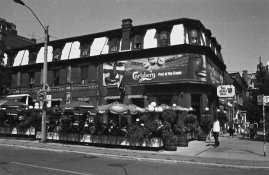
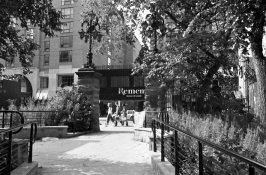
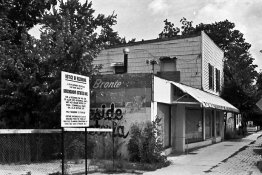
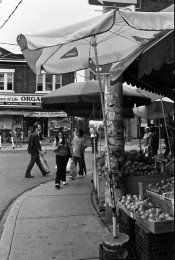
I was out shooting this past weekend with a bright sunny day Saturday, was using classicpan 400 in my OM-4. I rate my film down to 200asa and I develop in 1:50 Rodinal for 11 minutes. This is the result I get (The Black Bull Tavern), almost too contrasty for me. Now to compare I shot (fruitstand) a few weeks ago on a hazy/ overcast day with a Spotmatic F same film, same rating, nicer results.

I am not using any coloured glass (yellow, orange, red) on my lenses, just UV/haze filters. Any secret to taming this film?

Bill
 

Attachments

  • Strolling.jpg
    Strolling.jpg
    81.8 KB · Views: 223
  • Black Bull.jpg
    Black Bull.jpg
    80.1 KB · Views: 223
I've just started to use this film and I think I'm probably going to give D-76 a whirl. Xtol will be my second choice. The first go around in HC-110 was to contrasty. Rodinal would be very similar.

The light in either photo was very different from each other. It appears the market shot was more overcast than the tavern. On bright sunny days I probably would not rate it at 200asa.
 
I'm having all sorts of problems getting it to behave. Rated the latest 6 sheets at 200, developed in R09 1:40 for 15 minutes @ 72 degrees, and the negatives are very thin.
 
Eric Rose said:
I've just started to use this film and I think I'm probably going to give D-76 a whirl. Xtol will be my second choice. The first go around in HC-110 was to contrasty. Rodinal would be very similar.

The light in either photo was very different from each other. It appears the market shot was more overcast than the tavern. On bright sunny days I probably would not rate it at 200asa.

The street shot was an overcast/hazy day while the tavern was cloudless skies. What should I rate the film at on super sunny days and how should I adjust the developing time? I am partial to Rodinal because I am quite used to playing with the formulations.
 
Dear Bill,

Try reducing your development time 15-20% for bright sunny days. At 200 you probably have plenty of exposure to make up for it.

Neal Wydra
 
I've similar experience with Classic Pan 400. I've found that 4-5 minutes in D-23 folowed 3-4 minutes in a 1.5% borax solution works to tame the contrast (see below). The film seems to me to be very sensitive to agitation. I seem to get best resutls with very minimal and gentle agitation regimens.

 
Uncle Bill said:
I was out shooting this past weekend with a bright sunny day Saturday, was using classicpan 400 in my OM-4. I rate my film down to 200asa
Is there a particular reason that you shoot this film at an EI of 200 rather than at its box speed? Have you determined this speed as a result of your own testing?
 
if you are going to compare photo's they should be shot of the same subject as close to the same conditions as possible, otherwise it is apples & oranges. Pat :D
 
I shoot at 200 as Classicpan 400 is only 400 asa under Tungstan light and is red spectrum sensitive at that speed in the early morning and evening.

On hazy/overcast days I have great results with the film pulled to 200 in 1:50 rodinal for 11 minutes. What I might do is I have a half roll I exposed yesterday under bright sunshine, I am going to finish it today and develop for nine minutes and see what I get.

Another experiment is not agitate every minute, maybe pull it out to two minutes.

Bill
 
The difference may in the meters, have you checked both camera with a gray card to see if they are reading the same? The spot has very basic center wighted meter, I don't what the metering pattern of the OM 4 is. My spots read within a 1/2 of my gosson meter which I use as my master meter, but the spots read much different than my newer 35s. One last thought is my 42 mm Pentex lens seem to have more inherent contrast than my new Sigma lens.
 
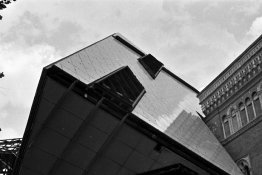
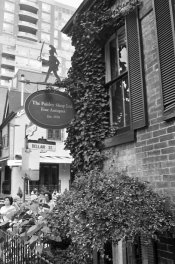
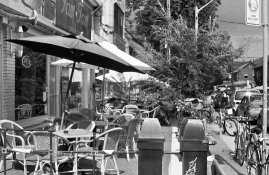
I scanned some shots from from my OM-1 which shares lenses with the OM-4, it was developed in the same tank with the same agitation as the hyper contrasty roll and these are the results. You could be right, the meter might have something to do with it. The Spotmatic F and OM-1 meter technology are not far off, while the OM-4 is much more sosphisitcated in what it can do.
I should try a roll through a Spotmatic on a sunny day and see what I get.

Bill
 

Attachments

  • Old and New.jpg
    Old and New.jpg
    60.1 KB · Views: 125
  • Paisley Shop.jpg
    Paisley Shop.jpg
    104.8 KB · Views: 131
  • Patio Tam Tam.jpg
    Patio Tam Tam.jpg
    112.1 KB · Views: 134
  • Towards Bloor St..jpg
    Towards Bloor St..jpg
    116.4 KB · Views: 125
This may be one of the few occasions where Diafine is ideal as a general purpose developer! :wink:

Lachlan
 
I don't develop J&C 400 in Rodinal, so I don't have a specific recommendation, but this seems just like a straightforward testing issue that would apply to any new film/developer combination. Test the film speed to be sure you're getting good shadows but not overexposing and pushing the highlights into the shoulder. If it's too contrasty once you've established the film speed for good shadow detail, then adjust the development time for the highlights.
 
Uncle Bill said:
I shoot at 200 as Classicpan 400 is only 400 asa under Tungstan light and is red spectrum sensitive at that speed in the early morning and evening.
???

I have never heard of a film that has a higher tungsten than daylight speed.
In fact, I doubt that one could be made. Even Ilford publishes only a single speed for their SFX film which has a true extended red sensitivity. Typically, a manufacturer will give two speed ratings if they are measureably different. J&C gives only a single speed for this film.
 
This is one of those things I am going to fool around with for a while. The meter with the OM-4 is not the issue as I shot fuji Superia, Ilford Delta, adox 100 through it. I sent an email off to John at JandC and we'll see what he has to say.

Bill
 
You are most likely overdeveloping your film.

When you photograph a low-contrast scene, it comes out looking fine, because the high values are still on the straight-line portion of the film's development curve.

But when you photograph a high-contrast scene, one that has dark values in shade and light values in sun, the high values get pushed onto the shoulder, resulting in the classic "soot and chalk" effect.

You need to do exposure and development tests, based upon the extremes (expose for a low value in shade, develop for a high value in sun), then recognize that on a hazy day, you may want to develop the film a bit longer to expand the natural contrast of the scene, or not, depending on the mood you're looking to convey.
 
So should I cut my developing time with a Classicpan 400 roll exposed on a sunny day vs going for 11 minutes for a hazy overcast day? Or, should I cut back on agitation? I have one roll I am going to play with tonight, I am toying of going down to nine minutes instead of 11.

Bill
 
Just some thoughts...

What kind of lenses do you use? A Spotmatic with say, a Takumar f1.4 50 with single coating (a bit lower in contrast, with more light in the shadows) will behave different from the Olympus optics which may be multicoated (?) (higher contrast, less information in your shadows).

If you use glasses, the Spotmatic (only one of the cameras I am familiar with) might leak light into the finder and meter may then be a bit off.
 
Last edited by a moderator:
At this point I have no clue, the above photos I took with an OM-1 with same optics as the OM-4. The Patio shot was taken when the sun was out from behind the clouds and processed at 11 minutes. So I don't think its the optics (yet).

To really experiment I am going to use either my Leica M3 or Asahi Pentax model K on the weekend, both cameras are roughly the same vintage (within three years) and see what I get. The lenses on them were considered state of the art for the time.

Bill
 
To Update

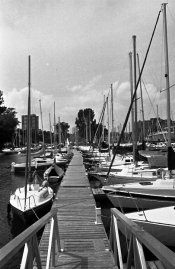
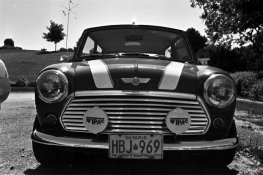
I processed a roll for 11 minutes but agitating 5 seconds every three minutes. Well, not bad, I can do better than this. My next roll of bright sunshine exposures on Classicpan, I am going to dial back to 9 minutes. What amazes me is the level of contrastiness without an orange and yellow filter.
 

Attachments

  • Lakeside Notice.jpg
    Lakeside Notice.jpg
    105.9 KB · Views: 116
  • Sail Boats 1.jpg
    Sail Boats 1.jpg
    84.9 KB · Views: 119
  • Old Cooper.jpg
    Old Cooper.jpg
    78.2 KB · Views: 131
My challenge is finding the stuff in Toronto. The other option is trying HC110 dilution b.

Bill
 
I started rating the classic pan at 320 which is probably its true film speed, I did rate at 200 but found due to the overexposure the negs and finished print were to grainy and I knew the film could be better than this also controlling shadow and hilight detail took a lot of work on the finished print the 100 ISO is good at EI 64.
So I rated at 320 on the 400 iso and used an orange filter good cloud definition without out blacking out the fore and mid ground This film responds very well in Pyro
 
I just developed some Classic 400 shot at 400asa and 1600asa. Souped it in HC110 dil B for the recommended times (n+1 on the 1600 stuff over and above the recommended time). I will have to scan the negs to see for sure but the 400asa ones look just a touch thin, but still very presentable.

If I get a chance I will post some scans tonight. When I get back from Dominica on the 23rd I will do some printing and see what they really look like. I will be shooting the Classic 400 underwater rated at 1600asa in an N90s enclosed within an Ikelite housing. Want to do mainly moody stuff so won't be using a flash. Should be interesting. I suspect D-76 or ID-11 will be a better developer for the push processing than HC110.

Like Dusty I think this stuff will sing in PyroCat-HD. That's mainly what I bought the film for as I found HP5 to not be so great in PC-HD. If experience means anything I think the rated asa of 400 will be about right in pyro. Tests to follow trip.
 
What amazes me is the level of contrastiness without an orange and yellow filter.

Filters have no effect on the overall contrast of a film. Consider two photos of a grey scale, one taken with a filter and one without. They will be identical. Using a filter will not change the steps in the scale. Overall contrast is controlled by development.

However, a filter can affect the contrast between certain areas in a particular negative. All this can depend on the filter color, the color of the ambient light, and the predominant colors in different areas. You will often hear, "Use a yellow filter, that will increase contrast." What is meant is that a yellow filter will increase the contrast between the shadow areas of a negative and the directly lit portions. This effect is dependant on scattered light from a blue sky which will cause shadows to have a larger percentage of blue than other areas. Therefore, the yellow filter will render them darker than the more fully lit areas. Without a blue sky there is no effect. Conversely, a blue or green filter is said to "open up the shadows."
 
Photrio.com contains affiliate links to products. We may receive a commission for purchases made through these links.
To read our full affiliate disclosure statement please click Here.

PHOTRIO PARTNERS EQUALLY FUNDING OUR COMMUNITY:


Ilford ADOX Freestyle Photographic Stearman Press Weldon Color Lab Blue Moon Camera & Machine
Top Bottom