• Welcome to Photrio!
    Registration is fast and free. Join today to unlock search, see fewer ads, and access all forum features.
    Click here to sign up

"classic" emulsions?

Valencia

A
Valencia

  • 2
  • 1
  • 64
Tied to the dock

D
Tied to the dock

  • 4
  • 0
  • 98

Recent Classifieds

Forum statistics

Threads
203,096
Messages
2,849,760
Members
101,664
Latest member
logan.perrin
Recent bookmarks
0

Shootar401

Member
Allowing Ads
Joined
Feb 25, 2012
Messages
399
Location
New England
Format
Large Format
Can anyone recommend a 50 or 100ASA B&W 120 film that accurately represents tone and grain in film found in the 20's and 30's? Other than looking on the bay and buying film of that era and and taking a chance of it not exposing or developing correctly.

Thanks
 
None or very very few exist today.

"Classic" emulsions were orthochromatic (green and blue sensitive) and todays are panchromatic which includes red sensitivity.

PE
 
Thanks for the info, I'll pick up 2 rolls each of the Rollei and Adox, and I'll see which ones look better to me.

I plan on shooting a roll in my 645, then move it over to a folding Brownie for some shots. I have a idea for a 30's style photoshoot using the brownie, just taking care of some details before the shoot.
 
Maybe the best approach would be to use a medium speed film, say FP4+, and use filtration (minus red) to get that 'ortho' look?
 
Efke emulsions are supposedly virtually unchanged from 50-s. Still closer to 30's than sterile t-grain.

Actually EFKE emulsions are far removed from the Classic thick emulsions of the 20's and 30's they were way ahead of their time when released in the early 1950's.

Can anyone recommend a 50 or 100ASA B&W 120 film that accurately represents tone and grain in film found in the 20's and 30's? Other than looking on the bay and buying film of that era and taking a chance of it not exposing or developing correctly.

Thanks

The 20's & 30's look of films of the era with regards to tonality etc is more to do with the use of uncoated lenses and quite different ways of working in terms of exposure and processing. As both Orthochromatic and Panchromatic films were readily available by 1910 photographers in the 20's & 30's had a wide choice of films to work with and it's not really this factor.

It was an era before the general use of exposure meters and films were exposed at approx half the speeds we'd use now and negatives were processed to much higher densities and contrasts. (ASA/BS speeds were doubled in the early 60's when new standards were adopted). 20's& 30's negatives don't print as well on modern papers and the dgree of enlargement used was much smaller, if you see pre-WWII contemporary prints of work by photographers like Kertesz they have a very different quality (small and jewel like) to modern prints made much later off the same negatives.

So it's not as simple as just the film, the use of uncoated lenses and the way you expose and process would be important as well. In terms of grain modern films are so far advance you's need to use a 400 ISO film to be in the ball-park
 
Like Ian Grant said grain wise all modern 100 ASA films have less than emulsions from the 1920's and 30's. So using a 400Iso film like Kentmere 400 or Lucky SHD 400 might come closer grain wise than say Efke 100. Lucky films have a pretty much nonexistant antihalation layer, though films from the 20's and 30's had one it was less effective than todays AH layer.

Another thing is Nostalgia even using a film, camera and lens from the 1920's to 30's won't make a photograph look like it was made in this time period since the cityscape and fashion has changed dramatically and often what we like about the photos from the 30's is the fashion and old cityscape and not the look of the film.

To create a photograph looking like it was made in the 1930's you have to photograph the subject in 1930's surroundings. Old houses/streets man/woman dressed in classic clothing (e.g. trench coat or a dress made in the style of the 30's, all still available from current fashion houses)

Take HCB shot of the man jumping over a puddle this image is timeless and doesn't scream 1930's neither in look nor in fashion, one could make a photograph that looks like HCB's even today all that is required is the same foggy lighting.

Dominik
 
- Use a strong blue or cyan filter to make any panchromatic film behave as if it were orthochromatic.
- Try to get a Forte 400 film
- Overexpose.
- Overdevelop in Rodinal.
- You get grain galore, strange tones, and a white sky. That's what you asked for. Don't forget to add some black and white dots with a felt pen to mimic 1920s emulsion quality.
 
To create a photograph looking like it was made in the 1930's you have to photograph the subject in 1930's surroundings. Old houses/streets man/woman dressed in classic clothing (e.g. trench coat or a dress made in the style of the 30's, all still available from current fashion houses)

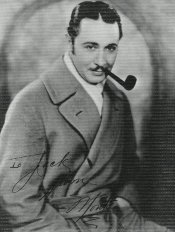
Don't forget great hairdo and accessories:

Blue01.jpg
 
CMO especially the pipe since smoking is forbidden pretty much everywhere a classy pipe just oozes bygone times. :smile:

Dominik
 
Yes, and I am a chain non-smoker.

But the amount of bygone memories depends on what you put into the pipe :cool:

Of course, the world looked different in other countries. Only after the war styles and fashion spread all over the western world.
 
The thickness of the older emulsions combined with overexposure produced more diffraction in negative. This gave them a certain luminosity that modern emulsions do not have.

Orthochromatic films can cause very poor skin tones particularly with women where they emphacize every blemish. Red lipstick would show as black so special cosmetics were made that were green and not red. This produced a normal gray tone.

Another point is that studio photographers took more care in lighting their subjects than today. Todays photos can be very flat and lacking in dimension. Study examples of the work of Holllywood photographers to see how they used light effectively.
 
Photrio.com contains affiliate links to products. We may receive a commission for purchases made through these links.
To read our full affiliate disclosure statement please click Here.

PHOTRIO PARTNERS EQUALLY FUNDING OUR COMMUNITY:


Ilford ADOX Freestyle Photographic Stearman Press Weldon Color Lab Blue Moon Camera & Machine
Top Bottom