
• Welcome to Photrio!
    Registration is fast and free. Join today to unlock search, see fewer ads, and access all forum features.
    Click here to sign up

Clarifying measurements

A long time ago...

A
A long time ago...

  • 0
  • 0
  • 17
Boy and teddy, 1920's.jpg

A
Boy and teddy, 1920's.jpg

  • 1
  • 2
  • 39

Recent Classifieds

Forum statistics

Threads
201,202
Messages
2,820,388
Members
100,582
Latest member
v1photos
Recent bookmarks
0

Photo Engineer

Subscriber
Allowing Ads
Joined
Apr 19, 2005
Messages
29,018
Location
Rochester, NY
Format
Multi Format
One of the most frequent questions I get about scratch mixing B&W chemicals is "how much X hydrate do I use if the formula specifies the anhydrous salt" or the reverse, "how much X do I use if the formula specifies the hydrate salt".

This is an easy question and yet hard at the same time. I'll do the easy part first.

Lets say that the formula uses 25 grams of Sodium Sulfite anh and you have the monohydrate. Well, you use 28.6 grams then.

If your formula calls for 25 grams of Sodium Carbonate anh and you have the monohydrate, then you use 29.2 grams, but if you have the decahydrate you use 43.9 grams.

How did I get that? There is a generic formula for it.

Going from ANH -> Hydrate you need a factor x ANH molecular weight.
Going from Hydrate -> ANH you need a factor X ANH molecular weight.

Whoa, where do I get molecular weight and factor? MW can be looked up on the internet and factor can be calculated. Here is how.

In the formulas below, using Kirk's suggestions...

MW = molecular weight, sometimes called formula weight
ANH = anhydrous form
HYD = hydrated form

ANH -> HYD

(MW ANH + (number of atoms of water x 18)) / MW ANH -- So, for a monohydrate the number of atoms of water is 1 and for the sulfite example above the MW is 126. The factor is then 144/126.

HYD -> ANH

MW ANH / (MW ANH + (number of atoms of water x 18)) -- so for a monohydrate to ANH conversion the factor is 126/144.

See how easy?

Now, here is the hard part.

If you consider this conversion to be important enough to ask how to convert, then you are talking about 25 grams of sulfite vs 28.6 grams of sulfite in the example I used. Easy to do on a scale, but not so easy with spoon measure. The error in spoon measures, by my direct lab experimentation is on the order of 20% either way due to crystal type and smoothing off a level spoonful, and that would mean that if you tried the above, you might get from 20 - 30 grams of sulfite no matter which salt you used.

Since sulfite controlls developer keeping and also sharpness and grain when used in film developers, I hardly think you want to mess with all of that hard work and lose it by making a 20% error, so this is the hard part.

Do you weigh out the exact number of grams or not? I doubt if there is a spoon set accurate enough to give either one of the sulfite values above, so how do you get there from here. The best you can do with a set of spoons is what they deliver when level. This may not be any of the values you need for your formula.

If the difference between anhydrous and monohydrate salts is important, then you must weigh your chemistry. If it is not, then use spoons! (again, provided that the spoons give you the values you might need, which is problematical)

Considering the number of questions I have read on both of these topics (types of salts and use of spoons and cups), I think that this is an important issue that only the individual artist can answer.

Remember, you are the judge of your own work, but I also read here of people saying this film isn't good or that film isn't good, and I also read about the complaints of lab service today due to sloppy lab techs. Do you want to be counted among them?

Do what works for you, but remember that the results are due to choices you make.

PE
 
Last edited by a moderator:

Kirk Keyes

Member
Allowing Ads
Joined
Jun 17, 2004
Messages
3,234
Location
Portland, OR
Format
4x5 Format
Just to clarify, I would edit your post to modify the formulas to have more brackets to clarify the equations:

(MW ANH + (number of atoms of water x 18)) / MW ANH

and:

MW ANH / (MW ANH + (number of atoms of water x 18))

And to clarify a bit more:
MW = molecular weight, sometimes called formula weight
ANH = anhydrous form
HYD = hydrated form

Perhaps someone that knows html better than I can figure out a way to make a table of common conversions (gravimetric factors) and post them...

And maybe we can make a sticky post out if this, as there really are a lot of threads about this subject.
 

gainer

Subscriber
Allowing Ads
Joined
Sep 20, 2002
Messages
3,699
Just to clarify, I would edit your post to modify the formulas to have more brackets to clarify the equations:

(MW ANH + (number of atoms of water x 18)) / MW ANH

and:

MW ANH / (MW ANH + (number of atoms of water x 18))

And to clarify a bit more:
MW = molecular weight, sometimes called formula weight
ANH = anhydrous form
HYD = hydrated form

Perhaps someone that knows html better than I can figure out a way to make a table of common conversions (gravimetric factors) and post them...

And maybe we can make a sticky post out if this, as there really are a lot of threads about this subject.

I usually do the table in EXCEL and convert to jpg. Then you can post it as an attachment.
 
OP
OP
Photo Engineer

Photo Engineer

Subscriber
Allowing Ads
Joined
Apr 19, 2005
Messages
29,018
Location
Rochester, NY
Format
Multi Format
Patrick;

I thought you might get more out of this technical explanation than EXCEL and .jpg file formats.

PE
 

gainer

Subscriber
Allowing Ads
Joined
Sep 20, 2002
Messages
3,699
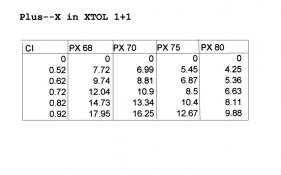
I had a pretty good handle on the other stuff. I thought I was helping you by suggesting a method of presentation other than HTML. In fact, when I went to check myself, I found a few extra steps were necessary. I had to print the EXCELL spreadsheet, scan the print into Paint Shop Pro or equivalent, add the title and the column dividing lines, THEN save it in JPG format. It all took about 10 minutes. As an example, I used a spreadsheet for PX in XTOL that I had handy.
 

Attachments

  • PX-XTOL 1+1.jpg
    PX-XTOL 1+1.jpg
    55.1 KB · Views: 126
OP
OP
Photo Engineer

Photo Engineer

Subscriber
Allowing Ads
Joined
Apr 19, 2005
Messages
29,018
Location
Rochester, NY
Format
Multi Format
I would do it in Visual BASIC or Visual C++ and give you a tidy EXE Windows file with the run-time DLL myself. But I don't see how your posted thumbnail helps us here with the OP.

PE
 
OP
OP
Photo Engineer

Photo Engineer

Subscriber
Allowing Ads
Joined
Apr 19, 2005
Messages
29,018
Location
Rochester, NY
Format
Multi Format
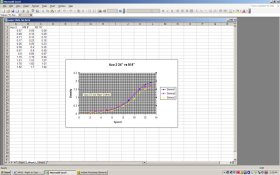
I forgot to add that you can copy a spreadsheet to the clipboard directly and then save it as a JPG file for posting.

Or, you can insert it into this document directly.

The attached is my spreadsheet on reflection densities measured on contact papers and the resulting graph. It compares Azo paper with 2 grades of my contact emulsion.

PE
 

Attachments

  • spreadsheet demo.jpg
    spreadsheet demo.jpg
    88.1 KB · Views: 109

Kirk Keyes

Member
Allowing Ads
Joined
Jun 17, 2004
Messages
3,234
Location
Portland, OR
Format
4x5 Format
OK - so how about you guys post a gravimetric factor chart...
 
OP
OP
Photo Engineer

Photo Engineer

Subscriber
Allowing Ads
Joined
Apr 19, 2005
Messages
29,018
Location
Rochester, NY
Format
Multi Format
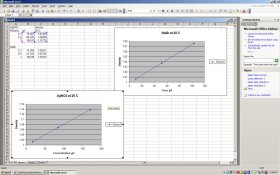
You mean something like this?

Nah, I'll leave that to the student (or Patrick).

Hint, the Silver Nitrate algorithm is 8th order even if it does not look that way. And, if you peek hard, you can see what I've been doing lately in EXCEL.

:D

PE
 

Attachments

  • densities.jpg
    densities.jpg
    90 KB · Views: 126

gainer

Subscriber
Allowing Ads
Joined
Sep 20, 2002
Messages
3,699
What you didn't tell us was how you know if what you bought as anhydrous is still anhydrous, and what do you do if you don't know? You should tell the troops that if you put it in an oven at 305 F for a while, it will be anhydrous, whether it started out at any other state of hydration.

I didn't find monohydrated sodium sulfite in my CRC handbook. How careless of them. But whatever it is, it will be anhydrous if you heat it to 212 F for a while. I don't know how long it will take, but if you heat a big enough pot of it, you can weigh the whole mess with a kitchen scale from time to time and note when it stops losing weight.

The carbonate comes in a number of states of hydration, from 0 to 10 moles of water per mole of anhydrous, but they all "boil down" to the same thing. So does sodium bicarbonate.
 

Kirk Keyes

Member
Allowing Ads
Joined
Jun 17, 2004
Messages
3,234
Location
Portland, OR
Format
4x5 Format
You mean something like this?

NO, actually I meant gravimetric conversion factors for hydrate to multihydrate to anhydrous. You know, like in your original post...

But I do like what you posted - I think you mentioned them a week ago or so in the emulsion forum.
 

Kirk Keyes

Member
Allowing Ads
Joined
Jun 17, 2004
Messages
3,234
Location
Portland, OR
Format
4x5 Format
What you didn't tell us was how you know if what you bought as anhydrous is still anhydrous, and what do you do if you don't know?

If you buy chemicals of a known grade, you should be pretty certain you are getting what you paid for. I've used a lot of different chemicals over the last 20 years in the lab and I can't think of any time when a bulk chemical was not what it was claimed on the label.

Now if you are buying laundry detergent or pool chemicals, you may not have as much certainty as to what you are getting. There's no obligation for someone selling pH-plus that they are selling you sodium carbonate of a certain hydration of water. It's not that critical for that application.

So if you are buying chemicals of known quality, then you don't need to learn little tricks to drying out chemicals. And, if you only buy what you can use in a reasonable time, then you should not have to worry about your chemicals ageing or changing hydration. And finally, keep the lid on the bottle tight!
 

gainer

Subscriber
Allowing Ads
Joined
Sep 20, 2002
Messages
3,699
If you buy chemicals of a known grade, you should be pretty certain you are getting what you paid for. I've used a lot of different chemicals over the last 20 years in the lab and I can't think of any time when a bulk chemical was not what it was claimed on the label.

Now if you are buying laundry detergent or pool chemicals, you may not have as much certainty as to what you are getting. There's no obligation for someone selling pH-plus that they are selling you sodium carbonate of a certain hydration of water. It's not that critical for that application.

So if you are buying chemicals of known quality, then you don't need to learn little tricks to drying out chemicals. And, if you only buy what you can use in a reasonable time, then you should not have to worry about your chemicals ageing or changing hydration. And finally, keep the lid on the bottle tight!

So you don't worry about unknown things that you think you know, and you don't explain why the CRC Handbook of Chemistry and Physics says hydrated Na2SO3 has 7 molecules of water and you think that using the math to convert what you think you have to what you want is better than simply heating to make sure that what you have is what you want. And then you think I don't know what I'm doing when I use teaspoons of known volume to measure out developers for use, not for lab research, when I can and have demonstrated that the margin for error in most working developers is greater than the probable error of the teaspoon measures. Very scientific.
 
OP
OP
Photo Engineer

Photo Engineer

Subscriber
Allowing Ads
Joined
Apr 19, 2005
Messages
29,018
Location
Rochester, NY
Format
Multi Format
Patrick;

I used a monohydrate as a simple example, not as a factual representation. It was meant as a single hydrate counterpoint to a multi hydrate salt in that example.

In fact, Sodium Sulfite Heptahydrate, Na2SO3.7H2O is unstable and rapidly decomposes into Sodium Sulfate, Na2SO4. Even the anhydrous salt is only about 97% pure. My handbook does allude to a monohydrate but gives no example nor any other information. I assume it to be unstable as well.

Basically, I think you should re-read the OP.

PE
 

gainer

Subscriber
Allowing Ads
Joined
Sep 20, 2002
Messages
3,699
I read it several times. I had no complaint about the way you calculated what you calculated. There are a number of states of hydration of sodium carbonate, including what is called washing soda but seems not to be. I think it would be a service to us if you would post some simple way to determine whether what you buy is what you thought you bought. If you want the best purity of sodium carbonate, for example, perhaps you should buy the bicarbonate and heat the bejeezuz out of it. It is intended for human consumption as an antacid and for making biscuits and other edible things, and it is fun to watch as the gas makes little geysers while it is being heated. The net result is anhydrous.

It seems to me that everything you post these days in this forum is aimed at proving that measuring spoons are not sufficiently accurate for lab work. We know that. I never said they were. I have, however, had enough experience with them to know that they give sufficiently repeatable results for the developers I use them for. It would be worthwhile for someone with appropriate equipment to do an analysis of sensitivities of developer activity to deviations in measurement of its various components. Now that would be a good task for someone with OCB.
 
Joined
Jan 21, 2003
Messages
15,710
Location
Switzerland
Format
Multi Format
:munch:
 

df cardwell

Member
Allowing Ads
Joined
Jul 16, 2005
Messages
3,357
Location
KY USA
Format
Multi Format
Or just look it up in Anchell & Troop.

With all the respect in the world,
A&T isn't the gold standard of accuracy.

We HAVE to take it upon ourselves to double check formulae;
in the manner of an urban legend, misprints and errors can become
gospel. Kodak, and Ilford, and Agfa/Ansco have always done a good job or documentation. Ed Lowe, of Edwal fame, left a vast amount of documentation.
Geoffrey Crawley, a remarkable career of genius and transparency.

In the age of the unaccountability of the Internet, however, a small flaw, a supposition, or wild-assed-guess, can become accepted as truth and NO good comes from that. I'm glad PE and Gadget have spelled out some of the basic conversion that help make it easy to function in the lab. Thanks.
 
Last edited by a moderator:

Mahler_one

Member
Allowing Ads
Joined
Oct 26, 2002
Messages
1,155
Thanks to all who took the time to post and then clarify the information above. Much appreciated.

Ed
 

Kirk Keyes

Member
Allowing Ads
Joined
Jun 17, 2004
Messages
3,234
Location
Portland, OR
Format
4x5 Format
So you don't worry about unknown things that you think you know, and you don't explain why the CRC Handbook of Chemistry and Physics says hydrated Na2SO3 has 7 molecules of water and you think that using the math to convert what you think you have to what you want is better than simply heating to make sure that what you have is what you want.

Why is it unknown that when I buy anhydrous sodium sulfite (or any other chemical that has a grade on it) that it is not truly anhydrous?

I think you are more likely to mess something up the more you muck around with it. And I can't recommend "heating the bejeezuz out" of anything. You really need to be careful when doing stuff like that. Heat your sulfite up too much and you wreck the sulfite. Heat your bicarb up too much and you make some carbonate, do it insufficently and you have a mixture of the two compounds. How does that help you now.

I buy anhydrous, I keep the lid on tight, and I store it in a dry location.

That's a lot more certain than hauling out the kitchen kemistry set and trying to make compounds and then not even testing them to verify that what you've made is what you think you've made...

Please don't start dissing the CRC Handbook...

And you're also saying that one of the foundations of chemistry is not trustworthy? Chemical formulas can not be trusted when converting states of hydration? I think you need to restudy your Intro Chemistry texts.
 

gainer

Subscriber
Allowing Ads
Joined
Sep 20, 2002
Messages
3,699
Kirk, I don't know how to say what I'm thinking in polite form, but I think you have absolutely no sense of the absurd, or humor as some call it. I was using the CRC handbook to diss YOU. My comment was to be taken as sarcasm. You do know what that is, don't you?

When did I ever present a formula that I had not used myself?

It is quite plain when heating the bicarb is complete. You can see that the little geysers are no longer forming. You can find out how much the weight has changed since you started heating. 2 molecular weights of bicarb produce 1 molecular weight of anhydrous sodium carbonate. Bicarb has no state of hydration, so all the weight change is due to loss of H2CO3 which passes off as HOH and CO2. The temperature of decomposition of the remaining Na2CO3 is very much higher. It melts at 851 C which is in the cherry red range.

Bejeezuz is a technical term I learned from "Caveman Chemistry" by Kevin M. Dunn. I would recommend it to you, but it may be a little too advanced.
 

gainer

Subscriber
Allowing Ads
Joined
Sep 20, 2002
Messages
3,699
PS: Maybe yours does, but mine does NOT list sodium sulfite monohydrate. For most of the purposes of ordinary mortals doing B&W photography, it wouldn't make a hill of beans difference if we used the imaginary monohydrate of sulfite.
 

gainer

Subscriber
Allowing Ads
Joined
Sep 20, 2002
Messages
3,699
I just came back from a colonoscopy. I'm not being nice to anyone for a while. Don't take it too personally. If you've ever had one you know it's not the procedure itself, it's the preparation for it. At least I learned that my 81-year-old colon is not what is making me feel old.
 
Photrio.com contains affiliate links to products. We may receive a commission for purchases made through these links.
To read our full affiliate disclosure statement please click Here.

PHOTRIO PARTNERS EQUALLY FUNDING OUR COMMUNITY:


Ilford ADOX Freestyle Photographic Stearman Press Weldon Color Lab Blue Moon Camera & Machine
Top Bottom