• Welcome to Photrio!
    Registration is fast and free. Join today to unlock search, see fewer ads, and access all forum features.
    Click here to sign up

Changing focal length with a diopter?

Forum statistics

Threads
201,659
Messages
2,828,096
Members
100,875
Latest member
Actionuy
Recent bookmarks
10

Donald Qualls

Subscriber
Allowing Ads
Joined
Jan 19, 2005
Messages
12,532
Location
North Carolina
Format
Multi Format
This just popped into my head the other day -- at present the only "modern" lens I own for 4x5 is a Compon 150 f/5.6 (which I've also used as a 265 f/13 with only the rear group -- with good results at least when stopped down). It occurred to me, though, that adding a diopter would shorten for focal length -- and since this lens has plenty of image circle, moving it closer to the film plane to focus infinity with a +1, +2, even +4 diopter (about all I've got the bellows compression for) might be practical.

I know the diopters I can afford are likely to degrade image quality by a small amount, but has anyone actually tried this? Does image circle run out faster than I think it will? Or would I be a lot ahead on image quality to use the 135 f/4.5 Tessar and 105 f/4.5 triplet (branded by the camera maker, covers at f/22 and focused to 12 feet or closer) that I already have?

Wait, I just remembered I have a 90 mm f/6.8 (IIRC) Angulon...
 

Maris

Member
Allowing Ads
Joined
Jan 17, 2006
Messages
1,594
Location
Noosa, Australia
Format
Multi Format
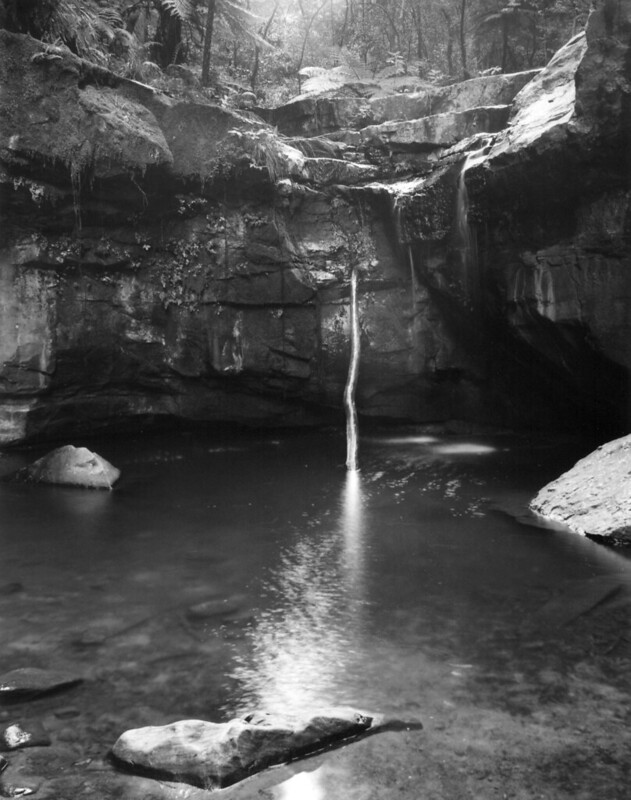
50095478998_2a2c18fd8e_c.jpg

Carnarvon Gorge, Moss Garden
Gelatin-silver photograph on Agfa Classic photographic paper, image size 24.7cm X 19.3cm, from a 8x10 Tmax 400 negative exposed in a Tachihara 810HD field view camera
fitted with a Fujinon-W 300mm f5.6 lens and a #1 close-up lens for a wider field of view.

There was only one place to stand for this one and I needed a space above the waterfall and the big foreground rock for a balanced composition.
The close-up lens left me with just enough image circle and f64 sharpened up the corners. Job done.
 

wiltw

Subscriber
Allowing Ads
Joined
Oct 4, 2008
Messages
6,689
Location
SF Bay area
Format
Multi Format
The issue is that the Dioter does not 'change FL'; it has a focal length of its own...


f(meters) = 1 / Diopter (D),

...this is the focal length equivalence of the closeup lens. If you hold the Diopter out in front of you, notice that it INVERTS the image. But if you put a converter lens (which alters the FL of the primary optic) out in front of you, it presents an image which its NOT INVERTED.
I just took out a Canon WA convertor and a Canon teleconvertor both meant to be screwed in front of a Canon Powershot G2 point and shoot, and BOTH present non-invertered images (of different sizes) of the scene thru the convertor.
 

OAPOli

Member
Allowing Ads
Joined
Sep 26, 2022
Messages
834
Location
Toronto
Format
Medium Format
Congratulations, you have invented the close-up filter :smile:

The focal length of the diopter can be computed as shown above. The combined focal length F will be 1/F = 1/f + 1/fD where f and fD are your lens and diopter focal length, respectively.
 

_T_

Member
Joined
Feb 21, 2017
Messages
428
Location
EP
Format
4x5 Format
I use diopters for lf quite a bit.

There are a few drawbacks. The image circle will usually be slightly smaller than ideally predicted, the ffd will usually be slightly shorter than ideally predicted.

With some lenses it will introduce a pretty strong curve to the plane of focus. Sometimes it will be worse with a single lens diopter design but sometimes an achromatic doublet diopter will cause worse field flatness, it depends on the design of the lf lens.

You might also see some chromatic aberration towards the corners of the image.
 

loccdor

Member
Joined
Jan 12, 2024
Messages
2,545
Location
USA
Format
Multi Format
Some diopters are meniscus lenses, some are plano convex, and some use multiple elements.
 

grahamp

Subscriber
Allowing Ads
Joined
Mar 2, 2004
Messages
1,767
Location
Vallejo (SF Bay Area)
Format
Multi Format
A 150mm prime with a +3 diopter close-up lens will get you a 103mm effective focal length. Assuming there is no vignetting, the angle of view will be unchanged in practice, and will be proportional to the focal length change. It will be around IC = 103/150. A bare positive diopter is likely to add aberrations, though
a yellow or green filter can help with chromatic aberration. What you actually get may be better or worse.

A lot depends on the format, the lens(es), and how much you can stop down. I do it sometimes to get my 135mm down to 106mm (-ish) using a +2 for use on a 2x3 camera. Easy enough to try.
 
Photrio.com contains affiliate links to products. We may receive a commission for purchases made through these links.
To read our full affiliate disclosure statement please click Here.

PHOTRIO PARTNERS EQUALLY FUNDING OUR COMMUNITY:


Ilford ADOX Freestyle Photographic Stearman Press Weldon Color Lab Blue Moon Camera & Machine
Top Bottom