

• Welcome to Photrio!
    Registration is fast and free. Join today to unlock search, see fewer ads, and access all forum features.
    Click here to sign up

Canon AE-1 Meter and Exposure Adjustment - Variable Resistor Functions

Parliament Square.

A
Parliament Square.

  • 1
  • 0
  • 75
Courtyard

A
Courtyard

  • 2
  • 5
  • 89

Forum statistics

Threads
203,335
Messages
2,853,159
Members
101,788
Latest member
Rooi
Recent bookmarks
0

Howie1922

Member
Allowing Ads
Joined
Sep 2, 2025
Messages
64
Location
Minnesota
Format
Medium Format
Hey Everyone!

I am working on an AE-1 that is underexposing in its Auto mode by 1-1.5 stops. I would like to adjust this setting so that camera exposes correctly for my customer. I believe the adjustment involves one (or more) of the 4 variable resistors show below:
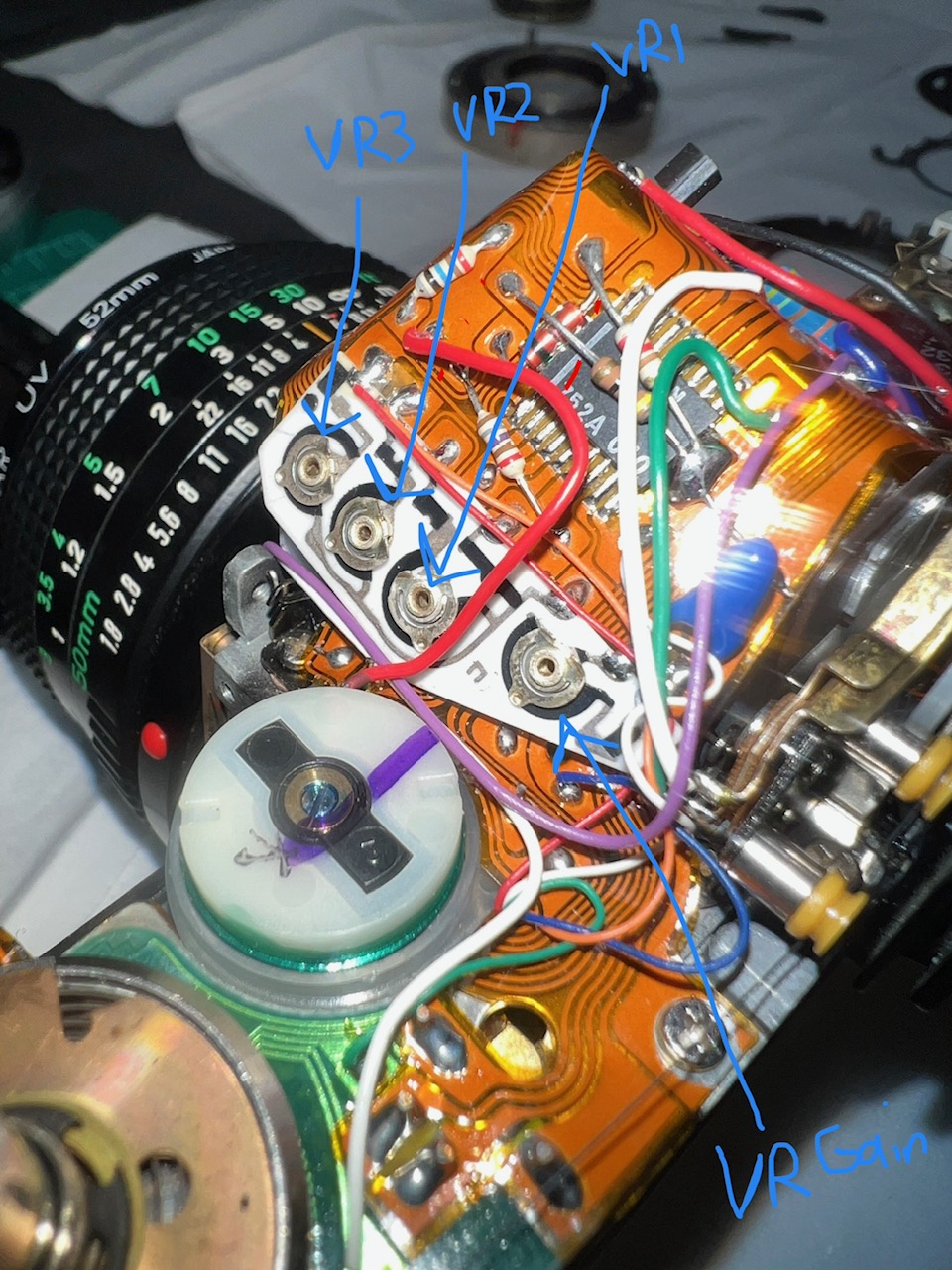
IMG_7190.jpeg


The camera craftsman article that I am referencing states that they are called:

VR1
VR2
VR3
VR Gain

Does anyone know what each of these variable resistors adjusts? The article goes into a little too much detail, and I'm looking for a simplified explanation. I haven't seen any other literature or videos that describe what these do either.

Thanks!
 
Based simply upon my own fundamental understanding of principles taught in high school Physics, I am guessing that the AE-1 employs what is known as as Wheatstone Bridge circuit in its meter, and the CdS cell of the camera is one of the four resistors employed in the Wheatstone Bridge circuit. So adjusting ONE of the three variable resistors (VR1, VR2, VR3) would be adjusted in order to achieve proper circuit balance (vs. the variable resistance due to light intensity of the CdS cell). Without seeing a circuit diagram, I cannot simply guess which one to adjust...it is best to have the guidance of a repair manual for the AE-1 telling the repair person which one to adjust in what circumstance. Is the camera powered properly with a 1.35V source during your evaluation of the meter accuracy?...deviation of Voltage CAN affect meter accuracy, dependent upon circuit design (the AE-1 might or might not be a Voltage-dependent design!)

edit: Per an AI-provided answer, "
The light meter in the Canon AE-1 is not a voltage-dependent design in the way older cameras were. While it requires a 6V battery to function, its electronic circuitry is regulated, meaning it does not rely on a precise 1.35V mercury battery for accuracy. ...
The AE-1 uses an SPC rather than older CdS (Cadmium Sulfide) cells. "
 
Last edited:
The article goes into a little too much detail, and I'm looking for a simplified explanation.

Sorry to be critical, but that sounds like a very shaky basis to start adjusting things.

1: Determine the probable cause of the wrong metering.
2: Resolve to the extent possible this cause.
3: Then determine whether re-calibration of the meter is necessary.
4: Calibrate as described in the service manual you apparently have.

I would NOT cut corners in this approach as you'd just be sticking a band-aid over the problem and you will likely end up making things worse. That's one thing if it's your own camera, but since you mention a client, this means you're in the process of messing up someone else's camera due to a lack of proper analytical approach.

I am guessing that the AE-1 employs what is known as as Wheatstone Bridge circuit in its meter, and the CdS cell of the camera
The AE-1 has an SPC meter cell and thus the topology you describe is not what's used here.
A further hint is in the 'Gain' label for one of the VR's.
 

Brief functional description of the light meter system is on page 12. A MOS log amp is used as a transimpedance amplifier to convert SPD current to linear voltage; this is further amplified by an opamp. Both the log and lin amps and the SPD are apparently integrated into IC4; see more detailed explanation on page 15 and further.

Adjustment procedure is discussed starting at page 40.

I'd start by verifying the voltages around IC4 to make sure these are as listed on page 61.

It would be nice if you could fine additional schematics that offer a more detailed view than the manual linked to above.

If any of the above sounds like Greek to you, IMO you should leave the metering system alone, return the camera to the customer and suggest them to offer it for repair by someone who has the know-how to troubleshoot such a metering system.
 

Brief functional description of the light meter system is on page 12. A MOS log amp is used as a transimpedance amplifier to convert SPD current to linear voltage; this is further amplified by an opamp. Both the log and lin amps and the SPD are apparently integrated into IC4; see more detailed explanation on page 15 and further.

Adjustment procedure is discussed starting at page 40.

I'd start by verifying the voltages around IC4 to make sure these are as listed on page 61.

It would be nice if you could fine additional schematics that offer a more detailed view than the manual linked to above.

If any of the above sounds like Greek to you, IMO you should leave the metering system alone, return the camera to the customer and suggest them to offer it for repair by someone who has the know-how to troubleshoot such a metering system.

Thanks for the insight, I plan on digging deeper tonight/tomorrow.

I don’t plan on touching any adjustments until I fully understand how it all works. If I can’t get there, I do plan on giving the camera back to my client. It’s not worth messing with if I don’t understand it.
 
Sorry to be critical, but that sounds like a very shaky basis to start adjusting things.

1: Determine the probable cause of the wrong metering.
2: Resolve to the extent possible this cause.
3: Then determine whether re-calibration of the meter is necessary.
4: Calibrate as described in the service manual you apparently have.

I would NOT cut corners in this approach as you'd just be sticking a band-aid over the problem and you will likely end up making things worse. That's one thing if it's your own camera, but since you mention a client, this means you're in the process of messing up someone else's camera due to a lack of proper analytical approach.


The AE-1 has an SPC meter cell and thus the topology you describe is not what's used here.
A further hint is in the 'Gain' label for one of the VR's.

In your experience, what other problems could cause faulty metering in the AE-1? I’d love to learn so I can troubleshoot better in the future.

The shutter speeds are good (1/500th-1/1000th have shutter capping though, I don’t use them to check the meter), and I checked that the lens I am using is giving me the proper apertures (I checked the T stops on my shutter tester).

I usually stick to mechanically controlled cameras, all the electronics in the AE-1 throw me off my game a little bit. I’m excited to learn more though!
 
Based simply upon my own fundamental understanding of principles taught in high school Physics, I am guessing that the AE-1 employs what is known as as Wheatstone Bridge circuit in its meter, and the CdS cell of the camera is one of the four resistors employed in the Wheatstone Bridge circuit. So adjusting ONE of the three variable resistors (VR1, VR2, VR3) would be adjusted in order to achieve proper circuit balance (vs. the variable resistance due to light intensity of the CdS cell). Without seeing a circuit diagram, I cannot simply guess which one to adjust...it is best to have the guidance of a repair manual for the AE-1 telling the repair person which one to adjust in what circumstance. Is the camera powered properly with a 1.35V source during your evaluation of the meter accuracy?...deviation of Voltage CAN affect meter accuracy, dependent upon circuit design (the AE-1 might or might not be a Voltage-dependent design!)

edit: Per an AI-provided answer, "
The light meter in theCanon AE-1 is not a voltage-dependent design in the way older cameras were. While it requires a 6V battery to function, its electronic circuitry is regulated, meaning it does not rely on a precise 1.35V mercury battery for accuracy. ...
The AE-1 uses an SPC rather than older CdS (Cadmium Sulfide) cells. "

I can try and find the circuit diagram later and post it to see if that helps.
 
IMO every AE-1 left the assembly line being adjusted by conscientious employees using purpose-made and accurate calibration equipment.
What I'm getting at is that the root cause of improper exposure is probably not a mis-adjusted potentiometer (unless a wannabe repairman was inside before). Maybe oxidation of the wiper of one of the VR*? Or a trivial cause like a broken flex?

In addition to the document linked to by @koraks I have three docs in my computer, all addressing assembly, repair, and adjustment of the AE-1:
  • A document from Camera Craftsman, 72 pages
  • An article from SPT journal, 8 pages
  • A document from NatCam, 118 pages
Since they "weigh" up to 50MB, I believe I can't attach them here. Send me a PM if you are interested.

 
Photrio.com contains affiliate links to products. We may receive a commission for purchases made through these links.
To read our full affiliate disclosure statement please click Here.

PHOTRIO PARTNERS EQUALLY FUNDING OUR COMMUNITY:


Ilford ADOX Freestyle Photographic Stearman Press Weldon Color Lab Blue Moon Camera & Machine
Top Bottom
