• Welcome to Photrio!
    Registration is fast and free. Join today to unlock search, see fewer ads, and access all forum features.
    Click here to sign up

Calibrating dichroic head for ILford Multigrade

Recent Classifieds

Forum statistics

Threads
203,404
Messages
2,854,164
Members
101,819
Latest member
Mark J Tudyk
Recent bookmarks
0

HTF III

Member
Allowing Ads
Joined
Apr 18, 2013
Messages
133
Format
Multi Format
Firstly, please don't laugh because I'm dragging out equipment made in 1972 and daring to make it work.I have this 1972 Beseler PM2 Color Analyzer in pristine cosmetic condition. Possibly it would need new filter capacitors in the power supply, but for now, I want to perform an experiment. I have a Beseler 67C with colorhead and I want to see if I can get the analyzer to help me jive my dichroic filtration to duplicate the filtration that my Ilford Multigrade filter set would give. If that makes sense.
I've researched this on the old APUG threads and someone included an Ilford publication discussing this matter. In that publication there were perhaps 3 systems--a Durst, a Kodak, and Meopta, I believe. From what I could gather, my Beseler was listed under the Kodak classification.
I may be missing something here. But I'd still like to play with this analyzer and see if it will match the dichroic to the gelatin filters. Thanks.
 
I have based my calibration on this article:

http://www.butzi.net/articles/vcce.htm

I use a two-tube VC head, Aristo VCL4500, but the principle is the same.

It might seem like a lot of work, but it's not bad. One session in the darkroom with a Stouffer Transmission Step Wedge and a bit of arithmetic with a spreadsheet and you're done.
 
Thank you. I don't have a 31 step Stouffers, but I do have about a 20 step one. But while I've got you on the line, how compatible is a set of old Polycontrast filters to a set of Ilfords? Anybody know?
 
It's getting on in years for electronic equipment though. I really ought to find a repair manual and go through and check voltages. Caps get leaky and resistors change value. I haven't opened it up for a look-see to find out what's in it. It's still a virgin. Nobody's ever opened it up and tinkered with it.
 
Firstly, please don't laugh because I'm dragging out equipment made in 1972 and daring to make it work.I have this 1972 Beseler PM2 Color Analyzer in pristine cosmetic condition. Possibly it would need new filter capacitors in the power supply, but for now, I want to perform an experiment. I have a Beseler 67C with colorhead and I want to see if I can get the analyzer to help me jive my dichroic filtration to duplicate the filtration that my Ilford Multigrade filter set would give. If that makes sense.
I've researched this on the old APUG threads and someone included an Ilford publication discussing this matter. In that publication there were perhaps 3 systems--a Durst, a Kodak, and Meopta, I believe. From what I could gather, my Beseler was listed under the Kodak classification.
I may be missing something here. But I'd still like to play with this analyzer and see if it will match the dichroic to the gelatin filters. Thanks.

I have done that experiment, but the color meter readings I got through the high grade Ilford Filters (4 and above) were not accurate. I suspect that is due to a sharp cutoff in the spectrum on those filters. As you have probably noticed, the Ilford #5 filter is not the same color as the magenta filter in a dichroic head, though they should give the same contrast grade. Problem is your PM2 probably won't read those high-contrast 'non-magenta' filters correctly. Try it and see.
 
All the information is on our website :

Simon ILFORD Photo / HARMAN technology Limited[/QUOTE
I had researched this on APUG before taking out this new thread and found this link (below). But I was unclear. So, Simon Galley, since I am using a Beseler 67 Dichro, does this mean I pick out my listing under the Kodak category? And if so, a complaint about my enlarger is that it is too bright. When printing color, I have to throw a lot of cyan into it and run up my magenta and yellow to keep proportions, to lengthen exposure time. Assuming I've interpreted the Ilford information correctly, will this work here too? I wonder how accurate these charts are from one model of a certain make to another.
I have a couple sets of Multigrade filters, but no matter how carefully you handle them, sooner or later they become something you don't feel comfortable holding under the lens. And a last question while I've got you on the line: I've got a set of Kodak Polycontrast filters in the little plastic yellow storage box. Are they compatible at all with Multigrade? Thank you. Here's the link from an old APUG thread.:
Dead Link Removed
 
All color heads, even same model of same brand, are different, and you don't need to match the filtration against a set of filters, you need to match the filtration against the paper's ISO R.

Start with the recommended filtration for all grades and using a stouffer determine the ISO R, then you will know if you need more or less for each grade. The idea is matching against a evenly distributed contrast range, not against what comes up from the filters.

Talking from memory, on 21 steps tablets each step is half stop. There are 30 R units per stop so ISO R will be dmax-dmin x 15 (numbers on tablet). Is not super-precise but it will put you on track quickly and you can refine later. The key is having a pure white in the strip. If you have a densitometer choose 0,04logD for dmin, proof for dmax and use 90% of it as dmax. I should say again that I'm talking from memory, so check for the right figures on available literature.
 
Last edited by a moderator:
After having studied the Ilford paperwork (repeated below), The Company sure doesn't show a lot of enthusiasm for using colorheads to replace filters. I guess I have to agree with them. Still, the biggest part of me tells me I need to pay attention to getting the negative right in the first place. Conventionally, the idea is to use grade 2 for everything. I'm going to tinker with this to at least get a good grade 2 on the colorhead, just to cut out reaching for a filter, flipping through the little tabbed filebook every blasted time. That gets old And since #2 will spend the most time out of the protective file, it'll be the first one that gets ruined. Then the whole book is no good. It's an extra step I could do without
 
Last edited by a moderator:
FWIW, I rarely used the specific grade "equivalents" when I switched from discrete, under the lens filters to using a colour head on my Beseler 67.

The chart referred to on Ilford's site helps you at first, because it gives you a feel for how much adjustment is needed to make a meaningful change, but the speed matching is usually of marginal value, because it is dependent on matching a particular mid-tone, and the mid-tone I want to match varies from negative to negative.

The great advantage of the dichroic head is, IMHO, its ability to supply an almost infinite variety of fine adjustments to contrast.

I'd suggest to the OP that he/she start with the suggested setting for grade "2" from the Ilford technical publication (using the Beseler/Kodak numbers) and a negative of known "average" contrast. And then tweak from there, if necessary.

EDIT: Just to make sure that we are talking about the same thing, this is one of the publications I am referring to: http://www.ilfordphoto.com/download.asp?n=782&f=2010628932591755.pdf

The paper also includes a slip with the same information.
 
Thank you Matt. I neglected the link in my last post, which is the same Ilford publication. At this moment and for the next few nights I am making my tests. Some with negatives, some with a 21 step Stouffers. This post is just an aside in the meantime to ponder that the price of the 67 Dichro bulb is something to consider in this attempt to switch from the standard Beseler 67C head to the color head. I wonder how long these dichro head bulbs last and if they can take thermal shock well from repeated on-off cycling like this. For instance, flip a slide or movie projector on and off a few times and you'll blow the bulb. I wonder if these dichro bulbs can take the punishment. At any rate, maybe I'd better order a spare or 2. Setting up the kitchen to do darkroom and then having a dead bulb would be annoying.
 
I found that if I used the internet sources for the bulbs the price went down significantly.

I never had to replace my bulb, after I bought a couple of backups (naturally). I would think though that, even though I had my enlarger on a moveable cart, the bulb would be less subject to physical shock then bulbs in slide and movie projectors. And I think that physical shock is a way more important factor than thermal shock when it comes to use in an enlarger.

My Beseler 67 is currently in storage - I switched to an Omega D6 with an Ilford Multigrade head when one came available on local Craigslist. I would prefer, however, to have both installed in a full time darkroom, because there are real advantages to each enlarger.

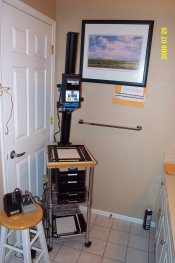
EDIT: See below for a photo of my Beseler 67 with the colour head "in action" in my bathroom/temporary darkroom. Now just imagine how much larger the Omega D6 is!
 

Attachments

  • Beseler67.JPG
    Beseler67.JPG
    702.9 KB · Views: 156
Last edited by a moderator:
:pouty:
Setting up the kitchen to do darkroom and then having a dead bulb would be annoying.

Having used almost every light source I don't find dichroic bulbs in the enlarger particularly weak, in my experience they last about the same than home ones. Also, I've used color head filtration and over the lens, also under the lens filters. No differences whatsoever except for the 4 1/2 - 5 grades which looks more hard with filters.
 
Id suggest that the OP has a look at Ralph Lambrecht's Darkroom Magic site as well. Ralph very kindly makes available his research into dual filtration and balancing exposure. It is the case that the Ilford dual filtration figures differ slightly from Ralph's own if I recall correctly but more importantly Ralph gives fstop corrections( in fractions of fstops) needed to achieve balance as the dual filtration numbers fail to achieve exact balance by themselves although the differences over say grades 2.5 to 3 are fairly small.

Of course the whole thing is easier if you have an fstop timer such as the Nocon, RH Designs or Darkroom Automation but it can be done with a timer working in secs and tenths with the aid of Ralph's table. Also available at Darkroom Magic

pentaxuser
 
I'm probably foolish and slapdash, but who cares what grade-equivalent the colour filtration is? Just make a note and use the same next time you print the neg on that enlarger. If you use a different enlarger, then print up some standard negative on both systems and see how much to "aim off". Alternatively make two (differing) exposures - one each with max yellow and max magenta. If there is too much light for practical exposure manipulations, consider putting an old Cokin filter holder on the enlarger lens, with a neutral density filter in there.

The flimsy multicontrast filter sheets are intended for use in filter drawers and there is a more solid version made for under lens use. With these filters, the harder grades do seem harder than using magenta filtration, on my colour-head enlarger at least, but Grade-5 is rarely necessary.

You might find that a notional Grade-2 equivalent is a bit soft for an average neg, if you developed them for a condenser enlarger originally, but you can always bump up the magenta a bit.
 
HTF
Get a spare bulb.
I always have a spare bulb on hand. This is especially important today, where there are less and less local cameras shops to drive to and get a new bub.
 
Photrio.com contains affiliate links to products. We may receive a commission for purchases made through these links.
To read our full affiliate disclosure statement please click Here.

PHOTRIO PARTNERS EQUALLY FUNDING OUR COMMUNITY:


Ilford ADOX Freestyle Photographic Stearman Press Weldon Color Lab Blue Moon Camera & Machine
Top Bottom