
• Welcome to Photrio!
    Registration is fast and free. Join today to unlock search, see fewer ads, and access all forum features.
    Click here to sign up

Caffenol-C-M troubles

On The Mound

A
On The Mound

  • 1
  • 1
  • 8
On The Mound

A
On The Mound

  • 0
  • 0
  • 10

Forum statistics

Threads
202,132
Messages
2,835,550
Members
101,127
Latest member
esotericentity
Recent bookmarks
0

Coffeehound

Member
Allowing Ads
Joined
Nov 20, 2010
Messages
55
Location
Chillicothe,
Format
Multi Format
I have tried two rolls of TMY; TMax 400 35mm film with Reinhold's Caffenol-C-M recipe. With what I feel is total failure. Each roll is so faint that I can just make out the slightest image. Each roll does NOT show any edge markings, no barcode or frame numbers.
I used Arm&Hammer Washing soda - 54 grams
Vitamin-C powder from a health food store - 16 grams
Potassium Bromide - 1 to 1.5 grams
Folgers Instant coffee - 40 grams.

I used very warm water (about 500 ml) to start to make sure I got all the ingredients mixed well then added 500ml of cold water to get the needed 1 liter of working stock.
I kept the temperature at 20º C, including the wash water, and standard agitation. The only point I think I did wrong is I fixed for 15 minutes. Nothing worth using, very thin, unusable film. At first I thought I had over fixed the film or had made up the fixer (Iford Rapid Fix) to strong. I dumped the fixer and rechecked as I mixed 1:4 for 1 liter.
I shot another roll of Tmax 400 TMY and tried again. This time I varied my agitation, with 6 or 7 to start and a few gentle turns every few minutes. And only fixed for 5 minutes. Still the same results! Very thin film with just a hint of frame separation, still no edge markings.
What next? I keep seeing the great results I don't know where to turn next.

Jackie
Chillicothe, MO
 

FiatluX

Member
Allowing Ads
Joined
May 11, 2010
Messages
226
Location
Scandinavia
Format
4x5 Format
To me it sounds like you accidently underexposed but if not:

I`d try the next TMY with 1 g/l Potassium Bromide and no more perhaps even only 0.8 g/l, check the C-vit for purity - it has to be pure ascorbic acid - E300 and even drop the initial "very warm water" method, mixing with 20º C water from the beginning.. It only takes a bit longer and some additional stirring, but it will dissolve eventually.

Oh and btw. I use the Ilford Rapid Fix @ 1:9 and about 9-10 min. fixing time, that way I´m sure that it isn´t to hard on the emulsion. :wink:

Good luck! :smile:
 
Last edited by a moderator:
OP
OP
Coffeehound

Coffeehound

Member
Allowing Ads
Joined
Nov 20, 2010
Messages
55
Location
Chillicothe,
Format
Multi Format
The first roll was at box speed of 400. The second one was at 320, with a few frames at 160! I know that the camera is working ok. What is confusing is the missing edge markings. The ascorbic acid is as pure as I think I can find. Guess the next roll might have to be developed for less time and see how that works.
 

bobwysiwyg

Subscriber
Allowing Ads
Joined
Mar 28, 2008
Messages
1,627
Location
Ann Arbor, M
Format
Multi Format
You don't mention how long you developed the film, just the fix time. Or, did I miss that. The last roll of T-Max I did in Caffenol (no vit c) I exposed two stops over and developed for 30 min.
 

Attachments

  • Neg-1.jpg
    Neg-1.jpg
    741.2 KB · Views: 168
Last edited by a moderator:

guitstik

Member
Allowing Ads
Joined
Jun 19, 2010
Messages
1,095
Location
Eads TN.
Format
Multi Format
The vitamin C powder can have impurities in it that can upset the actual amount. Try pure ascorbic acid.
 

Gerald C Koch

Member
Allowing Ads
Joined
Jul 12, 2010
Messages
8,131
Location
Southern USA
Format
Multi Format
The developing agent in coffee is said to be caffeic acid. Unfortunately coffee is a natural product of variable composition. The amount of caffeic acid varies between 35 to 175 mg for a 200 ml cup of coffee. Roasting destroys the caffeic acid and the darker the roast the less caffeic acid. The amount also varies with the type of coffee, robusta beans containing more than arablica beans.

The addition of ascorbic acid creates an additive type developer. This is to say that the activity of such a developer is equal to the sum of the activities of the caffeic acid and the ascorbic acid. Most developers are of the super-additive type where the activity of the mixture is greater than the sum of the activities of the individual developing agents.

When you add ascorbic acid you are simply admitting that coffee by itself is a rather poor developer. In such a mixture the majority of the activity is coming from the ascorbic acid and not from the caffeic acid.

Coffee is blended and roasted for its taste and aroma and not for its caffeic acid content. This means that each batch will have a different developer activity.

Despite claims to the contrary, there is nothing magicial or miraculous about caffeic acid. It behaves exactly as its parent chemical catechol does as a developing agent. I fail to see the fascination that some people have for it.
 

ntenny

Subscriber
Allowing Ads
Joined
Mar 5, 2008
Messages
2,525
Location
Portland, OR, USA
Format
Multi Format
The addition of ascorbic acid creates an additive type developer.

You sure? I thought that people who know more than I (of which there are a heck of a lot) had concluded it was probably superadditive. I may, however, be wrong.

I've always used volumetric measurements for coffee developers, so I'm not sure how the OP's weight measurements relate to what I've used successfully. The absence of edge markings seems to indicate that the problem is in the developer for sure, but assuming the vitamin C is pure ascorbic acid, I don't immediately see what would be wrong. Folgers instant seems to be the most widely used coffee for this purpose and has worked well for me historically.

As you observe, a developer based on coffee is never going to be particularly consistent, but I think the OP's experience is well outside the kind of variation that can be expected.

-NT
 

Gerald C Koch

Member
Allowing Ads
Joined
Jul 12, 2010
Messages
8,131
Location
Southern USA
Format
Multi Format
You sure? I thought that people who know more than I (of which there are a heck of a lot) had concluded it was probably superadditive. I may, however, be wrong.

-NT

Positive.

To have a superadditive developer one of the developing agents must be capable of regenerating the other. This is the case for MQ and PQ developers where the hydroquinone regenerates the other agent. It is not true for a caffeic acid - ascorbic acid mixture.

For superadditivity one developing agent must be of the Pelz type HO-(C=C)n-OH and the other of type HO-(C=C)n-NH2. Also included in this latter type are compounds such as HO-(C=N)n-NH2. Both caffeic acid and ascorbic acid are of the former type while metol and phenidone fit the latter type. If you are interested read further about the Pelz rule and how a developing agent fits into one of four types. If you wish to make a superadditive developer with caffeic acid you need to use either metol or phenidone as the second developing agent.

I agree that the OP probably made a mistake in mixing the developer perhaps leaving out the ascorbic acid or the alkali. From the description the negatives appear to be grossly under-developed. Also the formula he says he was following does not list any potassium bromide. Once again this proves the need to keep a darkroom notebook detailing what was done.
 
Last edited by a moderator:

hrst

Member
Allowing Ads
Joined
May 10, 2007
Messages
1,293
Location
Finland
Format
Multi Format
I fail to see the fascination that some people have for it.

The fascination comes from the belief that such ordinary product like coffee can develop their film. By actually using ascorbic acid as the main developer, like in XTOL, one could think that this belief is crushed, but it does not matter as long as you continue believing!

I think this is the main concept of any belief. It works as long as you don't try to analyze it :D.

Using film and densitometer to evaluate the caffeic acid content in coffee - for analyzing the TASTE of the coffee quantitatively and objectively, would be quite interesting! :munch:
 
OP
OP
Coffeehound

Coffeehound

Member
Allowing Ads
Joined
Nov 20, 2010
Messages
55
Location
Chillicothe,
Format
Multi Format
I did try to keep measurements as exact as possible, my measuring spoons and cups are labeled in both TBS/Tsp and ml. I also converted the g/l volume to the current Yankee method.
54 g/l = 3.46 US Tablespoons or 1.73 ounces (Washing Soda),
16 g/l = 1.04 Tablespoons or 0.52 ounces (Vitamin-C),
1 g/l = 0.2 teaspoons or 0.033 ounce (Potassium Bromide Kbr)
and 40 g/l = 2.6 Tablespoons or 1.29 ounces (Instant Coffee)( I use Folgers Crystals).
I used distilled water (I assume this is also know worldwide as "demineralized water".
The recipe from http://caffenol.blogspot.com shows a starting point of 15 minutes at 20ºC.
SO. Do I try one more time and possibly develop for only 8 minutes or should I start over and mix
up a new brew?

Jacqueline Alkula
 

FiatluX

Member
Allowing Ads
Joined
May 11, 2010
Messages
226
Location
Scandinavia
Format
4x5 Format
I definitely wouldn´t shorten the dev. time and yeah, mix a new brew..

You could go C-C-L but thats like 60-70 mins of dev. time @ 20ºC, thats the one I use! :smile:

Look here (if you haven´t already): http://caffenol.blogspot.com/search/label/TMax400

EDIT: If your EI is 400 or less then yes, maybe a shorter dev. time is called for.

My variation:

Caffenol-C-L

Instant Coffee: 40g/l
Washing Soda: 16 g/l
Vit. C: 10 g/l
Potassium Bromide/Kbr: 1 g/l

20°
5 min. presoak
70 min dev.

Continuous gentle agitation for the first 30 secs
Then 3 inversions @ 1 -2-4-8-16-and 32 minute markers
Then let it stand for the remaining time.
(a slight shake to release any bubbles around 50 mins)

I recommend a very dilute acid stopbath or just plain water.
 

ntenny

Subscriber
Allowing Ads
Joined
Mar 5, 2008
Messages
2,525
Location
Portland, OR, USA
Format
Multi Format
For superadditivity one developing agent must be of the Pelz type HO-(C=C)n-OH and the other of type HO-(C=C)n-NH2. Also included in this latter type are compounds such as HO-(C=N)n-NH2. Both caffeic acid and ascorbic acid are of the former type while metol and phenidone fit the latter type.

Thanks for the education. I have an absolutely pathetic chemistry background, and photography is the first thing that's really made me realise how much I missed out on.

Personally, I don't have any religious attachment to coffee developers, I just think they're fun for their hack value and have produced some results I like.

-NT
 

removed account4

Subscriber
Allowing Ads
Joined
Jun 21, 2003
Messages
29,832
Format
Hybrid
SNIP SNIP

The developing agent in coffee is said to be caffeic acid. Unfortunately coffee is a natural product of variable composition. The amount of caffeic acid varies between 35 to 175 mg for a 200 ml cup of coffee. Roasting destroys the caffeic acid and the darker the roast the less caffeic acid. The amount also varies with the type of coffee, robusta beans containing more than arablica beans.

Despite claims to the contrary, there is nothing magicial or miraculous about caffeic acid. It behaves exactly as its parent chemical catechol does as a developing agent. I fail to see the fascination that some people have for it.

hi gerald

i have 65lbs of green sumatra robusta coffee beans and i have roasted some of them to be charred / black inside and outside,
and i have others that i have roasted a little darker than cinnamon roast
both work well for the developer i make with it.

my fascination is that it made of household items for the most part, it works, and works better than most store bought developers i have used over the years.
I had 1.5 L of developer i made up in december, and i processed the equivalent of 25 sheets of 4x5 film ( both color and black and white ) and 25 sheets of 11x14 paper in it ...
and it performed as well 3 weeks ago as it did the day i mixed it ...

and it i have a lot of fun using it ...
 

Denverdad

Member
Allowing Ads
Joined
Apr 20, 2009
Messages
316
Location
Superior, Co
Format
Medium Format
Jackie, I was just about to reiterate Gerald's observation that KBr is not called for in Reinhold's caffenol-C-M formula, but then I re-read that you are using 400 speed film. So maybe you meant to say you are using his caffenol-C-H formula? That one DOES call for KBr (and in fact that's the only difference between the two), and it is what you want to use for a 400 speed film. So I think you are ok in that regard.

The missing edge markings is really the most interesting thing. From what I have read, that can happen if you mix up the development sequence and pour in the fix before the developer. Is there any chance you did that, or perhaps somehow got your developer contaminated with fix?

Your ingredients and quantities all sound right to me. In fact I use almost the same ingredients - Folger's instant coffee, Arm and Hammer washing soda, distilled water, pure vitamin-C powder from the health food store - and it works fine for me. I checked your volumetric measurements too and they are very close to what I had used previously (before I got a scale and switched to weight measurements).

So I have to think something went wrong in mixing them, or in the overall dilution. How much are you mixing up at a time? One liter? I ask because I only make up enough for one roll at a time, which for me is 500ml. It is very easy to get a factor of two error in there if you forget the volume you are actually mixing to. Also, even though there are people demonstrating development of many rolls from one batch of caffenol, I would recommend using it one-shot until you get it working. I.e., mix it up in proportions just enough to fill your tank, and dispose of it afterwords.

I definitely wouldn't shorten the development time at this point, but making up a new batch rather than using your existing stock would make sense, just in case there was some mixing error involved. I hope you can figure it out and get it right. It is a fun developer to use and should be pretty foolproof once you figure out what is going wrong.

Good luck!

Jeff
 

Andrew O'Neill

Moderator
Moderator
Joined
Jan 16, 2004
Messages
13,027
Location
Coquitlam,BC Canada
Format
Multi Format
I fail to see the fascination that some people have for it

For me it gives a lovely warm tone when used as a print developer... and smells like tuna fish sandwiches once plunked into the fixer.
 

grommi

Member
Allowing Ads
Joined
Mar 14, 2010
Messages
165
Location
continental
Format
Multi Format
Hello Jaqueline,

I see some serious differences between your volumetric measurings and my experiance. Did you calibrate your TSP and TBS for each agent?

Assuming 1 TBS is equal to 15 millilitres (ml) I use about 4 times more caffee than you. With the brand I use I need 160(!) ml instant coffee for 40 gramms or 10.7 TBS/l, you use 2.6 TBS/l.

54 gramms of my waterfree soda equal 100(!) ml or 6.7 TBS/l, you use 3.5 TBS/l.

Only the ascorbic acids volume seems to be quite the same as for me. Of course I don't know the weight per volume of your coffee and your soda. But if it's only near to the values of my agents, you use much less soda, much less coffee and the same amount of Vit-C, meaning the mix might have a far too low pH with far too little developing agents. Ascorbic acid alone is not the main developing agent as Gerald stated above, try a developer containing only Vit-C at a reasonable pH and you will recognize that it is a very poor developer. And despite of all clever theories the working mechanism of many developing agents isn't clear at all. F.e. who knows that caffeic acid is the only active agent in coffee. It contains a lot more substances that could be potent developers including catechol, that is very common in many, many plants.

Calibrate your teaspoons and tablespoons by measuring the weight per volume for each agent yourself and not from hearsay. Weigh at least 100 gramms and determine the volume as a reference if using a regular kitchen scale. Forget the method completely if you might want to use a low-pH-caffenol like Caffenol-C-L, a scale precise enough is demanding for consistant results.

So the best thing you can do is to buy a cheap lab scale for 15 bucks or so. My humble recommendation. As stated many times before, wrong measuring is the winner hands down if something goes wrong followed by using the wrong soda. Don't use hot water for diluting, follow the instructions.

http://caffenol.blogspot.com/2011/02/trouble-shooting.html
http://caffenol.blogspot.com/2011/02/lab-gear.html

A simple test if your mix works: cut of a small piece of the film, exposed completely to daylight and develop and fix the fizzle in a cup. It must become almost completely black within the given time even if looking against a strong light.

Good luck - Reinhold
 
Last edited by a moderator:
OP
OP
Coffeehound

Coffeehound

Member
Allowing Ads
Joined
Nov 20, 2010
Messages
55
Location
Chillicothe,
Format
Multi Format
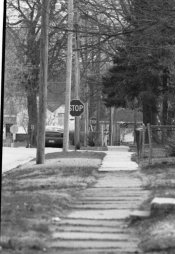
Well, stupid me. I bought various chemicals for two different formulas and thought I had Kbr when in fact I have Sodium Carbonate...100%. This is what I thought I had to get Caffenol-C-H. I tossed the entire batch and remixed Caffenol-C-M and shot a roll of expired Gold 200. And have success! I found some of the worst instant coffee that I think is made for sale to unsuspecting fools. "Nescafé Clásico" sold at Wal*Mart here in the states. A small box has 8 packets for individual use. Each packet is 2g for a total of 16g per box. Instant measurements! I think the price for the box is $1.12 and I need 20 packets per batch. I did the following with the current batch:
 

Attachments

  • Stop signs dof.jpg
    Stop signs dof.jpg
    908.6 KB · Views: 161
  • Stop signs 500mm lens.jpg
    Stop signs 500mm lens.jpg
    946.8 KB · Views: 139
  • Melissa on phone.jpg
    Melissa on phone.jpg
    1.1 MB · Views: 147
  • Bridge and pond.jpg
    Bridge and pond.jpg
    1 MB · Views: 129
Last edited by a moderator:

removed-user-1

my fascination is that it made of household items
...
and it i have a lot of fun using it ...

I agree with both of these statements. I like the idea that I can go to the grocer [instead of the camera store] and buy developer, and I also love having fun with my photography, whether I'm building something usable out of broken lenses or mixing up chemistry from scratch. In spite of the fact that my main source of income is from photography, I like to think that I embody the true meaning of the word "amateur."
 
Photrio.com contains affiliate links to products. We may receive a commission for purchases made through these links.
To read our full affiliate disclosure statement please click Here.

PHOTRIO PARTNERS EQUALLY FUNDING OUR COMMUNITY:


Ilford ADOX Freestyle Photographic Stearman Press Weldon Color Lab Blue Moon Camera & Machine
Top Bottom