
• Welcome to Photrio!
    Registration is fast and free. Join today to unlock search, see fewer ads, and access all forum features.
    Click here to sign up

C-41 Process Control

Valencia

A
Valencia

  • 0
  • 0
  • 40
Tied to the dock

D
Tied to the dock

  • 4
  • 0
  • 86

Recent Classifieds

Forum statistics

Threads
203,092
Messages
2,849,710
Members
101,657
Latest member
9000man
Recent bookmarks
0

sillo

Member
Allowing Ads
Joined
Nov 22, 2020
Messages
137
Location
NY
Format
35mm
Recently switched back to Kodak LORR developer after using Fuji for that last year. I prefer being able to buy 5 liters of replenisher and a single bottle of starter when needed, where Fuji forces you to purchase 4x5L replenisher and 6x1l bottles of starter. First batch of film I processed after the switch back did not pass the eyeball test (very cool negatives with slightly more grain and flatter colors). I'm RA-4 printing too and my filtration values were pretty different from what I was previously using for the same films. I wrote that off partially to the very overcast, dreary days we'd been experiencing here in the beginning of this year. Anyway, I figured it was about time I just bite the bullet and get myself a densitometer before I drive myself crazy second guessing my process.

Replenisher was mixed about 3 weeks ago and the working solution was mixed when I started processing. Bleach was fresh replenisher with about 100ml of old working solution instead of starter. Fixer was fresh.

Developer was poured in at 101.7f (assuming ~1.5-2 degree temp loss from the lift). Measured with a thermaworks therma k that I just did the ice bath test with about two weeks ago. It was spot on at 32f. Dev tank was preheated for around 10ish minutes rotating with no presoak. Water bath was ~102f. CPE2+ so only 1 agitation speed (iirc 75rpm).

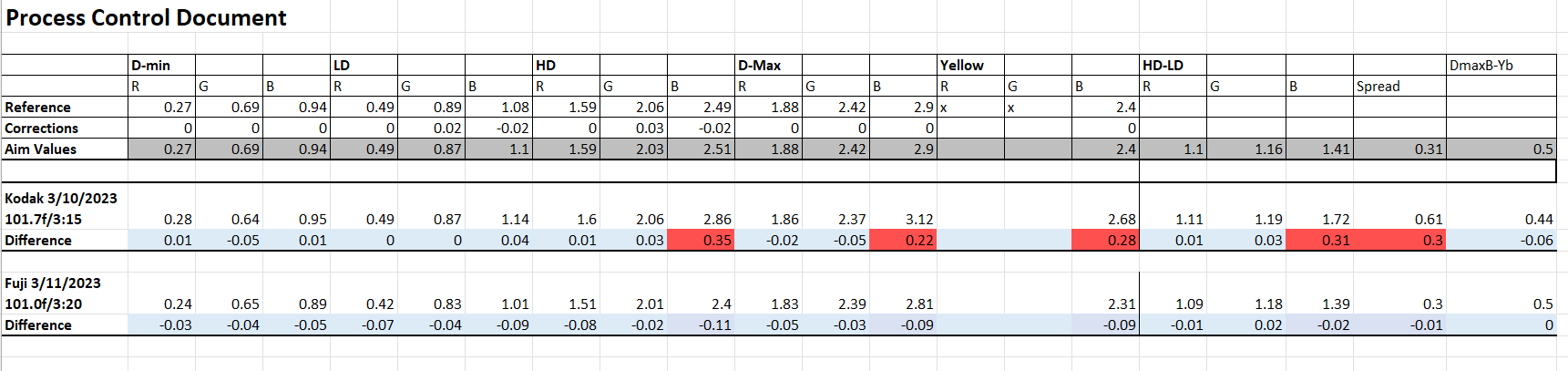
Most values measured close to the aims, but my HD-LD(b), Color spread were pretty far out. Around 0.3 when the control limits are significantly lower.

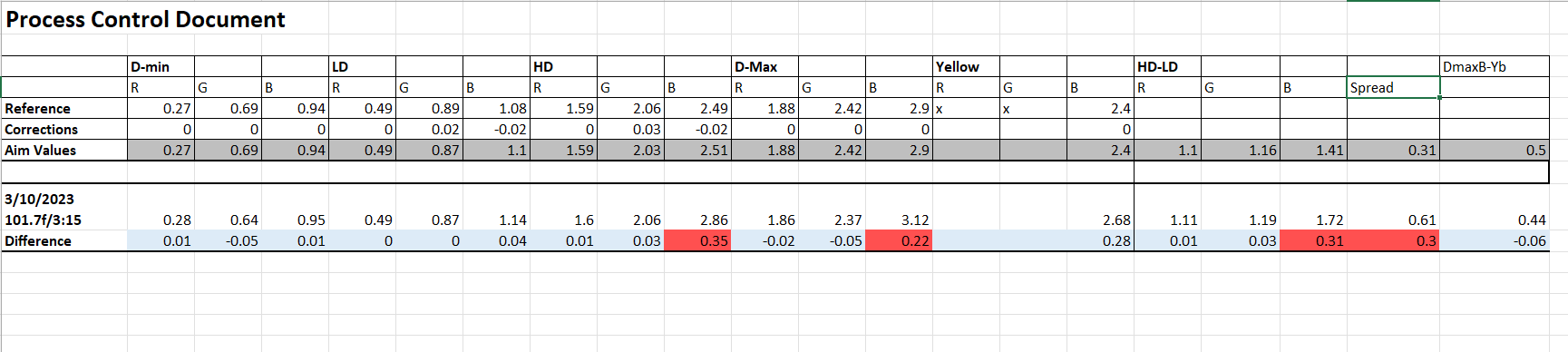
zZw5u8c
TbKhyH8.png


I'm somewhat at a loss here since I didn't really change any part of my process except for the brand of developer I'm using. Date codes are the bottles are from 2022, so it's not too old. I've read Z131, chapter 5 over a few times and have consulted the flow charts and graphs, but none of the graphs show the blue channel being so far out of wack. I ordered more Fuji developer, but I don't *really* wanna dump a fresh 5 liters of Kodak stuff if I don't have to.
 
Last edited:
In my experience, the blue channel going whacky is usually the bleach. It'd also be helpful to check the Ph and specific gravity to make sure it's within spec. The yellow patch will only indicate if you're bleaching to completion, the blue channel contrast and density relative to the other two channels will get a bit nutty if you're over or under replenishing and/or the Ph or specific gravity is off.
 
It's been a long time since I worked with that sort of thing, but I'd be inclined to be suspicious of a possible bleach contamination (bleach into the developer). Your blue densitometer reading actually measures the amount of yellow dye, which is the top color layer of the film. Being the top layer it is also most susceptible to the effects of a contamination. It doesn't take much.

Regarding your densitometer, it needs to be "status M" for accurate readings. Anything else MIGHT give distorted readings, as could a blue channel with the slope not properly calibrated. Have you used this densitometer on the previous chems with good results? If there is any doubt about the readings you might try having a lab double check your readings (both the reference strip and your own strip).

As a note the published troubleshooting charts are not necessarily that accurate. For a general indication they're probably fine, but if you're expecting to see the exact relationships between color layers, etc., I'd be more than a little skeptical.

Best of luck.
 
Thanks for the suggestions. Developer contamination I think I can rule out since this is freshly mixed replenisher/freshly mixed working solution used one shot, so there realistically isn't any chance of bleach making it's way into the developer before processing. The bleach is a brand new batch too and I aerate it with an aquarium air pump before each processing session.

I'm gonna take some specific gravity readings today and see how those match up.

Regarding your densitometer, it needs to be "status M" for accurate readings. Anything else MIGHT give distorted readings, as could a blue channel with the slope not properly calibrated. Have you used this densitometer on the previous chems with good results? If there is any doubt about the readings you might try having a lab double check your readings (both the reference strip and your own strip).

Could you explain this more? I'm using an x-rite 890, but I'll be honest I'm not super knowledgeable here and it's new to me.

I also have an emergency arista kit sitting in my darkroom, I might mix up the blix and run the control strip through that and check the densitometer readings again. Should be a quick way to check if my bleach is the issue.
 
Last edited:
Update that is leaving me even more confused. Used the fresh blix mixture and ran the control strip through that for 10 minutes and got absolutely no change in the densities.

Checked the specific gravity of the developer replenisher, measured 1.040, accepted range is 1.036 to 1.042. Checked the fresh tank solution, measured 1.037, accepted range is 1.034 to 1.040.

Finally checked the Bleach III replenisher and this was slightly out of spec at 1.043, accepted range is 1.030 to 1.040. Not sure that this would cause the blue channels to be so far off though. The accepted sg range for a seasoned tank goes up to 1.060.
 
One other thing to keep in mind is that even though C-41 is technically interchangeable with what chems are used with each step (Kodak developer, Fuji bleach, or vice versa), the aims are different between C-41 and CN-16, so using different chems could introduce a variation that’s not accounted for in z-131. That doc is assuming you’re using all Kodak chems.
 
One other thing to keep in mind is that even though C-41 is technically interchangeable with what chems are used with each step (Kodak developer, Fuji bleach, or vice versa), the aims are different between C-41 and CN-16, so using different chems could introduce a variation that’s not accounted for in z-131. That doc is assuming you’re using all Kodak chems.

Good point, but I think the results being so far off the aim values and my own observation of my negatives being a lot cooler than I'm used to the data I'm getting is useful. The rest of the data is more or less within Kodak's control limits too so I don't think that proves some value.

Also, it's just all that I can get my hands on these days in terms of control strips so it'll have to do.
 
Could you explain this more? I'm using an x-rite 890, but I'll be honest I'm not super knowledgeable here and it's new to me.
Hi, I looked at an online operator manual for the 890; it appears to properly use status M for color neg strips.

Fwiw status M is a certain spectral response, and it is used for color negs. The 890 seems to have the capability of different "status" readings, apparently selected automatically by the reading format you use. (The technical specs part of the manual tells what status is being used for what.) So presumably your machine is doing what it should.
 
@Mr Bill, appreciate you checking that out.

I have a very interesting update. Mixed up a fresh 5l batch of Fuji Developer as a last resort. Ran another control strip. I did get impatient waiting for the developer to heat up so I dumped at 101.0f and because of that my values are slightly lower than the aim, but that is easily correctible when I get to processing actual film.

tBBwy7O.png


So I think I can say I either got a bad batch of replenisher or Sino promise has bungled their factory restart
 
@sillo where are you getting your Fuji chemistry?

Unique photo. Fuji just switched the product code though so it's hard to find on their website. 600022875 is the new product code which supersedes 600007031 as a direct replacement (and a $10 price increase). I had to email them to get a link to that page though so don't drive yourself crazy on their site trying to find it.

Couldn't find any updated tech bulletin/datasheet with the new product number either so just continued using it exactly as I did the old one. 600007031 Tech Bulletin.
 
@sillo will you sell me some of the starter? I understand that you bought a lot! :smile:
 
I absolutely would, but I was able to get my local lab to sell me a single bottle instead of buying the 6 bottle box.
 
@koraks Appreciate the offer, but I think it will be easier for me to talk to the local labs, they're quite friendly and supportive of the community.
 
Unique photo didn't really have much to say, the rep I spoke with on the phone was at least honest and said what I was talking about was over his level of knowledge. They did give me a email to a rep at sino promise and I'm just waiting to hear back after I sent them my data.
 
Well, Sino Promise didn't have much to say either. Said they hadn't seen anything like this and I should just get a refund from the supplier. After a few more exchanges on my process they just stopped answering.

I do have another 5l batch I ordered from Unique at the exact same time and I'm considering just mixing it up and testing that too to see if it was a one off thing or this batch has the same issue.
 
Well, Sino Promise didn't have much to say either. Said they hadn't seen anything like this...

Well yeah, it's not a "normal plot," meaning that the "normal problems" don't look like this.

If you wanted to test what a bleach contamination would look like you could put a small sample of your current "good" developer in a beaker, or whatever, then splash a bit of bleach in it. Then develop a control strip in it by hand, in the dark. (Maybe someone out in the light will time it for you.) I can't tell you how much bleach would be needed, but offhand I'd guess something on the order of one part in a thousand, maybe less.

Given that your densitometer seems to have been proven ok, some sort of a developer contamination, wherever it may have come from, seems most likely to me.
 
To update this thread with new data:

I mixed a fresh batch of Flexicolor LORR developer and I started getting exactly the same results! I think we can safely say that the remaining stock of Flexicolor LORR developer is defective and leave the Kodak color chemistry saga behind us.
 
Photrio.com contains affiliate links to products. We may receive a commission for purchases made through these links.
To read our full affiliate disclosure statement please click Here.

PHOTRIO PARTNERS EQUALLY FUNDING OUR COMMUNITY:


Ilford ADOX Freestyle Photographic Stearman Press Weldon Color Lab Blue Moon Camera & Machine
Top Bottom