
reneboehmer
Subscriber
1 Introduction
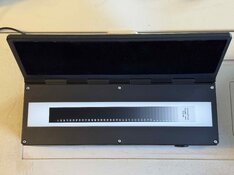
When working with analog materials, one of the key instruments used is a sensitometer. It is
used to expose a piece of light-sensitive material with a known amount of electromagnetic energy.
The spectral characteristics of which depend on what specific material shall be exposed.
When working with black-and-white silver halide films, the spectral properties are defined in
International Standard ISO 7589:2002 — Photography — Illuminants for sensitometry — Spec-
ifications for daylight, incandescent tungsten and printer.
2 ISO 7589
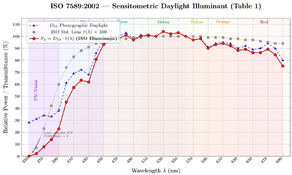
To test black-and-white film, a sensitometer’s light source should simulate real-world conditions.
In this case, this means that a source with a specific photographic daylight spectrum (D55),
modulated by the spectral transmittance of an ISO standard camera lens, shall be used.
The usability of a source is defined by the use of a Spectral Distribution Index (SDI) score
system, which defines RGB index tolerances of:
• Blue must not differ from Green by more than ± 4
• Red must not differ from Green by more than ± 3
3 Goal
Needed is to build a calibrated sensitometer that allows absolute film speed calculation. The
unit shall give a repeatable and exact amount of predefined illuminance over a repeatable and
exact amount of time. The device should be able to perform easy self-calibration by the use of an
external calibrated lux meter, that measures illuminance at direct contact with the light source
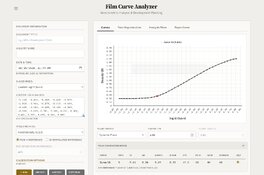
surface. The software of the unit should handle the calibration of a step wedge used, taking into
consideration the transmittance of each field of the step wedge, and then informing the user of
the absolute illuminance at any given point. This allows the user to read absolute illuminance,
without flare, reaching the film surface from a table generated by the unit.
4 Plan and Assumptions
Building a sensitometer light source that is in spec with ISO 7589 is not the target of this project.
The target is to build a functioning unit that is calibrated and as close to ISO 7589 as reasonably
achievable.
Since this unit will not be used as a colour sensitometer, given tolerances can be assumed to
be much lower. Spectral power distribution of the light source is of course important, but the
sensitivity shift that can be expected by not exactly adhering to ISO 7589 is most likely negligible.
The reason why ISO 7589 is not followed exactly has to do with the comfort of using off-the-shelf
LED light sources. It is possible to meet the ISO SPD characteristics with custom LED arrays
and drivers, but not without expensive time and money investment.
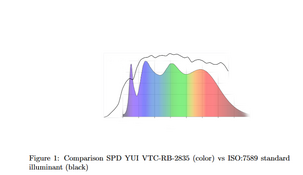
We are assuming that high-quality 5600 K LEDs with a CRI of 98 are sufficiently close to an
ISO light source that further improvements would only result in marginal positive impact.
We also assume that SPD does not change in a relevant way when PWM dimming these LEDs.
We further assume that high-frequency (20 kHz) PWM dimming does not result in reciprocity-
related effects in silver halide materials, as the off-period duration (∼12.5 μs at 50% duty) falls
well within the persistence window of latent sub-image centres.
5 Parts
All parts are off-the-shelf, not requiring any custom PCB work. It was important to us that this
unit was easy to build, as it would allow others to replicate the sensitometer easily.
• ESP32 + breakout board
• USB-C PD board (20 V)
• Variable step-up converter (20 V to 24 V for LEDs)
• Variable step-down converter (20 V to 5 V for ESP32)
• MOSFET with PWM capability
• Button
• LEDs — Yuji VTC-RB-2835-24V
• Custom-cut flashed opal glass
The cat design was done by my friend Angelo, I can't take credit for this.

When working with analog materials, one of the key instruments used is a sensitometer. It is
used to expose a piece of light-sensitive material with a known amount of electromagnetic energy.
The spectral characteristics of which depend on what specific material shall be exposed.
When working with black-and-white silver halide films, the spectral properties are defined in
International Standard ISO 7589:2002 — Photography — Illuminants for sensitometry — Spec-
ifications for daylight, incandescent tungsten and printer.
2 ISO 7589
To test black-and-white film, a sensitometer’s light source should simulate real-world conditions.
In this case, this means that a source with a specific photographic daylight spectrum (D55),
modulated by the spectral transmittance of an ISO standard camera lens, shall be used.
The usability of a source is defined by the use of a Spectral Distribution Index (SDI) score
system, which defines RGB index tolerances of:
• Blue must not differ from Green by more than ± 4
• Red must not differ from Green by more than ± 3
3 Goal
Needed is to build a calibrated sensitometer that allows absolute film speed calculation. The
unit shall give a repeatable and exact amount of predefined illuminance over a repeatable and
exact amount of time. The device should be able to perform easy self-calibration by the use of an
external calibrated lux meter, that measures illuminance at direct contact with the light source
surface. The software of the unit should handle the calibration of a step wedge used, taking into
consideration the transmittance of each field of the step wedge, and then informing the user of
the absolute illuminance at any given point. This allows the user to read absolute illuminance,
without flare, reaching the film surface from a table generated by the unit.
4 Plan and Assumptions
Building a sensitometer light source that is in spec with ISO 7589 is not the target of this project.
The target is to build a functioning unit that is calibrated and as close to ISO 7589 as reasonably
achievable.
Since this unit will not be used as a colour sensitometer, given tolerances can be assumed to
be much lower. Spectral power distribution of the light source is of course important, but the
sensitivity shift that can be expected by not exactly adhering to ISO 7589 is most likely negligible.
The reason why ISO 7589 is not followed exactly has to do with the comfort of using off-the-shelf
LED light sources. It is possible to meet the ISO SPD characteristics with custom LED arrays
and drivers, but not without expensive time and money investment.
We are assuming that high-quality 5600 K LEDs with a CRI of 98 are sufficiently close to an
ISO light source that further improvements would only result in marginal positive impact.
We also assume that SPD does not change in a relevant way when PWM dimming these LEDs.
We further assume that high-frequency (20 kHz) PWM dimming does not result in reciprocity-
related effects in silver halide materials, as the off-period duration (∼12.5 μs at 50% duty) falls
well within the persistence window of latent sub-image centres.
5 Parts
All parts are off-the-shelf, not requiring any custom PCB work. It was important to us that this
unit was easy to build, as it would allow others to replicate the sensitometer easily.
• ESP32 + breakout board
• USB-C PD board (20 V)
• Variable step-up converter (20 V to 24 V for LEDs)
• Variable step-down converter (20 V to 5 V for ESP32)
• MOSFET with PWM capability
• Button
• LEDs — Yuji VTC-RB-2835-24V
• Custom-cut flashed opal glass
The cat design was done by my friend Angelo, I can't take credit for this.
Attachments
Last edited: