
• Welcome to Photrio!
    Registration is fast and free. Join today to unlock search, see fewer ads, and access all forum features.
    Click here to sign up

BTZS curves for TMAX 100 in D76

Recent Classifieds

Forum statistics

Threads
202,928
Messages
2,847,714
Members
101,541
Latest member
pibanez
Recent bookmarks
0

kinderhookphotog

Member
Allowing Ads
Joined
Nov 15, 2014
Messages
7
Format
Medium Format
Hi

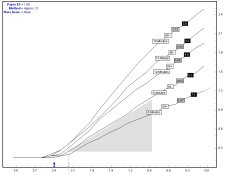
I'm getting back into analog photography after many years away and I'm geeking out with my btzs test. I just performed my first test film test with TMAX 100 in D76 1:1 @68 degrees. I bracketed the development times based on a (apparently mistaken) notion that 12 minutes would produce "normal" development.

I'm getting some odd results from WinPlotter, however, which seems to claim that 6 minutes in "normal" development time! This is completely confusing and I'm wondering if I perhaps might have a problem with old D76 (about a month) that has been stored in wine bottles with the air sucked out of them.

Are there any BTZS geeks that might check out my curves? I'm going to run a second test using 9 minutes as the mean dev time but I'm wondering if anyone else had thoughts about these results or could share curves with the similar combo of film & developer.

Thanks,

August
 

Attachments

  • TMAX_D76_Curve_Family.jpg
    TMAX_D76_Curve_Family.jpg
    72.7 KB · Views: 268
  • TMAX_D76_DEV_TIME_N.jpg
    TMAX_D76_DEV_TIME_N.jpg
    107.7 KB · Views: 214
From John Sexton:

NOTE: If you use D-76 developer be sure to use FRESH D-76 (not some that has been sitting around in a half-full bottle for a month!) As D-76 ages a chemical compound, hydroquinone monosulfonate, is formed. This chemical compound will INCREASE the activity of the developer and the contrast of your negatives in a big way with T-MAX. When mixing a gallon of D-76 I suggest storing it in 4 one-quart glass bottles filled to the brim. In this way you can work out of one bottle while the others remain full to minimize oxidation. If in doubt about the age of chemical ... dispose of it. There appears to be no similar aging problem with the T-Max system of developers.
 
I have never tested that combination, but the sample plotter files have TMX with ID11 1+1 at 70F and they have N at 6:45. So it looks like you are in the ball park. Generally ID11 and D76 are thought to be the same.
 
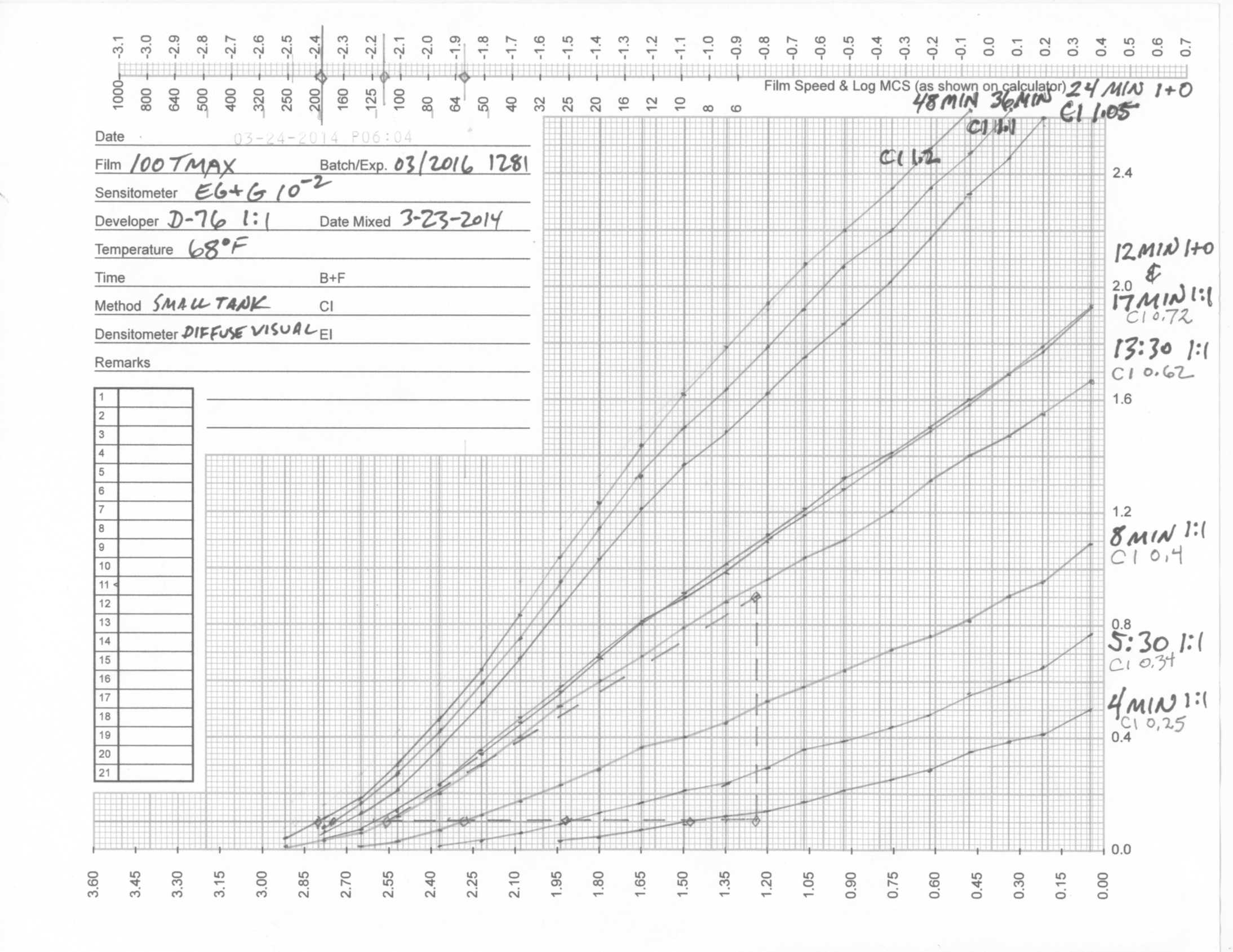
Here is my curve family of 35mm TMAX 100 in D-76 1:1, and for extended development, in D-76 straight.

My development times are always longer than anyone else's standard times, and there are many possible explanations (possibly because I use half of the recommended stock solution per roll). You should not expect long development times like I have.

So your times are probably fine. The only additional tests I would recommend is a different kind of developer if you plan to do N-2 development, because short processing times can lead to uneven development, and it looks like the minus development times are going to be too short in D-76 1:1.

Then my other additional recommendation is to only occasionally run one test sheet at the "N" time with some other sheets of "N" film. Read that one test sheet to see if your curve family predicts your development times. If it does... then you might consider yourself in control. And if you are in control, you are done... you only need to occasionally do a spot-check.

tmxfamily.jpg
 
Is there something I can read (online perhaps) that would explain how to read these charts, and others relating to film and developer characteristics? I see all these charts, and they may as well be inkblots to me...
 
You know, it is a funny thing. When I am designing a film, paper or developer, I use these charts to plot out my next design move or strategy, but when I am taking pictures, I never bother with these plots at all. I just set my meter and go shoot!

And I use the mfgrs spec for development conditions.

PE
 
NOTE: If you use D-76 developer be sure to use FRESH D-76 (not some that has been sitting around in a half-full bottle for a month!) As D-76 ages a chemical compound, hydroquinone monosulfonate, is formed. This chemical compound will INCREASE the activity of the developer and the contrast of your negatives in a big way with T-MAX. When mixing a gallon of D-76 I suggest storing it in 4 one-quart glass bottles filled to the brim. In this way you can work out of one bottle while the others remain full to minimize oxidation. If in doubt about the age of chemical ... dispose of it. There appears to be no similar aging problem with the T-Max system of developers.

A month! I use D76 stock well stoppered for a year.
 
August

I am familiar with the BTZS Plotter program, so I may be of some assistance.
Based on the settings for your curves, I think you will get results closer to what you were expecting,
if you change the paper ES to 1.05, and the flare density from 0 to 0.4 in the appropriate plotter program fields.
Once you have done that, Plotter will recalculate, and display the updated curves. The calculated values will have changed substantially.
In this statistically average situation, the aim CI = 1.05/(2.2-0.4) = 0.58,
based on a 7 1/3 stop scene luminance range, and 1 1/3 stop flare factor.
Flare is always present in photography, even when it goes unnoticed.

You can determine your paper's exposure range easily by testing, while the flare factor is less easily known. Usually, some approximation is necessary.
To the best of my knowledge, film manufacturers use in their calculations for development times about 1 1/3 stops as an average amount of flare.
Others on this forum have written extensively about flare and it's importance.
In particular, consult the postings of Stephen Benskin if you are interested in delving deeper into these topics.

For more information:
"Basic Photographic Materials and Processes" by Stroebel, Compton, Current, and Zakia
"Sensitometry for Photographers" by Jack Eggleston
Also, the Kodak references in post #11 are very good as well.

Keep in mind that BTZS uses some non-standard terminology compared with most of the photographic literature.

Mark
 
Can't help you specificaly with this plot application but depending on what you consider to be a normal contrast index I have found 12 minutes in D-76 1+1 (20C) to be pretty close.

Are you using continuous agitation or intermittent?

Michael,I didthe test for the same combo. if you can email me ar rlambrec@ymail.com,I can send you the summary sheet with the results.from memory,N development was 10minutes.
 
Can't help you specificaly with this plot application but depending on what you consider to be a normal contrast index I have found 12 minutes in D-76 1+1 (20C) to be pretty close.

Are you using continuous agitation or intermittent?

I'm agitating continuously for the first minute, and then 5 seconds every 30 seconds. I was thinking this might be the other variable.
 
August

I am familiar with the BTZS Plotter program, so I may be of some assistance.
Based on the settings for your curves, I think you will get results closer to what you were expecting,
if you change the paper ES to 1.05, and the flare density from 0 to 0.4 in the appropriate plotter program fields.
Once you have done that, Plotter will recalculate, and display the updated curves. The calculated values will have changed substantially.
In this statistically average situation, the aim CI = 1.05/(2.2-0.4) = 0.58,
based on a 7 1/3 stop scene luminance range, and 1 1/3 stop flare factor.
Flare is always present in photography, even when it goes unnoticed.

You can determine your paper's exposure range easily by testing, while the flare factor is less easily known. Usually, some approximation is necessary.
To the best of my knowledge, film manufacturers use in their calculations for development times about 1 1/3 stops as an average amount of flare.
Others on this forum have written extensively about flare and it's importance.
In particular, consult the postings of Stephen Benskin if you are interested in delving deeper into these topics.

For more information:
"Basic Photographic Materials and Processes" by Stroebel, Compton, Current, and Zakia
"Sensitometry for Photographers" by Jack Eggleston
Also, the Kodak references in post #11 are very good as well.

Keep in mind that BTZS uses some non-standard terminology compared with most of the photographic literature.

Mark

Wow - flare does radically change things! Now things are lining up as I would expect and is more consistent with a earlier traditional zone system test that indicated 12 minutes was normal development.

Question about flare - does .4 include Base+Fog or is in addition? It seems the software is adding .4 to my Base+Fog (which is about .15 density).

From playing around with the software I also noticed that the paper ES was affecting what the software was calculating as normal. My paper tests with Ilford MCIV Perl are showing a ES of .98 with a 0 filter (which the software is identifying as Grade #2). I think I've found the issue here - it is with the light source in the Zone IV cold head (but that is another story!).

Thanks very much!
 
I'm going to try again with fresh D-76 and see if that makes a difference. Based on other feedback here, I'm thinking the difference is probably in calculating in the flare. Thanks! A
 
Dear PE

I don't either... and I don't even use a light meter! its my party trick ! Outside my office now is 30th @ F8 ( gloomy NW England ) at 400iso but I do bracket !

But as always....in Photography, processing and printing do what works for you...

Simon ILFORD Photo / HARMAN technology Limited
 
I use D76 1:1 on TMX 100 all the time. I pull up the Kodak Publication F-4016 and proceed. Following the manufacturer's directions works wonderfully every time. I have to admit, the consistency is one of the reasons I love this combination.
 
August,
It can be very confusing when concepts and procedures of one system are mixed with another. Although zone system testing assumes a paper exposure range of about 1.2, and doesn't account for flare in the testing, the results nevertheless can be very good. I looked at the curves included in the Plotter program for TMAX 100 that produce a CI close to 0.58 with rotary processing. Somewhere around 9 minutes with rotary agitation looks good. If you are using intermittent agitation your time might be 10%-15% longer. As Dan mentioned, the Kodak publication F-4016 is an excellent place to start. With all the hard to control variables in personal testing in mind, it is difficult to do better than the film manufactures themselves. I have found testing most helpful with films,papers, and home-made developers for which there may not be detailed public information.
Just to be clear, for your testing using the BTZS system, if you are exposing your films by contact, a flare-free situation, it is not necessary to make any flare density adjustment in the plotter program itself. The numbers I suggested in my original post were for demonstration purposes only, just so you could see a flare effect very easily. If you intend to use any of the BTZS aids, like the ExpoDev program or the PowerDial, you can also use your film test data without any added flare compensation, since they have some kind of flare compensation built-in.
With regard to your paper exposure range issue, I don't have any idea.
Mark
 
See Simon Galley's post, and mine as well.

All of this Zone System and BTZS does is waste time, paper, film and does nothing over just going out and shooting a few rolls of film, following the manufacturers instructions for processing the film, and then making prints.

After all, there are masterpieces out there done before these two systems were touted abroad. And the ones who touted them were good BEFORE they touted these systems. Learning to make paper plots will NOT make you a better photographic artist, and in fact I have seen some flawed photographs that were great art!

PE
 
NOTE: If you use D-76 developer be sure to use FRESH D-76 (not some that has been sitting around in a half-full bottle for a month!) As D-76 ages a chemical compound, hydroquinone monosulfonate, is formed. This chemical compound will INCREASE the activity of the developer and the contrast of your negatives in a big way with T-MAX. When mixing a gallon of D-76 I suggest storing it in 4 one-quart glass bottles filled to the brim. In this way you can work out of one bottle while the others remain full to minimize oxidation. If in doubt about the age of chemical ... dispose of it. There appears to be no similar aging problem with the T-Max system of developers.

A month! I use D76 stock well stoppered for a year.

I have experienced this myself. When I first started using D-76 I couldn't figure out what was going on with it until I read Sexton's article on the LFF site. Found out later it is the production of sodium hydroxide that causes the activity change. One should be consistant with when one uses it after mixing. I used home-brew, I have read that packaged D-76 has less of a problem. I just switched to D-23 and don't worry about it.
 
Photrio.com contains affiliate links to products. We may receive a commission for purchases made through these links.
To read our full affiliate disclosure statement please click Here.

PHOTRIO PARTNERS EQUALLY FUNDING OUR COMMUNITY:


Ilford ADOX Freestyle Photographic Stearman Press Weldon Color Lab Blue Moon Camera & Machine
Top Bottom