• Welcome to Photrio!
    Registration is fast and free. Join today to unlock search, see fewer ads, and access all forum features.
    Click here to sign up

B&W reversal film speed question

Cut

D
Cut

  • 2
  • 0
  • 24
The Kite Surfer

A
The Kite Surfer

  • 4
  • 0
  • 46

Recent Classifieds

Forum statistics

Threads
201,951
Messages
2,832,570
Members
101,030
Latest member
kkiippyy
Recent bookmarks
0

destroya

Subscriber
Joined
Jul 23, 2012
Messages
1,235
Location
Willamette Valley, OR
Format
Multi Format
I know that it is normal practice, for some, to over expose their B&W film. I also know that it is a no no to over expose slide film, better to under expose if you have to. So what about black and white film for reversal? I love doing reversal processing with normal (?) black and white film.

I never really thought about it until today, when i was taking some pix of some Canadian geese. should i expose the film at box speed, my rated speed for ned processing based on testing or bracket and figure it out? i did it at box speed as i have alwasys done nwith my specific film for rev processing. anyway....

what are your thoughts on this? film speed of B&W film for rev processing vs normal neg processing?
 

mrred

Member
Allowing Ads
Joined
Mar 8, 2009
Messages
1,251
Location
Montreal, Ca
Format
Multi Format
BW reversal processing is not like E6 or other standardized processes. You can have different developers in different strengths with different developing times. So exposure depends on more things than just being a reversal.

Projection of the reversal is the most forgiving of exposure. Like E6, under exposure has little bad effects and does protect the highlights. Scanners typically will have issues with the amount of DR and exposure should be the greatest possible without blowing the highlights.

When you get comfortable with reversal processing, it's not that more complicated than neg processing when dealing with an under or over exposed film. Just one developer time to tweek.
 

Athiril

Subscriber
Allowing Ads
Joined
Feb 6, 2009
Messages
3,062
Location
Tokyo
Format
Medium Format
Depends on the developer recipe. I've done Tri-X at 3200.
 

Bill Burk

Subscriber
Allowing Ads
Joined
Feb 9, 2010
Messages
9,477
Format
4x5 Format
When I used Panatomic-X for reversal processing, the rated speed recommended in the reversal chemistry kit was 80 (where the film normally is rated at 32). So the process does determine the speed and it could be different than the box speed.

I would believe that you want to maintain proper exposure, over exposure would be harsh to view projected... So err on the side of underexposure as mrred says. But since you are working with reversal, instead of exposing for the shadows, you would expose to keep from blowing out the highlights (or expose to make the important tone, such as people, look correct).
 

Tom1956

Member
Allowing Ads
Joined
May 6, 2013
Messages
1,989
Location
US
Format
Large Format
I've oft wondered what the good is in pursuing reversal of B&W film, when the film base itself already added unwanted density. In other words, makes the projector lamp much more dim. A 500W bulb or whatever is much dimmer by the time it penetrates just the film base alone. So what's the point in reversal processing, if there is no clear base film?
 

Ricardo Miranda

Member
Allowing Ads
Joined
Mar 31, 2012
Messages
2,408
Location
London, UK
Format
35mm
So what's the point in reversal processing, if there is no clear base film?

Tom,
There are some clear base films that are meant to be reversed, like the Adox Silvermax or Fomapan R 100.
In fact, it is said the same emulsion from which Silvermax is cut, it is also used for a Super8 film.
Have a look here: http://www.adox.de/english/ADOX%20Films/SILVERMAX/SMAX_index.html
http://www.adox.de/english/ADOX Films/page53/index.html
And here: http://www.foma.cz/en/catalogue-fomapan-r-100-detail-273
 

donkee

Member
Allowing Ads
Joined
May 3, 2011
Messages
219
Location
Mid Michigan
Format
Multi Format
I've oft wondered what the good is in pursuing reversal of B&W film, when the film base itself already added unwanted density. In other words, makes the projector lamp much more dim. A 500W bulb or whatever is much dimmer by the time it penetrates just the film base alone. So what's the point in reversal processing, if there is no clear base film?

Another thing to consider, with E6 disappearing those of us who want to project slides will have little choice than to go to B&W.
 

Steve Roberts

Member
Allowing Ads
Joined
Oct 12, 2004
Messages
1,302
Location
Near Tavisto
Format
35mm
I've been doing a fair bit of experimenting with FP4 reversal processing lately. To address the OP's question of over/under exposure - expose correctly for the brightest part of the scene or for your subject if that doesn't happen to be the brightest part. Underexposure (even a modest amount) leads to an overall appearance of muddiness. Overexposure, of course, burns out the highlights. When you get the exposure spot-on, it really shows. Bracketting by half a stop is a good idea if you want to be sure. The last little niggle that I'm trying to resolve is a slight tendency for the blacks not to be quite black enough and to exhibit a dark green hue when examined closely on projection with a 250W carousel. I have a feeling that the cause could be that I'm using well outdated Ilford Motion Picture stock and the faint base fog that I see in normal negatives which isn't an issue and I can print through actually gives a slight lightening of the blacks under reversal. I'm being picky, and other people (non-photographers) can't see what I'm fussing about! Anyway, to try to prove a point I bought a ***NEW*** roll of FP4 yesterday (exp date 2018!) and will try that. My camera won't know what's hit it. I can't remember the last time I used in-date film!
Tom1956 - Yes, there is some base colouration with most b/w film, but a) some films don't have any (as has been mentioned) and b) even base colouration that is visible when a neg is held up to the light has never been a problem for me when projected. I have no issues with brightness with my usual 250W carousel. As donkee says, there is an element of Hobson's Choice. With E6 films fast disappearing, part of my reason for b/w reversal is to maintain the ability to shoot slides. The other part is that a decent b/w slide of the correct subject matter has a lot of impact.
Apart from the availability of colour slide film, the cost of the stuff and of the processing are beginning to make me think twice every time I press the shutter. I can see the time when I'll take two cameras on a trip, one for b/w slides and one for colour. Most of the material would be b/w with expensive colour reserved for subjects that demanded it.
Another option for those of us who like to project images is, of course, to use colour neg film and scan it. A club I belong to (nothing to do with photography) has just bought an Acer video projector using DLP technology. It cost a shade over £300, produces a very sharp, bright picture with auto keystone correction and excellent colour rendition. That and a slide scanner do introduce the 'd' word but do at least allow us to continue shooting film for ultimate projection.
Best wishes,
Steve

 

mrred

Member
Allowing Ads
Joined
Mar 8, 2009
Messages
1,251
Location
Montreal, Ca
Format
Multi Format
I've oft wondered what the good is in pursuing reversal of B&W film, when the film base itself already added unwanted density. In other words, makes the projector lamp much more dim. A 500W bulb or whatever is much dimmer by the time it penetrates just the film base alone. So what's the point in reversal processing, if there is no clear base film?

Black is what it should to be - no light is black. Check out an E6 chrome; same thing. If the image of your reversals are too dark you have under exposure / under development. That would be something different.

The images in my gallery are reversals and they all have jet-black edges.
 
OP
OP
destroya

destroya

Subscriber
Joined
Jul 23, 2012
Messages
1,235
Location
Willamette Valley, OR
Format
Multi Format
I have done many rolls of B&W reversal before. it was just that yesterday when i was out shooting, i decided to shoot 2 rolls of the same things, dev 1 normally, in pyro and the other in reversal to see the difference. more of an experiment than anything else. I have to say that the frames i did before on reversal, the grain is much finer than the same film developed normally (I used to use D76 before). I just saw it when i was scanning through some older shots.

I have tried many films for reversal processing and odly enough the one that has given me the best luck has been the Ultrafine Xtreme 100. there are rumors about who makes this film. some say its Orwo 54 stock and others say ilford Pan 100. either way it does a great job and is really inexpensive in 100 foot rolls. I just got a few of the 120 to try out so 1 roll will be done today for reversal.

here is an example result. not the greatest shot, i was just trying to find scenes with contrast to check out the process.
xtremereversal+Scan-130819-0002 as Smart Object-1.jpg
 

mrred

Member
Allowing Ads
Joined
Mar 8, 2009
Messages
1,251
Location
Montreal, Ca
Format
Multi Format
The best films I have used are (in order) Foma 100, PlusX, ORWO UN54 and Neopan 400. I still have a few cans of Neopan 400 under the arista brand. I found orwo N74+ not bad, but lacking a bit of DR.

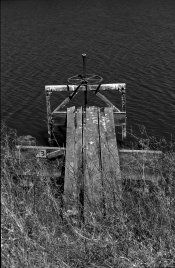
In my gallery, the vertical shot of railway deck was a Neopan 400/120 (my last roll) and it was shot in a Mockba-5 (1958) in 6x9. What a butiful reversal to see with the naked eye! That is enough to want to do large format, if one could afford such notions....:smile:
 
Photrio.com contains affiliate links to products. We may receive a commission for purchases made through these links.
To read our full affiliate disclosure statement please click Here.

PHOTRIO PARTNERS EQUALLY FUNDING OUR COMMUNITY:


Ilford ADOX Freestyle Photographic Stearman Press Weldon Color Lab Blue Moon Camera & Machine
Top Bottom