• Welcome to Photrio!
    Registration is fast and free. Join today to unlock search, see fewer ads, and access all forum features.
    Click here to sign up

Astronomy SLR reccomendations?

Recent Classifieds

Forum statistics

Threads
202,969
Messages
2,848,244
Members
101,564
Latest member
noelchenier
Recent bookmarks
1

McFortner

Member
Allowing Ads
Joined
Apr 6, 2009
Messages
459
Location
Stockbridge,
Format
Multi Format
I really want to do a little astrophotography and I already have a Minolta X-370 and a x-9 that I've tried. The mirror slap causes too much vibration for my use, so I'm wanting to save up for a SLR with a mirror lock. I'd prefer a Minolta that I can use my many MD lenses on as well. Anybody have any suggestions for a good and affordable SLR?

Michael
 
Not a Minolta, but an Olympus OM 1 would be perfect.
 
The Minolta SRT 101 and 102 both have mirror lock-up - Dead Link Removed

Both are reasonably priced and quite available - Dead Link Removed
 
Best part of the SRT is it doesn't need a battery for the shutter, it's all mechanical and perfect for astrophotography.
 
The SRT sounds like a good choice..or a Pentax K1000....Just as a side note, E200 (Ektachrome 200) does a killer job at night especially for exposures this long...I highly recommend it!!
 
I use the Nikon F2 (however, the Nikon F works just as well) for the following reasons:
1. Mirror lockup (use to reduce vibrations caused by mirror slap)
2. Battery independent (can work all night without worrying about battery failure)
3. Interchangeable view screens (I find it easier to focus with the type M view screen)
4. Interchangeable view finder (the DW-20 waist level finder makes viewing easier)

I use the F2 without the motor drive and battery pack because the lighter weight makes it easier to obtain proper balance when mounted on the telescope.

Speed, reciprocity, and color sensitivity are important factors in film selection. Here are some of the films I have used and recommend:
Fuji Astia 100 (slide)
Fuji Provia 100 (slide)
Fuji Provia 400 (slide)
Fuji Sensia II 400 (slide)
Kodak Ektachrome E200 (slide)
Kodak Technical Pan TP-2415 (black & white)
Kodak Royal Gold ISO 200 (color print)
Kodak Portait ISO 160 (color print) (avoid exposures longer than 1/10 second)

However, regretfully, some of these films have been discontinued.
 
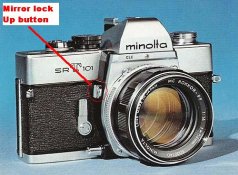
One of the Minolta SRT series cameras would be perfect but MAKE SURE that the one you get has the mirror lock-up feature; not all of them did. If the camera has a small round silver "button" looking thing on the right-hand side of the lens mount (the same side of the camera as the shutter release is on,) then it has mirror lock-up; if it doesn't have the little button-like thing then it doesn't. BTW, it isn't really a button, you rotate it to lock the mirror up. Fantastic camera!

Mike
 

Attachments

  • srt101-MLU.JPG
    srt101-MLU.JPG
    49.4 KB · Views: 513
A classic choice is the Nikkormat FT (and FT2). Totally mechanical, mirror lock up. Oh, and I've got one for sale if you want it :wink:
 
Good morning, Michael;

In the Minolta line, anything, from the SR-7 through the SR-T series, which has the Mirror Lock-Up (MLU), and a "B" setting on the shutter speed dial, will work fine. Do not worry about the accuracy of the timed speeds on the camera, as long as the shutter works properly when opened and closed with a cable release on "B." You will be using exposure times from a few seconds to perhaps hours with a tracking German Equatorial Mount and/or guiding. The one place where you might use the timed settings on the shutter speed dial is with lunar photography. Once you get into the Minolta X Series of cameras, they require batteries that will be affected by the frequent cold temperatures encountered while hanging off the back of your telescope, especially during the winter when we have reasonably long times available for photography at night, and they probably will not have an MLU. This is a case where the simple older mechanical cameras are still preferred, and they probably will be cheaper. The Anglefinder or Anglefinder V helps getting the focus right and puts the eyeport in a position that is much more comfortable to use with your telescope.

While I have hung one of my Minolta SR-T 102 bodies off the back of my little telescope, I actually prefer the Nikon F2 with the Type M Focusing Screen and the DW-2 Magnifying Finder (6x). The Type M Screen with the cross hairs for aerial image focusing does help in getting the focusing right where you want it. It is just a little more convenient than using the ground glass collar area on the Minolta viewfinder screen. Not too much more convenient, but there is a difference.

 
For years before the digital invasion all the telescopy enthusiasts held the Olympus OM1 in high regard for its light weight, mirror lockup and adaptability.
 
I've always assumed that the mirror slap wouldn't be a big problem for astrophotography since the exposure is so long. It's just a quick slap at the beginning and end of the shot, then you keep it open for ages, right? So little light would reach the film during that time that it would pretty much be negligible, right.

I may be mistaken though. I don't personally practice astrophotography, but maybe I'll try sometime.
 
BushPig,

You are correct!

SLR mirror slap is not a big problem for long exposures (longer than 1 second). However, it is a problem for exposures in the 1/15 to ½ second range and that is where many lunar shots are taken.
 
Regarding the suggestion for the Nikon F, the mirror lockup on this wastes a frame of film every time that you engage it, so maybe not a good option?

My astrophotography is limited to shooting the moon & I use a Nikon F3 with a DW4 finder. The finder is great for avoiding getting a crook in the neck. Although the F3 is an electronic camera it does have a mechanical T setting which will keep the shutter open without draining the battery. Not that I can see me ever using it.
 
Well, I decided to go with a SRT-101 because I already have a T-mount and lenses for my other Minoltas. I thank all of you for your input.

Michael
 
A dumb question here, but why do you need mirror lockup? Aren't astronomy photos taken with long exposure times? If so then wouldn't any mirror slap dampen away rather quickly compared to the exposure time, and therefore be negligible? If it were a problem then why not just release the shutter and hold a dark hat in front of the optics for a second or two and then pull the hat back?

By the way, there is one SLR (Exakta) that has a "T" setting, which should be more convenient for long exposures than cameras with only a "B" setting for timed exposures. I don't know if there are other brands that feature a T setting.
 
Well, mirror lockup is useful for Lunar photos. That is my main interest right now since I don't have a tracking mount (I'll need to save up for one of them).
 
BushPig,

You are correct!

SLR mirror slap is not a big problem for long exposures (longer than 1 second). However, it is a problem for exposures in the 1/15 to ½ second range and that is where many lunar shots are taken.

I didn't realize he meant lunar shots. You're right as well.

I was thinking stars. That's where my mind must be.
 
I understand that for some SLR cameras you can use the self timer as a poor-man's mirror lockup. This only works for models in which the mirror goes up as soon as the self timer is actuated. This is not the case for all cameras. Some cameras wait until the self timer times out before the mirror flips up, just a fraction of a second ahead of the shutter. This scheme would not work for such cameras.
 
The perfect camera for this job is the Olympus OM-1
 
Got two SRT-101s in today off of eBay. The were both listed as-is but after a little CLA and new batteries the shutters fire and the meters appear accurate. I have a T-Mount already so now I just need a clear night to do some lunar photography. Thanks for all the advice!

Michael
 
I use a Minolta sRt 102 with a 28mm lens and the mirror lock up. It's a great camera for astronomical photography.
 
Photrio.com contains affiliate links to products. We may receive a commission for purchases made through these links.
To read our full affiliate disclosure statement please click Here.

PHOTRIO PARTNERS EQUALLY FUNDING OUR COMMUNITY:


Ilford ADOX Freestyle Photographic Stearman Press Weldon Color Lab Blue Moon Camera & Machine
Top Bottom