
• Welcome to Photrio!
    Registration is fast and free. Join today to unlock search, see fewer ads, and access all forum features.
    Click here to sign up

Archival Resudual Hypo Testing - a "Dead Horse?"

Recent Classifieds

Forum statistics

Threads
202,916
Messages
2,847,525
Members
101,533
Latest member
jasonfrags81
Recent bookmarks
0

Paul Wainwright

Member
Allowing Ads
Joined
Jul 6, 2006
Messages
8
Format
4x5 Format
I've looked through other posts on this subject and have not seen anything recent, so -- here we go again. I need to test for residual hypo in archival contact prints on fiber-based double-weight silver gelatin paper (Ilford Multigrade Fiber-based VC Warm-Toned), and I note that the back of the Photographers Formulary Residual Hypo Test box says that it is not sensitive enough for archival printing. Anybody out there know of another test that can be used for archival printing? I believe my process is archival (been making B&W prints for 53 years and follow all the Best Practices I am aware of), but I'd like a test to be sure. Thanks!
 
The Formulary test is also HT-2 AFAIK, but the color is too faint in all of these tests to be really accurate.

And, as Haist points out, two of the culprits are retained HQ and retained Metol. There are no easy tests for these.

PE
 
Anyone know the ANSI method described in PH4.8-1985?
 
In the Kodak Data Book, Processing Chemicals and Formulas, there's a brief description of "American Standard Method for Determining Residual Thiosulfate and Tetrathionate in Processed Photographic Papers, Z38.8.25-1950" and saying full details are in "The Quantitative Determination of Hypo in Photographic Prints with Silver Nitrate," by Crabtree, Eaton and Muehler, Journal of the Franklin Institute, Vol. 235, pages 351-60, April, 1943.

From what they hint at, it sounds like you stabilize the silver nitrate and dry the sample and then read it with a transmission densitometer.

I'm going to take my Formulary kit (Silver Nitrate and Acetic Acid, so likely same as HT-2), put a drop of it on the face of a damp, washed print, and hope for at least "Good"... I think a test shortly after washing begins and then later in the wash cycle could be useful because then I would see some "Poor" results and progress through "Fair" to "Good".
 
Please upload the PDF or other relevant document.

I doubt if anyone has the expertise.

PE

The Kodak J-11 publication about HT-2 states:
This test procedure does not conform with the ANSI method of determining residual thiosulfate levels. To determine the exact level of thiosulfate retained in black-and-white photographic papers, use the procedure described in ANSI Standard PH4.8-1985, "Determination and Measurement of Residual Thiosulfate and Other Chemicals in Films, Plates and Papers."


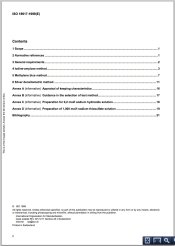
Further research shows PH4.8-1985 may be replaced by ANSI/ISO 417 1993 Edition, January 1, 1993 which has been revised by ISO 18917:1999 Determination of residual thiosulfate and other related chemicals in processed photographic materials -- Methods using iodine-amylose, methylene blue and silver sulfide

Looks like ISO 18917:1999 is copyright protected and only the table of contents is available on-line. Maybe someone has the document and can paraphrase it:
ISO 18917.jpg
 
Last edited by a moderator:
I've looked through other posts on this subject and have not seen anything recent, so -- here we go again. I need to test for residual hypo in archival contact prints on fiber-based double-weight silver gelatin paper (Ilford Multigrade Fiber-based VC Warm-Toned), and I note that the back of the Photographers Formulary Residual Hypo Test box says that it is not sensitive enough for archival printing. Anybody out there know of another test that can be used for archival printing? I believe my process is archival (been making B&W prints for 53 years and follow all the Best Practices I am aware of), but I'd like a test to be sure. Thanks!

Paul,if archival processing is your goal,You might be better off following reasonable procedure rather than precisely measuring residual hypo.two-bath fixing followed by HCLand a good final wash is the best you can do.extra protection comes from brief sulphide toningand/or silver stabilizersand proper storage.But first,make sure your images are worth of protection.Who needs an archival print of a mediocre concept?:wink:
 
Remember too that Ctein has pointed out that overwashing is bad for prints. See his article for details.

PE
 
Remember too that Ctein has pointed out that overwashing is bad for prints. See his article for details.

PE
That is correct but mainly pertains to RC-paper and film.Also, minute amounts ofhypo actually protect silver images, similar to toning,all very peculiar;I still think it's best to stick to time-proven processes and technique rather than to concern one self with the technical and scientific details.Otherwise once head might explodeand brain spatter is not a recognized archival treatment:wink:
 
I still think it's best to stick to time-proven processes and technique rather than to concern one self with the technical and scientific details.

The advantage here is that most of the work has been done for you. All that need be done is to follow the directions that someone else has worked out. This also implies not making substitutions or changes to the method. So do not overwork your fixer and wash you prints for the recommended time.
 
Hi Everybody -- Thanks for your thoughtful replies. As I said earlier, I'm following all the "best practices" I know of, having had workshops with Mark Klett, George Tice, Bruce Barnbaum, and John Sexton. I'd just like to run a test. And I guess the answer is: "It's Complicated."
 
Hi Everybody -- Thanks for your thoughtful replies. As I said earlier, I'm following all the "best practices" I know of, having had workshops with Mark Klett, George Tice, Bruce Barnbaum, and John Sexton. I'd just like to run a test. And I guess the answer is: "It's Complicated."

not at all butyou have to settle for the sensitivity it gives you.if you want more sensitivity it gets complicated if not impossible without a professional science lab and you may have to question your motivation for practicallity's sake.:wink:
 
Photrio.com contains affiliate links to products. We may receive a commission for purchases made through these links.
To read our full affiliate disclosure statement please click Here.

PHOTRIO PARTNERS EQUALLY FUNDING OUR COMMUNITY:


Ilford ADOX Freestyle Photographic Stearman Press Weldon Color Lab Blue Moon Camera & Machine
Top Bottom