
• Welcome to Photrio!
    Registration is fast and free. Join today to unlock search, see fewer ads, and access all forum features.
    Click here to sign up

Archival Print Washer Repair

Texas

A
Texas

  • 2
  • 0
  • 21

Forum statistics

Threads
203,432
Messages
2,854,525
Members
101,837
Latest member
Chapster
Recent bookmarks
0

Todd Barlow

Subscriber
Allowing Ads
Joined
Aug 9, 2004
Messages
522
Location
Ontario
Format
Multi Format
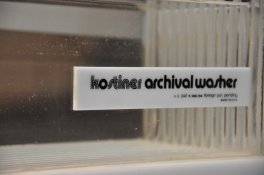
I am looking for some guidance on how to repair a Kostiner 16x20 Archival Print Washer (the version with an inlet, outlet and over flow port).

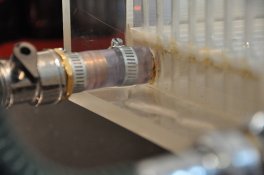
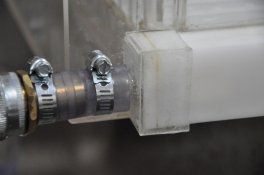
Repair 1 - Inlet and outlet ports are both leaking (photo 1 and 4)
-Would silicone chaulking applied liberally around the ports be a suitable repair?
-Speciality product like Weld-On 16 or another Weld-On product?
-Other approaches?

Repair 2 - Inlet port mounting plate seam is leaking (photo 1)
-Silicone?
-Another APUG post suggested additional white plexiglass over the seam with Weld-On Number 16 Solvent Cement, could the solvent cement be used by it self on the outside seam?

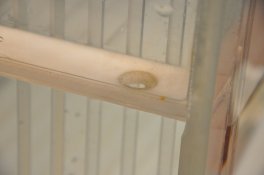
Repair 3 - Overflow port tube has broken off (photo 3)
-I was going to drill out the hole to remove old glue and then silicone back in place
-Based on question above would the Weld-on be a better solution?

Thank you in advance for any experience or suggestions you can offer.

Best regards

Todd
 

Attachments
  • DSC_0227 (800x531).jpg
    DSC_0227 (800x531).jpg
    224 KB · Views: 261
  • DSC_0228 (800x531).jpg
    DSC_0228 (800x531).jpg
    224.8 KB · Views: 255
  • DSC_0229 (800x531).jpg
    DSC_0229 (800x531).jpg
    216.1 KB · Views: 217
  • DSC_0230 (800x531).jpg
    DSC_0230 (800x531).jpg
    224.2 KB · Views: 224
Last edited by a moderator:
Apparently mine predates yours as mine doesn't have an outlet tube. It takes quite a while to drain while to bottom chamber dribbles and longer to dry totally (I don't use it that often).

I don't have much faith in silicone sealer as a repair product. If there was any on previously you will not get a good seal with the new stuff, and I would be hesitant to subject it to pressure.

I have no experience with welding acrylics with solvents but it sounds feasible for repair 2.

Best of luck with your repairs.

Dave
 
How about using a toliet inlet valve, sealed and tighten with washer on both sides, tightened with the nut supplied, cut to length.
 
I'd think that silicone around the leaks would be at best, temporary.

Removing the tube(s) cleaning the hole & tube and replacing it with the correct solvent would be more effective and look better.
 
Silicon formulated for aquarium repair should be good to fix leaks.
 
There are many types of silicon. The commonest sort seems to me to make an ok gasket, but isn't much good for more structural repairs, and it deteriorates with age. I'm no expert, but I think a repair with the correct adhesive for the materials in question would be best. Second choice would be a better sort of silicon, maybe plumbers' outdoor silicon.
 
Repair 3 - Overflow port tube has broken off (photo 3)
-I was going to drill out the hole to remove old glue and then silicone back in place
-Based on question above would the Weld-on be a better solution?

I inserted a plastic hose that end flush with the top edge of the overflow port. The right diameter plastic hose, you may have to clear out the old tube first, works without using any sealant.
 
Silicon formulated for aquarium repair should be good to fix leaks.

I used aquarium silicone to repair a cracked Calumet print washer. Seems to be holding up just fine. Home Depot, around $5.
 
Dear Tod,

The nice thing about starting with silicone is that you can always remove it with a sharp scraper. Having said that, if you have a plumber friend, tapping the holes and using polyethylene fittings (soft so they won't break the washer when you screw them in) would be a nice way to go. Make sure that any taps you use are nice and sharp so you don't crack the plastic.

Good luck,

Neal Wydra
 
Weld-on 16 is a pretty good product for leaks in seams, etc. It's thicker like syrup. It is also a solvent so it can't be removed. It won't adhere to materials it can't melt in to. You'll need to clean off any residue from water deposits first. Once you apply the weld-on, apply pressure to the seam/gap if you can with clamps.

As for the fittings, you can drill a proper sized hole (or drill/tap threads if you have the tools) into a small (2x2 inch) piece of acrylic and then glue that onto the tank which is less risky than messing with the holes already in the tank. I put silicon on the threads before screwing the spigot in.
 
Kostiner Archival Print Washer Repair - Update

Thanks for the responses and suggestions.
I thought I would post what I did in case someone else has a similar issue. I went with the Weld-On 16 (SCIGRIP16) solution, and no more leaks!

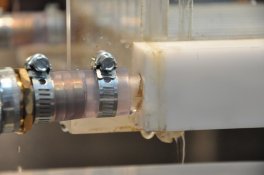
Repair 1 - Inlet and outlet ports are both leaking
-I added an additional acrlyic plate to the inlet and outlet ports (photo 1)

Repair 2 - Inlet port mounting plate seam is leaking (photo 1)
-I added additional plates that covered the seam on all three sides

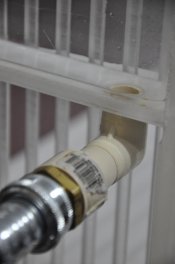
Repair 3 - Overflow port tube has broken off (photo 2)
-I cleaned out the hole where the overflow port was and then used the Weld-On 16 to cement a CPVC pipe (CPVC pipe is 5/8 OD which is exact size of the hole) and elbow configuration in place

Thanks agian for your help

All the best

Todd
 

Attachments

  • DSC_0231 (800x531).jpg
    DSC_0231 (800x531).jpg
    214.1 KB · Views: 237
  • DSC_0232 (531x800).jpg
    DSC_0232 (531x800).jpg
    214.9 KB · Views: 169
Todd: I plan on using Weld-on 16 to glue a sheet of plexi over a large crack in my similar ZoneVI washer. How did you apply the glue to the plates you used? Brush? Any hints you have based on your experience would be most welcome!
 
Todd: I plan on using Weld-on 16 to glue a sheet of plexi over a large crack in my similar ZoneVI washer. How did you apply the glue to the plates you used? Brush? Any hints you have based on your experience would be most welcome!

If the crack is tight together, you'll want some weld-on 4 and a syringe. Place tape on the inside of the tank over the crack to contain any excess and shoot the crack full of weld-on 4. It doesn't take very much. That should make a pretty strong bond and stop any leaks. If that doesn't do the job, proceed with your patch. Weld-on 16 cures pretty quickly so you don't want to do a really large area. I've only applied it directly from the tube although you can buy the tube with a couple different nozzles. I got mine from amazon.
 
Todd: I plan on using Weld-on 16 to glue a sheet of plexi over a large crack in my similar ZoneVI washer. How did you apply the glue to the plates you used? Brush? Any hints you have based on your experience would be most welcome!

Pete:
The Weld-On 16 is very "runny", so it comes out of the tube in a great quantity if you are not careful. I put it on both the plate and on the area I was patching and actually used wooden BBQ spears to spread it around. Popsicle stick or the like would also work. As for a brush I do not know if you would run into any issues using anything plastic to spread it around since the solvent in the Weld-On 16 could start to melt it.

Do a dry run, it does start to set up quickly, once in place maybe 30 seconds before you are pat the point of no return.

In the end it was pretty straight forward and easy to work with.

Use some disposible gloves in a well lit area.

Good luck and all the best.

Todd
 
Photrio.com contains affiliate links to products. We may receive a commission for purchases made through these links.
To read our full affiliate disclosure statement please click Here.

PHOTRIO PARTNERS EQUALLY FUNDING OUR COMMUNITY:


Ilford ADOX Freestyle Photographic Stearman Press Weldon Color Lab Blue Moon Camera & Machine
Top Bottom