• Welcome to Photrio!
    Registration is fast and free. Join today to unlock search, see fewer ads, and access all forum features.
    Click here to sign up

Ancient info for film dinosaur!

Recent Classifieds

Forum statistics

Threads
203,041
Messages
2,849,029
Members
101,615
Latest member
charliepongo
Recent bookmarks
1

Arvee

Member
Allowing Ads
Joined
Aug 23, 2006
Messages
976
Location
Great Basin
Format
Multi Format
Anyone out there have any information on Kodak film development times pre-1960 when film speeds were 1/2 what they are today?

Looking for TX/PX in D76 times pre-1960.

Thanks!

I suspect the info I am after is probably in a 50s Photo Lab Index.
 
Last edited by a moderator:
From KODAK Films for B&W Databook 1958: PX EI Daylight 80 7 / 8 / 9 minutes at 68F Continuous/ 30 sec Intermittent / 60 sec. intermittent

From KODAK Films for B&W Databook 1958: TXP EI Daylight 200 10 / 11 / 13 minutes at 68F Continuous/ 30 sec Intermittent / 60 sec. intermittent

The change that took place in the late 1950's was not a change in the films. The ASA rating change was an elimination of the exposure safety factor that had been used to reduce the risk of under-exposure.


I hope this is what you are looking for. If not let me know.

My email is listed at: makingKODAKfilm.com
 
Anyone out there have any information on Kodak film development times pre-1960 when film speeds were 1/2 what they are today?

Looking for TX/PX in D76 times pre-1960.

Thanks!

I suspect the info I am after is probably in a 50s Photo Lab Index.

Development to a specific gamma was not specified in the pre-1960 ASA. In the older system speed and development were independent. In the current fixed density method it can appear to the uninformed that speed changes with changes in development you can only use the fixed density measurement at a specified gamma.
 
I have a 1950s photo lab index I'm thinking of getting rid of. I can look this up, but if this is information you need often you really really need to own it.

name your price plus postage...or better yet, make a donation to the Red Cross for $30 and I'll mail it to you for free if you live in the continental us of hay.
 
Thanks, all, just the numbers I was looking for.

IC,

Any suggestions for reading material to further describe in detail what you are referring to in your response (the methodology for exposure/development for those early systems).
 
Ian,

I think TX came out in 1954. The film of choice prior to that was Super XX, I think. Laser's numbers above were for TXP; if you have numbers for TX I would appreciate it.

Thanks!
 
Tri-X, Plus X, Super XX etc all came out in 1938/9 as a complete new family of films. I've posted the data page from the 1940 Kodak Ltd Professional Catalogue here on APUG in the past (not sure where). In fact they were coated in at least 3 facilities at that time, Rochester (Eastman Kodak), and Kodak Ltd's UK Harrow facory and their Hungarian plant, possibly at the Candian plant as well.

So it was rather a shock to see Kodak celebrating 50 years of Tri-X many years too late :D In fact it wasn't initially sold as a 35mm emulsion probably becuase earlier versions were felt to be to grainy for the format.

Plus-X Panchromatic, Super-XX Panchromatic and Tri-X Panchromatic are the original names, I'm looking at a 1940's Dataguide. They were released after Iflord had upgraded their films with the first generation of Fine Grain Panchromatic and Hypersensitive Panchromatice which became FP2, FP3 then FP4 and HP2, HP3, HP4 and now HP5. Tri-X has been through as many revisions over the years.

Tri-X was 200 ASA Daylight and 160 ASA Tungsten light, for sheet film Kodak recommended DK60a, 6 mins intermittent agitation. However when the speed changed it was down to a change in the ASA (also BS) testing which removed a safety factor of a stop, the emulsions themseves didn't change and this affected every manufacturers films and ASA/BS rating

It's possible the research etc for these films was done in the UK there does appear to have been a wider range available here in 1939/40 than is shown in US publications.

Incidentially the Fortepan 400 was derived from Tri--X, the Fortepan 200 from Supper-XX, both were made in Kodak's Hungarian factory which later became Forte.

Ian

 
Fred, in some literature from the 40's & 50's Tri-X is called Tri-X Pan, given it's full nane of Tri-X Panchromatic, or just called Tr-X, but that's the same for Plus-X. Super-XX ect. The only film to change was Verichrome which had always been Orthochromatic from it's introduction in the early 1900's by Wratten & Wainwright, some products remaining in production after the became part of Kodak Ltd. It sold under the Kodak name from 1931 until 1956 when it was replaced by a Panchromatoc version - Verichrome Pan

A fly in the ointment with Tri-X was in fact it varied depending on which plant made and coated the emulsion. I had (and may still have somewhere) Kodak developer data-sheets showing different recommended exposures and development times for films made in the US, Canada or the UK. This wouldn't be so important to the average photographer buying films in their local market but by the 1950's photojournalists where regularly flying to different locations and Tri-X had become a film of choice for many, so getting the processing right was important.

I think it was the early to mid to 1970's before Tr-X became consistent/similar from every plant, this was matched by improvements in Kodkas Professional colour reversal films which no longer came with recommended speed ratings and colour filtration which had previously varied batch to batch.

It is odd that Kodak themselves didn't clarify the 50th Anniversary of Tri-X in the link you posted, but then it's just basic key points and sketchy.

Ian
 
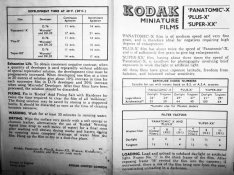
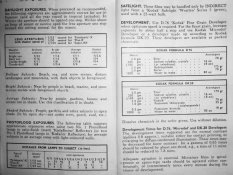
I have the inclusion sheet that came with some Plus X in the mid 50s. (I think) It's a quick snap with a digital camera and the light was poor bit it's legible, just.
 

Attachments

  • PanX_PX_SuperXX_a.jpg
    PanX_PX_SuperXX_a.jpg
    120.1 KB · Views: 95
  • PanX_PX_SuperXX_b.jpg
    PanX_PX_SuperXX_b.jpg
    112.7 KB · Views: 87
Thanks, guys, for all the help! Interesting how different the exposure index/development instructions were back then. Ian, you are a veritable fountain of historical photographic information!

Thanks, Murray, for the data sheet. Most helpful!
 
Last edited by a moderator:
I believe Tri-X was discontinued for a time in the late 40s or early 50s and then was reintroduced as an entirely new (and different) film in the mid 50s. That may not be true in all countries, however. There was a change in PX at around this time as well. Super-XX changed a bit over its life as well, but I don't remember any hype about it. The introduction of the new Tri-X was also about the time when Super-XX was discontinued in rolls, although it continued to be available in sheets for many years.
 
No, Tri-X was never discontinued it's in the Kodak Reference Databooks for 1946 (US), 1952/3, and Kodak UK publications during the same period.

It's not in the Kodak adverts in my WWII era BJP Almanacs but then it's quite possible that all production went to the military, I know that in the UK very little film was available for amateur use during the war.

Ian
 
Photrio.com contains affiliate links to products. We may receive a commission for purchases made through these links.
To read our full affiliate disclosure statement please click Here.

PHOTRIO PARTNERS EQUALLY FUNDING OUR COMMUNITY:


Ilford ADOX Freestyle Photographic Stearman Press Weldon Color Lab Blue Moon Camera & Machine
Top Bottom