• Welcome to Photrio!
    Registration is fast and free. Join today to unlock search, see fewer ads, and access all forum features.
    Click here to sign up

An Upswept Curve Question

Recent Classifieds

Forum statistics

Threads
202,092
Messages
2,834,988
Members
101,111
Latest member
gil9002
Recent bookmarks
0

ParkerSmithPhoto

Member
Allowing Ads
Joined
Jan 16, 2010
Messages
1,685
Location
Atlanta, GA
Format
Medium Format
Reading about HC-110, it says that it produces an "upswept curve." I get the basics on curves, but I am having a hard time visualizing what this means. Can someone translate this into plain English?
 

brucemuir

Member
Allowing Ads
Joined
Dec 25, 2007
Messages
2,228
Location
Metro DC are
Format
Multi Format
It means lower contrast in the mids than highlight.

contrast will increase towards the highlights to catchup for the slightly pulled down middle tone
 
Last edited by a moderator:

cjbecker

Member
Allowing Ads
Joined
Dec 9, 2010
Messages
1,400
Location
IN
Format
Traditional
Up sweep curves have more information in the shoulder section and s curves have more information in the mid section.
 

MattKing

Moderator
Moderator
Joined
Apr 24, 2005
Messages
55,364
Location
Delta, BC Canada
Format
Medium Format

holmburgers

Member
Allowing Ads
Joined
Aug 13, 2009
Messages
4,439
Location
Vienna, Austria
Format
Multi Format
Upswept Curves when combined with the appropriate lighting are really evident in some of the classic portrait styles.

Think George Hurrell: http://www.hurrellphotography.com/Hurrell/index.htm

Those are some of the most beautiful portraits (of equally beautiful women) that I've seen in a long time.

Can you elaborate more on how upswept curves & the lighting work together in this instance?

edit: More specifically, I see that these portraits rely heavily on shadows whereas the high-lights seem to be the focus. The shadows (faces in some instances) are full of detail, but the highlights (like light off the hair, or high points of the face) are glowing. Any comments on exposure determination as well? I'm just quite taken by them...
 

brucemuir

Member
Allowing Ads
Joined
Dec 25, 2007
Messages
2,228
Location
Metro DC are
Format
Multi Format
Holmes,
here's my thoughts on Matt's comments and we'll see how close I am...it helps me learn also.

You may know this already but Hurrell was BIG into fresnel/tungsten lighting where he could precisely focus the highlighting and even the amount off falloff etc.

Your observations about shadow detail and glowinging highlight would seem to reinforce Matt's upswept curve pairing, where optimal open shadows aren't a huge issue and better separation in the tones above middle gray being ideal for the subjects.

I've read he did use nylon/stockings over the lens sometimes and I'm betting that can cause some glow also.

The negs were 8x10 and heavily retouched also which contribute to his overall look.

It would be interesting if anyone knew his favored darkroom processing (soup/film type) and how much even the tungsten itself and the films spectral response from those times contributed.

I've always dug his work and the lighting from some of the cinematographers that came a little later.
 

holmburgers

Member
Allowing Ads
Joined
Aug 13, 2009
Messages
4,439
Location
Vienna, Austria
Format
Multi Format
Thanks Bruce that's very interesting. I didn't know about fresnel lighting really.

It's such a gorgeous look, and one that seems to be absent from modern times.
 
Joined
Jan 21, 2003
Messages
15,715
Location
Switzerland
Format
Multi Format
I think upswept curves can be really nice in landscape photography too. Looking at HC-110, for example, you don't have much shadow detail with a pretty pronounced toe, then mid-tones that are somewhat suppressed, and finally really good highlight contrast, unless you develop your negatives so much that they block up, in which case they become a nightmare in HC-110.

I always think of Bill Schwab's pictures when I think 'upswept'. Especially his older stuff has strong negative space in blacks, with low shadow contrast, some beautiful mysterious mood in the mid-tones, and crisp, bright, and glowing highlights, emphasized by his toning techniques. The printing obviously has a lot to do with it, and I have one of his prints where there are no real blacks anywhere, and highlights printed down far enough that it almost looks like an early platinum print, sort of pictorialistic. Same materials, I happen to know. Just different technique.
But his early work is an easy way to visualize what characteristics a print from a negative with upswept tone curve might look like, if treated carefully and well at printing time.
 
OP
OP
ParkerSmithPhoto

ParkerSmithPhoto

Member
Allowing Ads
Joined
Jan 16, 2010
Messages
1,685
Location
Atlanta, GA
Format
Medium Format
I always think of Bill Schwab's pictures when I think 'upswept'. Especially his older stuff has strong negative space in blacks, with low shadow contrast, some beautiful mysterious mood in the mid-tones, and crisp, bright, and glowing highlights, emphasized by his toning techniques..

Thanks to everyone for the feedback. I am a big fan of Bill Schwab's work, lovely stuff. Hurrel's work, too. There's almost too much great photography!

My work is primarily portraiture, with an editorial B&W style that I've been shooting for a few years. I've been using TMY+Diafine and a scan to print workflow, but I missed silver so much that I want to find a film and developer combo to continue my projects, and after studying HC-110, it seems like a good choice for a classic portrait look.

So, does HC-110 produce an upswept curve on any film, or just certain ones? Why does Ansel Adams rec HC-110 if there are other developers more suited to producing shadow contrast? Inquiring minds want to know...
 

Chuck_P

Member
Allowing Ads
Joined
Feb 2, 2004
Messages
2,369
Location
Kentucky
Format
4x5 Format
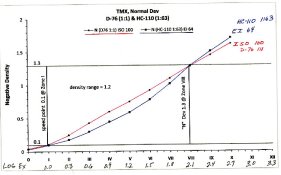
Best visualized in curve terms, IMO, when comparing one curve directly to another. Although not greatly upswept, the point is there. Just look at the curves themselves not any of the zone density data, that's not really relative to the point, IMO. Observe the slope of the HC110 curve from Zone VI to VII and VII to VIII, VIII to IX---the actual slope i.e. steepness of the curve in that region compared to the D76 curve is greater---you would expect somewhat greater highlight separation in that negative versus that same highlight developed in D76. I think with Tri-X with HC110, the length of the toe would be even longer and the steepness of the "upswept" curve would be more pronounced, IDK. Hope that was helpful.
 

Attachments

  • comparison-curves001-W.jpg
    comparison-curves001-W.jpg
    43.6 KB · Views: 189

ic-racer

Member
Joined
Feb 25, 2007
Messages
16,751
Location
USA
Format
Multi Format
The tone reproduction curve will be buggered. If you print the low zones the way you want and print the highlights the way you want, the middle zones will be too dark.
 

Photo Engineer

Subscriber
Allowing Ads
Joined
Apr 19, 2005
Messages
29,018
Location
Rochester, NY
Format
Multi Format
Reading about HC-110, it says that it produces an "upswept curve." I get the basics on curves, but I am having a hard time visualizing what this means. Can someone translate this into plain English?

Where did you find this information? I'm curious as this is much too rigid a statement and not necessarily correct.

If you go here: http://www.kodak.com/global/en/professional/support/techPubs/f4017/f4017.pdf

You will see that the curve shape depends on time of development and also dilution and developer type. You can select the curve you want from these families of curves and do it to suit your taste or your project needs.

PE
 

GraemeMitchell

Member
Allowing Ads
Joined
Aug 14, 2005
Messages
420
Location
NYC
Format
Multi Format
I've used nothing but HC-110 for years, and as PE and others have pointed out it isn't necessarily an "upswept curve" developer, or doesn't have to be, as I've lots of negs I've dev w/ it midday in the sun that could easily be mistaken for D-76.

BUT, w/ that, if you do want that long toe + no shoulder curve, HC-110 is a great developer to get there. Little less exposure, a little more aggressive agitation in developer, and...viola. Doing this ime, it retains a micro-contrast and highlight separation that I've personally never been able to replicate in other standard developers (d-76, xtol) which encourage a shoulder (not a bad thing). Of course, it's not just about the highlights, rather about where all the tones lay in relation to each other, and then all the more important things come into play, like light and exposure.

Anyway, best thing to do is to just try it. Take some TX, Hp-5, neopan 400, TMY. Expose a subject at box speed in flat light. Put it in HC-110 1+47 for about 8-9 min at 68 degrees, agitate, try a few more rolls, adjust, see what you think. These are rough starting points. It's a very very flexible developer. Very. I do suggest using a more classic S curve or linear curve film like one of those, b/c they sort of balance out that notion of building the upswept curve...if you try it w/, say, TXP, it can be a bit too much of a good thing so to speak (though people do have success w/ it).

The following link is TX at 400 in HC-110 as above. I think it displays a classic upswept curve's focus on the highlights, or in this case grays but that's how I liked it: http://freetheyounggiant.tumblr.com/post/13088638583/possiblyplausible-graeme-mitchell (not my tumblr page, but someone posted a pic of min I don't have online, so helpful here as a reference).

Mostly though, I use HC-110 b/c it's easy and cheap and replenishes nicely. It's look is nice for me, but I'd loose no enthusiasm for making pics if I was forced to find a look w/ something else tomorrow. B/c I imagine w/ TMY and D-76 I could make the same tones w/ a little testing.

Have fun w/ it.
 
Last edited by a moderator:

jbl

Member
Allowing Ads
Joined
Dec 4, 2009
Messages
93
Location
California,
Format
35mm RF
I think the upswept curve reference is from here

http://www.covingtoninnovations.com/hc110/

I'm not the OP, but that's what I remembered reading when I saw this thread. Though the linked article says "Although I have not made detailed tests, it appears that HC-110 tends to produce an "upswept" characteristic curve with relatively high contrast in highlights (dark areas of the negative, light areas of the picture)."

-jbl
 

Photo Engineer

Subscriber
Allowing Ads
Joined
Apr 19, 2005
Messages
29,018
Location
Rochester, NY
Format
Multi Format
That link shows one curve (Upswept) from a large family of curves with possible development times and films. It is therefore highly misleading. I don't suggest that this be taken as an absolute but rather one of a myriad of possible curves with HC-110.

PE
 

GraemeMitchell

Member
Allowing Ads
Joined
Aug 14, 2005
Messages
420
Location
NYC
Format
Multi Format
I don't suggest that this be taken as an absolute but rather one of a myriad of possible curves with HC-110.

PE

If you read the post, I pointed that out pretty clearly: that it was an example of one possibility. So I don't get your "misleading" bit. Sorry. After all, the whole point here is to show some examples of an upswept curve (which I personally love). HC-110 does it particularly well w/ some films. Had I posted a shot done in neopan 400 in xtol...now that'd be misleading.
 

Photo Engineer

Subscriber
Allowing Ads
Joined
Apr 19, 2005
Messages
29,018
Location
Rochester, NY
Format
Multi Format
Graeme;

My post was in answer to JBLs post above mine, not yours. In fact, I did not see your example. Even though I have JavaScript enabled, I was blocked from that site by Mozilla. So.......

To go a step further, showing a picture does NOT show me the curve and vice versa.

PE
 

GraemeMitchell

Member
Allowing Ads
Joined
Aug 14, 2005
Messages
420
Location
NYC
Format
Multi Format
PE, ah, the beauty of communicating via forum posts. But thanks for clarifying, makes much more sense to me now, and in this case, I agree w/ you completely.
 
Photrio.com contains affiliate links to products. We may receive a commission for purchases made through these links.
To read our full affiliate disclosure statement please click Here.

PHOTRIO PARTNERS EQUALLY FUNDING OUR COMMUNITY:



Ilford ADOX Freestyle Photographic Stearman Press Weldon Color Lab Blue Moon Camera & Machine
Top Bottom