• Welcome to Photrio!
    Registration is fast and free. Join today to unlock search, see fewer ads, and access all forum features.
    Click here to sign up

Advice needed: first rolls of Plus-X in HC-110

Forum statistics

Threads
203,277
Messages
2,852,217
Members
101,756
Latest member
rsj1360
Recent bookmarks
0

Jedidiah Smith

Member
Allowing Ads
Joined
Feb 22, 2006
Messages
441
Location
Ventura, CA
Format
35mm
Just finished my first full session in my "new" darkroom from developing the negs to prints. Everything is "new gear" to me since I recently moved. Cameras, lenses, enlarger, chems, etc. While it's all fresh in my mind, I'd like to ask some questions. I understand I will have to do a lot more testing and am willing to burn through the film to do it, but I figure some of you can point me in the right direction with your loads of experience... :D

Developed 2 rolls of Plus-X (really Arista re-branded stuff) in HC-110 at Jason's 1:49 dilution for 8 min. Agitated 10 revolutions of the film every 30 secs in a small, black plastic 2 reel tank. The rolls were developed SEPARATELY, not together. It's been a long time, and just in case I screwed up, I didn't want to kill both rolls at once!

First off, the tonality is great (at least with Roll "A"). By that I mean total amount of shades of grey - from blackest black to white and in between is just awesome. I do like the look when printed. However, the grain is not as fine as I remember seeing with D76 and Xtol in the past (with Xtol edging out the D76 for me, ever so slightly). Trying to get a 16x20 (full frame of course) would really be a big stretch for this combo. Not that I print large all the time, but I do like the ability when needed. Plus-X in Xtol and of course T-Max 100 in Xtol seemed better for this. Is there any way to have this great tonality and small grain size too, or is it mutually exclusive when shooting 35mm?

Second thing: Both rolls of negs look pretty "good" as far as detail in them, etc...but they print VERY differently. This is a bit strange to me, but could be a number of variables - can you help me track them down? For example, on Arista RC paper, Roll "A" prints a 5x7 at say 10 to 12 seconds, and a simulated 16x20 at about 24 seconds. Roll "B" prints a 5x7 at just 4 seconds! Simulated 16x20 at 12 seconds. Obviously Roll B is "over cooked", but can I tell if it's over exposed in the camera, or if it's over developed (like did I have too much HC-110 syrup in there?)
Roll B is also way more contrasty, and it would be harder to pull the same tonality out of it on a print. I mean, the negs look OK, but it would be work to print them as nice as Roll A.
Similarities: Both cameras set on ISO 100, film exposed same day, similar conditions, and I took a fair amount on Aperture priority, so the in-camera meter was calling some shots.
Differences: Roll "A" was shot with Minolta XE-7 (old Cds cell metering) and Minolta 50mm f1.7 prime lens.
Roll "B" was shot with Minolta XD-7 (newer silicon cell metering) and Minolta 35-70mm f3.5 zoom lens.
Both cameras working properly, and good glass - that particular zoom is nearly equal to a prime. Could the difference in the negs have all come from the cameras? Or do you think it's some in the development too? I think I made sure I got every last drop of HC-110 syrup out of the syringe for Roll B, but I don't think I did that for Roll A...at that kind of dilution (only 6.6 ml in the whole tank!), I wonder if that could account for at least some of the over cooking of Roll B?

EDIT: I almost forgot: There seems to be a bit of yellowish kind of base fog on the negs, but only in the center part where the pictures are (not on the edges where the sprocket holes are, those are clear, normal looking). It is there on the "leader" where there is no picture in the middle as well - but not on the edges of the film at all. It is slightly worse (more yellow) looking on Roll A than Roll B. Is this something normal for developing with HC-110? Or did I not fix for long enough or something else?

Thanks for reading this long winded post, and any help in steering me to the right direction for testing from here. It's been a long time, but I had a blast tonight...need to do this much more often! :wink:
Thanks for the help,
Jed
 
Last edited by a moderator:
Tell us a bit more about fixation. Fixer used, time, agitation...
 
There is the possibility you over agitated. 10 inversions per 30 seconds (for me) is too much. I generally go with 5 per 30 seconds or 10 per one minute. Also, I hope when you say revolutions, you mean inversions. The differences can be attributed to using two different cameras. No two cameras function exactly alike, not even identical brand and models.

Did you reuse the developer? If so, that could be another factor in the difference, depending on the volume used, and if you compensated for first use(adding time to 2nd use). Were temperatures consistant for both runs?

There are many questions you can ask yourself, but what I think you need to do, is make notes of every thing you do, and refer to them . Keep a developing procedure check list in front of you when working to refer to so as to minimize any mistakes. Again, keep logs of every thing you do from shooting to the finished print, this will help you to know what works, and what doesn't.

Rick
 
If roll A prints at 10'ish seconds, and B at 5, B is less dense and is under exposed compared to A.
A yellowish base fog is not normal for Plus-X and HC110, your fixer may be suspect.
HC110 will be grainy in comparison to D-76 or Xtol.
 
Thanks for the fast replies and the good advice!
In order:
Fixer was Arista Premium oderless liquid Fixer from Freestyle. It says to dilute 1+9 and use for 1 to 2 min. on papers or film. On Roll A I did 1.5 min (split the difference) and Roll B I did full 2 min (thinking this would help the yellowish fog, which it may have.) I did not reuse the fixer - fresh shot each time at the 1+9 ratio. The time seems way fast, though. I remember doing Kodak fixer for like 5+ min a long time ago! Should I try fixing longer? Or maybe less diluted? Say, 1+5 or 1+7?

I thought that seemed like a lot of agitation, but I just went off Jason Brunner's suggestion of "2 inversions every 30 sec." I have one of those black plastic tanks with the red push on cap, and if I do inversions with it, it leaks a little. (Lame, I know). But, it has a little stir rod in the middle that you twirl, and it spins the reel inside for agitation...so I just used 10 good twirls with my hand every 30 sec. Maybe I should try "10 twirls of the stirring rod" every min (i.e. half the agitation)?

I did not re-use any of the chemistry. All one shot. But I've never used anything like this HC-110 syrup, either. I came up with 6.63ml needed in the total of 325ml in the tank...so if I was a little off in the syrup measurement, then that would pose a problem too. How close does it need to be? I will try to be more exact anyway.

Bdial: I didn't realize that I had it backward! So if it takes longer to print a negative, then that negative is "more exposed" compared to a faster printing neg? This means that Roll B either got less exposure in the camera or less development, right? Would that account for why the tones are not as nice?

About the graininess - not super happy with that at the moment, but just had to try this HC-110. I may return to D-76 or Xtol in the near future, but I think doing several rolls in this HC-110 will be a good way to get up to speed in the darkroom again.

Thanks for the input!
Jed
 
The 1+9 dilution is probably for paper strength fixer. RC paper will probably fix in 1' and FB in 2' at that dilution. Film on the other hand will not. Check the instructions again and look for proposed dilutions. You'll probably see 1+4 for film and 3-5' fixation time. In any case, refix.
 
Jed, use Clayton's F76 or Arista Premium Developer for Kodak Plus-X...the results are nearly grain-free, creaminess awesomely sharp. As to the yellow goop in the middle of your frames, that shouts of not fixing long enough...I use the same fixer as you, but fix for 7 full minutes, with the first 30 seconds agitation, then I agitate 5 secounds every 30. Check out my images, the one of the singular gas pump...I shot that with Plus-X, F76, 1+9, using Kodak's published times for D76. I never liked the results of HC-110 for Kodak Plus-X and stopped using the developer for good.

(there was a url link here which no longer exists)
 
Hi Anon, thanks for the suggestion. It's a pity it doesn't say anything about that on the label!
It says Mixing Instructions: Dilute with water 1+9. Directions: For film or paper, fix for 1 to 2 minutes.
That's all it says...but I agree with you, it does not seem to be strong enough at that high dilution. I will try my next roll at 1+4 like you say and see what happens.

By the way, how should I go about re-fixing these negs if I need to? They are already cut and I was printing them. They are just "test rolls", so I'm not too worried about them, but good to know the procedure for re-fixing in case I need to on important stuff someday. :D
Thanks,
Jed
 
Hi Silverglow, thanks for the report! It does look like you have nice tones in that pump shot. I am kicking myself, because I almost bought that Clayton F76, and then at the last minute decided to go with HC-110. The problem is now I've got this HC-110 bottle, that from the looks of it, will last FOREVER and process hundreds of rolls! Ahhhhhhhh. :D

Hehe...so do you like the Clayton F76 better than Kodak's D76 or Xtol? Those are the only 2 developers I really have experience with.

Thanks for your advice,
Jed
 
Kodak's D76 has nothing over Clayton's F76 IMHO....and F76 is a lot cheaper too. Now to save even more $$ get Arista Premium Developer as it is even cheaper AND it is rebranded Clayton's F76...dump that HC-110...why destroy even more negatives? Don't forget to fix 7+ minutes! You'll be fine...
 
Jed, I'd presoak them in a tray and refix them in another. Take care not to scratch anything, be gentle. I'd put them emulsion side up. Wash and hang. Paperclips or wire night help in this. I don't really know, I never needed to do it.

EDIT: You don't need to do it in a single batch if you don't feel comfortable.
 
Anon, thanks for the tips, I'll give it a shot when I get time here.

Silverglow, yeah, I kind of agree with you about the HC-110. Well, interesting experiment, anyway - I suppose I had to try it at some point. I can see for LF guys, the increased grain would be no problem at all, and the tonality is really nice...
Kind of makes me leery about anything other than D76 or Xtol, since I know I like those, but hey - the Clayton F76 can't be that different, can it? :D
I know mixing and storing Xtol is kind of a pain, but I think it lets me eek just a little bit more out of the negs, so I dunno at that point...it's a toss-up which way I'll go. I've always wanted to try some Pyro too, as that's supposed to be the bomb for 35mm as well.
Thanks,
Jed
 
I like rebranded chemicals, but that Arista Premium Odorless fixer is junk, IMO. It took longer to fix, needed higher dilutions, and went bad faster. Now I use Illford fixer; I am convinced it is a better value.

I recently tried HC110 for the first time and I immediately noticed it was grainier than the D23 and D76 I had used in the past. This was noticeable in 35mm. You can see it in my developer comparison at chazmiller.com/projects/devtest.html and how much finer grain D23 gives. I prefer the fine grain of D23 for the small formats despite the supreme convenience and good speed/highlight tonality of HC110. I still use HC110 for larger formats where grain is not an issue, or where I am trying to squeak more shadow speed out of my negatives. I suppose Xtol might be the best of all worlds, but I'm getting away from powdered, commercial developers.
 
You will get somewhat more solvent effect with HC-110 at 1:31 (Dilution B). There's yet more at Dilution A, but the developing times are too short for anything but a press photographer on deadline.

Ilford DD-X is nice for low-volume use, speed enhancing, good solvent effect. Pricier than HC-110, however.
 
If you're mixing the HC110 directly from the syrup, then you need to be very accurate, because it's highly concentrated stuff and a little goes a long way.
Yes, roll B got less exposure in the camera (most likely). Development time and strength has an effect but generally not as much of an effect as exposure, other things being equal. From what you describe, the two are a stop apart. Without seeing the negatives it's impossible to judge, but it sounds like roll B is a stop, perhaps a little more under exposed. The result would be low contrast, no really bright highlights, and a lack of shadow detail.
 
Thanks for all the help and suggestions. I'm a little uncertain as to my direction with developers at this point, so I may sit back and do some more research. I do appreciate the comments, though, and I'll double the strength of this fixer and use it up fast! Then I will be back to name brand chemicals, I think.
Who knows, maybe I'll even go back to Tmax 100 and Xtol or try a pyro dev.

Jed
 
Two or three gentle turns back and forth of the agitating rod every thirty seconds should be about right. Don't overdue your agitation, but make it gentle and make it repeatable.
 
Plus-X is beautiful...but it is certainly not what I would call "fine grained" in anything but a pretty tiny enlargement. Finer grained than Tri-X? Of course...but not a super fine grained film. So, that is not odd IME.

Different printing times is likely a result of different exposures and/or luminance ranges in your compositions (different contrast, basically speaking).

Best thing you can do for yourself: Unless you need it to use the camera, and not just for the meter, take out your camera's battery and throw it away (via the proper hazardous waste disposal service). Get an incident light meter ASAP, and learn how to use it! It will end foul exposures and foul amounts of exposure variation shot to shot.
 
Last edited by a moderator:
Thanks for all the help and suggestions. I'm a little uncertain as to my direction with developers at this point, so I may sit back and do some more research. I do appreciate the comments, though, and I'll double the strength of this fixer and use it up fast! Then I will be back to name brand chemicals, I think.
Who knows, maybe I'll even go back to Tmax 100 and Xtol or try a pyro dev.

Jed

There's nothing wrong with the chemicals you used...it was all user error ;-) Sorry but to blame the chems is really not appropriate ;-) I'd pass on HC-110 though as it will increase grain size.

No need to go for brand names only....Arista Premium has lots of great products and often they're rebranded from major names.
 
The more you dilute a developer, the more grain will appear because you have diluted the 'solvent' effect. HC110 is better suited to LF folks where grain isn't such an issue.

D-76 and Xtol are far better choices for what you are trying to accomplish.
 
The more you dilute a developer, the more grain will appear because you have diluted the 'solvent' effect. HC110 is better suited to LF folks where grain isn't such an issue.

True, but only of solvent developers, which are common but not universal.

Also, remember that solvents decrease grain but decrease sharpness and acutance simultaneously. If you get sharp, distinct grain you also get sharp, distinct image detail. The two go together. Soften the grain, you also soften the image.

It's up to the photographer to decide where the sweet spot is in this trade-off, but grain is not inherently bad.

XTOL gives the best trade-off of grain versus sharpness with most films, although there are other developers that are very interesting.
 
Everyone, thanks for all the kind comments and help. Yes, I realize it was some "operator error" here, but have to admit the directions on the fixer bottle were far from accurate, then! :D But, yes, I will take full responsibility.

It's just been a really long time since I did this - we moved twice this last year, and I never had a chance to use any darkroom gear for any good length of time over the last 2 years. So all the equipment, etc is new to me.

I think I'll try some T-Max 100 in Xtol again for a baseline, and see my results. I would also like to try the best Pyro developer for 35mm T-Max 100. Does anyone have suggestions for that?

Lastly, I'd like to compare those results to some of the slow "old school" emulsions like Adox/Efke 25 and Pan 25. I don't really need too much speed - I'd rather fine grain and good tonality.

Thanks for all,
Jed
 
Jed, true, the directions on the AP fixer are way off, sadly...I'd suggest fixing for 7 minutes at least.
 
Regarding your question about roll A vs. roll B.

I have a number of cameras and I like to pick one up and go shooting. But I discovered that my cameras fall in two distinct categories. Those cameras from the 70s and early 80s have metering set to expose slide film well and will actually expose film per the mfrs. spec.

Those cameras from the late 80s on have meters set to expose about +2/3 of a stop more because folks started using more print film than slide film and print film benefits from a bit more exposure.

I had to 'normalize' my cameras so I could get similar results no matter which camera I used.

So, get a gray card or similar material that is a mid tone and check the exposure from both cameras. I'll bet a beer you'll see about +2/3 stop more exposure from the newer camera.

I'd be interested in hearing your results. I see this 2/3 stop difference between my X-700 and my Maxxum 7, and my F2 and my F4S, my F1 and my EOS cameras.

I also have a nice collection of meters. I find the same 2/3 stop difference between the early meters and current production.

This difference may have to do with the fact that the ANSI Exposure Guide standard was re-written in 1986. I haven't had the opportunity to review either the early 70s revision or the 86 revision. I am sure Stephen Benskin will know the answer.
 
Last edited by a moderator:
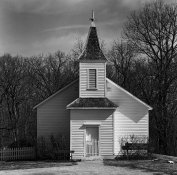
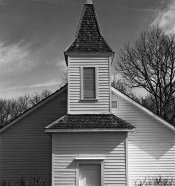
Clayton F76+ with Plus-X 120

I exposed a roll of Plus-X 120 today and developed it using the Clayton F76+, 1:9 for 6min @68F. This results in what I think are the best results I've had with Plus-X ever.

The convenience of this developer's dilution ratio, low cost and consistent results are why I've standardized on it... I can't seem to find a film that doesn't produce excellent results.

My attached scans here were made with Hasselblad 500 C/M, 120mm S-Planar, 1/60 @ F16, Plus-X Pan PXP120. No mods were made to the scans, these are unmanipulated.
 

Attachments

  • Church2March2010.jpg
    Church2March2010.jpg
    890 KB · Views: 132
  • Church3March2010.jpg
    Church3March2010.jpg
    863.5 KB · Views: 129
Last edited by a moderator:
Photrio.com contains affiliate links to products. We may receive a commission for purchases made through these links.
To read our full affiliate disclosure statement please click Here.

PHOTRIO PARTNERS EQUALLY FUNDING OUR COMMUNITY:


Ilford ADOX Freestyle Photographic Stearman Press Weldon Color Lab Blue Moon Camera & Machine
Top Bottom