• Welcome to Photrio!
    Registration is fast and free. Join today to unlock search, see fewer ads, and access all forum features.
    Click here to sign up

Adjusting Devlopment Time at different Temps -- looking for chart

Amour - Paris

A
Amour - Paris

  • 0
  • 0
  • 37
Bend in the river

H
Bend in the river

  • 2
  • 0
  • 55

Recent Classifieds

Forum statistics

Threads
203,235
Messages
2,851,836
Members
101,738
Latest member
parkeradam
Recent bookmarks
2

Vaughn

Subscriber
Allowing Ads
Joined
Dec 13, 2006
Messages
10,409
Location
Humboldt Co.
Format
Large Format
After a searching the forum and being unable to find one, I am looking for some sort of chart that gives a recommendation for film development time at different temperatures. Basically, one that says if your normal 68F development time is known, either add or subtract this percentage of the original development time to develop the film at a different temperature.

Seems to me I have seen one somewhere. It was not film-specific. I do not expect it to be spot on -- just ballpark figures for students to use as starting points.

And while I am here -- is there something equivilent for pulling and pushing films?

I just remembered that the Massive Developing Chart does have a graph, and it is about what I want. And they have recommendations for pushing film -- but not pulling film.

But since I have already started this post, any other recommendations out there?

Thanks!

Vaughn
 
Find a Kodak Black & White Darkroom Dataguide. Determine the development "number" for your standardised combination of film, developer, contrast, dilution, temperature and time. Adjust away!
 
This thread (long) covers the issues involved. (there was a url link here which no longer exists)

Not all Kodak B&W Dataguides have the development dial. Newer versions have charts.

I've done some work on this using data from Kodak Publication J-1 and some other sources.

The basic formula is:

new development time = old development time * b ^ (new temp - old temp)

where "b" varies with film and developer combination.

Here are some values for "b" that I've found regressing against Kodak J-1 Data and a couple of other sources, with temperatures in Fahrenheit.

Xtol 0.94576
Xtol + Acros 0.93784
Xtol + TMY-1 0.96670
D-23 0.93736
D-25 0.92698
Microdol-X 0.94592
D-76 0.95049
HC-110 0.95582
Rodinal 1:50 0.95223
Pyrocat HD 0.95800

These numbers are derived mostly from Publication J-1 for the most commonly used films. Your mileage will likely vary. The generic Ilford and Kodak temp vs. time charts are just that: generic, but are good first approximations for your own testing.

Lee
 
Thanks for the Ilford link! Much easier for the students to reference than the chart given on the Massive Development Chart website!

Matt -- what edition of the dataguide are you referring to -- can't seem to find any reference to a development "number" in my 1988 edition. I am wondering if Kodak stopped printing that because of the TMax films -- which seem to react more strongly to changes in developing than conventional films (thus may not fit the pattern.)

I have a good set of data points for TMax films and will probably post the Ilford chart for the students on all the rest of the films.
 
Vaughn:

All of my Darkroom Dataguides are older than 1988 :smile:.

My most recent is a 1980 version, and has the "dial".
 
Lee

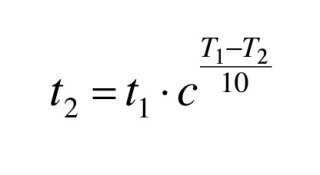
Great stuff. For a different approach see: Development by Jacobson & Jacobson. The attached equation goes along with it. I believe that Ilford used a temperature coefficient 'c' of '2.5'.
 

Attachments

  • Picture 1.jpg
    Picture 1.jpg
    35.9 KB · Views: 98
Thanks, Matt -- I probably have a much older one around somewhere.

This info will give us ballpark figures (we only use D-76, usually 1+1), which will keep things simpler.

Lee -- would D-76 straight and 1+1 have similar values for "b"?

But in the end, I will let students know that these are only ballpark figures -- and that the proof will be in the negatives and how they print!
 
I made my own... I started with Kodak's literature for the film/developer combination. Then interpolated the time for missing temperatures based on numbers published. Now, I have dev time at every degree of temperature within reason. Then, I took that number and figured out -15%, -10%, 0%, +10%, and +15% in time.

End result is a 2 dimensional chart. Sufficiently accurate for my needs.
 
Ralph,

That's the same approach as mine, except that dividing the difference between Tsub1 and Tsub2 (upper case "T", which are temperatures) by 10 normalizes the coefficient 'c' to a ten degree change, which is a common approach. I didn't bother with that since my aim was to create a spreadsheet where I state my baseline temp and time, and working temp and get a resulting adjusted time. For clarity, in the equation you posted tsub2 (lower case "t" is time) is adjusted development time and tsub1 is base development time.

The coefficient will obviously be different between Celsius and Fahrenheit, but the equation and method are the same.

Vaughn, I'd have to check the D-76 data. I didn't use any of the 1:1 info, but you could easily check for differences in adjustment by downloading J-1, or J-78 (for D-76) yourself.

Lee
 
Last edited by a moderator:
Thanks everyone -- I definitely have enough info to go on. Much appreciated!

Vaughn
 
Remember if using an equation that temp is measured in deg_F in some places, and deg_C in the rest of the world.
 
Remember if using an equation that temp is measured in deg_F in some places, and deg_C in the rest of the world.

The last time I touched down in Sydney it was 45C... call it 45 or call it 114, it was just dang hot!

Vaughn
 
Photrio.com contains affiliate links to products. We may receive a commission for purchases made through these links.
To read our full affiliate disclosure statement please click Here.

PHOTRIO PARTNERS EQUALLY FUNDING OUR COMMUNITY:


Ilford ADOX Freestyle Photographic Stearman Press Weldon Color Lab Blue Moon Camera & Machine
Top Bottom