• Welcome to Photrio!
    Registration is fast and free. Join today to unlock search, see fewer ads, and access all forum features.
    Click here to sign up

Adjustable Infrared Filter

Tompkins Square Park

A
Tompkins Square Park

  • 8
  • 0
  • 87
Siesta Time

A
Siesta Time

  • 2
  • 1
  • 66

Recent Classifieds

Forum statistics

Threads
202,861
Messages
2,846,718
Members
101,574
Latest member
JRSCollection
Recent bookmarks
0
I'd never even heard of them before, but suspect they are a variation on the variable density filters that change the angle between two polarizers. Many decades ago such a filter was marketed for moderate compensation for color temperature. They never became popular.
 
The so-called "variable ND" filters are really, really popular with the new generation of kids shooting video with their DSLRs. They don't seem to understand that those things are actually polarizers though. It's an easy "turn a ring and look at the screen and shoot" vs. having a set of NDs and a matte box.

Looks like you'd have the same issues with this product (blotchy skies, dead skin, etc). But the idea of balancing full-on opaque UV with some amount of visible light is interesting - I don't shoot full-on IR because I tend to be "seen one white tree, you've seen 'em all" and prefer deep red filters, so I'd like to see how many looks could come from the same scene. Would be great to frame up a composition and intuitively know the IR-to-visible balance that would serve your vision for the final print, wouldn't it?

 
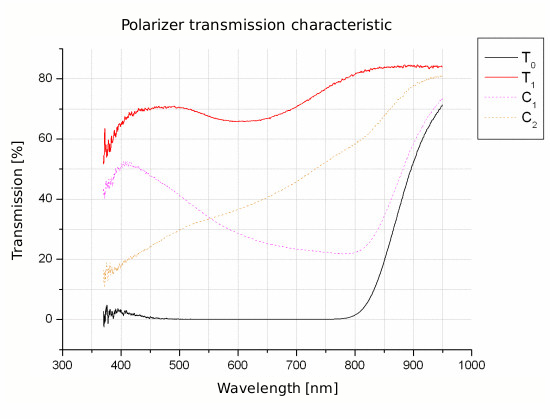
The idea behind such a filter is to take a deep red filter and adding a density-dependent transmission shift in the far red by that polarizer sandwich:

see red and black lines only
red = parallel, black = crossed

2648_transmisja.jpg
 
  • AgX
  • Deleted
New to me. I would need more information about whether they were true wavelength filters or polarizors.
 
I don't know of a different kind of adjustable band-pass filters than I described above, that could be used as camera filters.
(For other uses there indeed is a different concept.)
 
I must say since this filter is essentially a sandwich layer of 3 filters (as AgX explained) my trust in the whole thing is rather low. You have 6 additional optical surfaces and all the drawbacks that result from that (flares and ghosting, sharpness reduction, light loss) especially since they do not mention any optical coating...
 
I don't see however how this speciality filter could work with film.

IR-films sensitivity to the longer IR wavelenghts is a tiny fraction of that of their visible spectrum sensitivity.
Thus to start one would need a true infrared filter as base filter, not that red one.

I neither see the advantage of that band-pass tuning. For film a high-pass filter is sufficient as the "band-pass" will be formed by the falling film sensitivity at the right end. Using different IR high-pass filters would do better.
 
Photrio.com contains affiliate links to products. We may receive a commission for purchases made through these links.
To read our full affiliate disclosure statement please click Here.

PHOTRIO PARTNERS EQUALLY FUNDING OUR COMMUNITY:


Ilford ADOX Freestyle Photographic Stearman Press Weldon Color Lab Blue Moon Camera & Machine
Top Bottom