• Welcome to Photrio!
    Registration is fast and free. Join today to unlock search, see fewer ads, and access all forum features.
    Click here to sign up

Acros @ 80?

Conversations.

A
Conversations.

  • 3
  • 0
  • 18
The Charm.

A
The Charm.

  • 0
  • 0
  • 16

Recent Classifieds

Forum statistics

Threads
202,039
Messages
2,834,276
Members
101,086
Latest member
lyrical.outdoors
Recent bookmarks
0

RattyMouse

Member
Allowing Ads
Joined
Oct 18, 2011
Messages
6,045
Location
Ann Arbor, Mi
Format
Multi Format
Awhile back someone recommended me, that since I shoot a Fuji GA645 which has a contrasty lens, I should shoot Acros 100 at ISO 80. At least that is what I think I remember being told. Shooting ISO 80 should lift the shadows a bit (which are dark on occasion). One thing I dont understand. If I shoot at ISO 80, does that mean I need to develop differently too? Should I tell the lab that I give this film to develop as an ISO 80?

Also, do you agree with the idea to shoot Acros at 80?

Thank you very much.
 

thegman

Member
Allowing Ads
Joined
Feb 8, 2010
Messages
621
Format
Medium Format
If you want to lift the shadows, then shoot @80, but develop like you shot at 100. Basically, you'll just over expose the film by a very small amount, making the shadows less dark.
 

Klainmeister

Member
Allowing Ads
Joined
Jun 2, 2010
Messages
1,504
Location
Santa Fe, NM
Format
Medium Format
This advice is useful, but is dependent on development procedure. I shoot it at 64, but also have a developing scheme that promotes an insane amount of highlight and shadow detail (although I am moving away from this slowly). What developer are you planning on using and what look are you trying to accomplish.

Acros is an AMAZING film and very tolerable of mistakes.
 

JSebrof

Member
Allowing Ads
Joined
Oct 19, 2007
Messages
57
Format
Multi Format
When I was in school we used HC110, which according to the Fuji data guide, when used with Acros yields an EI of 80. That being said, I too would often expose it a bit longer and pull back on the development to increase the range of the film.
 

padraigm

Member
Allowing Ads
Joined
Feb 18, 2010
Messages
100
Format
Medium Format
Cut ISO in half and reduce development by 10% is a rule that works for me in regular circumstances.
 

markbarendt

Member
Allowing Ads
Joined
May 18, 2008
Messages
9,422
Location
Beaverton, OR
Format
Multi Format
do you agree with the idea to shoot Acros at 80?

No.

The film in your camera is one of the most reliable things in your system.

In my experience box speed provides excellent results with more detail in the shadows than I will use with every film I have tried.

Until your own experience tells you that your have a problem just follow the normal use instructions.

What I mean by that is that only after you have eliminated all your own errors in metering (and an incident meter can really you do that and, if you have a lab print for you, you have eliminated any problems there and asked for proper reprints, then adjust.
 

newtorf

Member
Allowing Ads
Joined
Nov 29, 2011
Messages
103
Location
SF bay
Format
35mm RF
I usually shoot at half of the speed and develop as normal. I think the accuracy of my Leica M4's shutter makes the difference of 1/3-1/2 stop negligible.
 

Klainmeister

Member
Allowing Ads
Joined
Jun 2, 2010
Messages
1,504
Location
Santa Fe, NM
Format
Medium Format
Its all kinda moot until we know the developer and the intent. But yes, it works great at 100, 80, 64, etc. and there's a lot of variation of what the film can accomplish. But for a general rule of thumb, going from 100 to 80 with a BW film like Acros is within the realm of silly since most cameras aren't that accurate metering OR there shutters would make up the difference.
 

DREW WILEY

Member
Allowing Ads
Joined
Jul 14, 2011
Messages
14,897
Format
8x10 Format
Depends on the developer, of course. I use PMK pyro and always rate it at 50 in order to get the
shadows further up the straight part of the curve. If you are having a lab develop it, you should
do some simple testing at different ASA's of the same subject and see what works best for you.
 
Joined
Jan 21, 2003
Messages
15,715
Location
Switzerland
Format
Multi Format
I suggest not quibbling over a third of a stop at this point. It's too small.

If you want more robust shadow detail, keep it simple: shoot at 50 and develop normally. Acros has very high highlight contrast with a long scale, so unless you are dealing with an extremely high contrast subject, you will not lose anything in the highlights by exposing at 50. You'll simply have better shadow detail, and you print the negative down a little.

Reducing development time would bring the highlights down somewhat, which can make it easier to print, but this really depends on the contrast range of the scene you are photographing. There is no rule. The lab might say something like reduce development time by 20% for one stop overexposure - but then again someone like me would say exposing Acros at 50 is normal exposure. You'll have to see what works for you.

x 2

EI 80 isn't going to render a practical difference. EI 50 is an entire stop, and that will be noticeable in the shadow (film speed) department.
 
OP
OP
RattyMouse

RattyMouse

Member
Allowing Ads
Joined
Oct 18, 2011
Messages
6,045
Location
Ann Arbor, Mi
Format
Multi Format
Thanks everyone. I'm not developing my own film yet because I dont have the equipment. Was expecting my tank and reel to arrive this weekend but now find that it will be delayed almost 2 months.

I send my film to a lab that will let me specify D79, D96, HC110, DDX, XTOL, and TMAX developers. So far I've only tried D76.
 

Poisson Du Jour

Member
Allowing Ads
Joined
Jul 1, 2008
Messages
5,462
Location
.
Format
Digital
How is a third stop change going to affect a film that has such a known wide latitude? I don't see how a "contrasty lens" can play into it?
With transparency film, 0.3 stop either way will be noticeable, 0.6 either way will either make or break the image, but with B&W film, you need to go 2 or 3 stops to get any benefit.
I have exposed ACROS at 400 and 80 in a pinhole camera (diffuse light) with no change to development at the lab.
 

Richard S. (rich815)

Member
Allowing Ads
Joined
Jan 14, 2003
Messages
4,924
Location
San Francisco
Format
Multi Format
I usually shoot at half of the speed and develop as normal. I think the accuracy of my Leica M4's shutter makes the difference of 1/3-1/2 stop negligible.

Shooting at half box speed is a full stop not 1/3-1/2. With some B&W films and developers over exposing can give more grain.
 

Richard S. (rich815)

Member
Allowing Ads
Joined
Jan 14, 2003
Messages
4,924
Location
San Francisco
Format
Multi Format
Some people shoot at 80 because some testing indicated to them that this is closer to the "true speed". But as mentioned in most circumstances it should not make any significant difference. Some people are very precise in their approach and it does matter to them and they like to talk about it too.

Only time I will purposefully "overexpose" is when I have fairly contrasty conditions. Then I'll shoot Acros at 50 or HP5 at 200 or 250. I will also then pull development time back by 10-20% as well. This can do wonders for getting better shadow detail while also preserve highlight details too. And is also better for scanning in my experience.
 

markbarendt

Member
Allowing Ads
Joined
May 18, 2008
Messages
9,422
Location
Beaverton, OR
Format
Multi Format
Shooting at half box speed is a full stop not 1/3-1/2. With some B&W films and developers over exposing can give more grain.

Actually, not just some, for any given film/developer combo it is my understanding that all normal B&W films get grainier as exposure increases. That has certainly been my experience.

Chromogenics though, like XP2 and BW400CN, get reduced grain with increased exposure.
 
OP
OP
RattyMouse

RattyMouse

Member
Allowing Ads
Joined
Oct 18, 2011
Messages
6,045
Location
Ann Arbor, Mi
Format
Multi Format
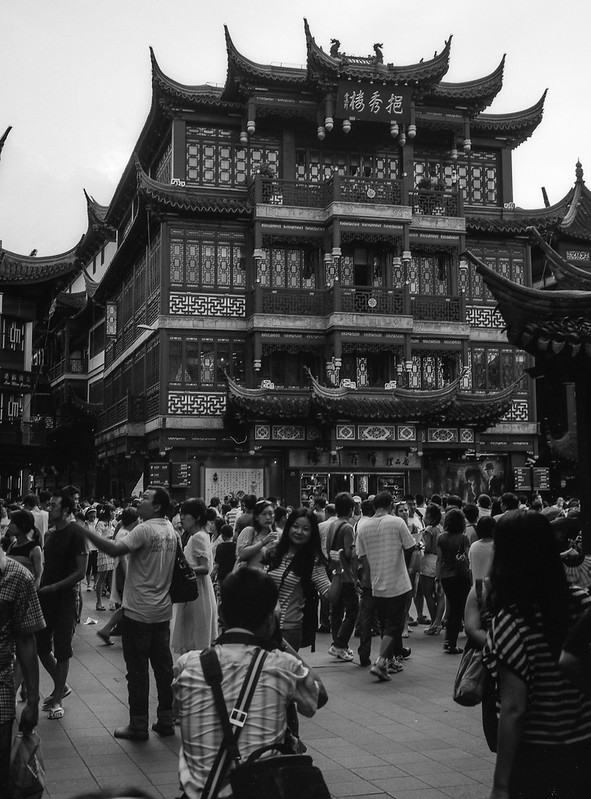
OK, I'm still a bit confused. How to get a shot like this and make it look better? It was VERY dark and I boosted the shadows in post after scanning. I think it is easily understood that the bright sky made the camera expose the foreground dark. In such a situation, I am not sure when I should add +EV to make sure the foreground is the stand out part of the image. Should I point the camera at the sky and take a meter reading, then meter the ground and compare the two readings to the "mixed" reading? If the differences are extreme, then determine if +EV is needed?

Is this better than shooting at a different ISO rating?

7899932720_699090cac4_c.jpg
 

MattKing

Moderator
Moderator
Joined
Apr 24, 2005
Messages
55,338
Location
Delta, BC Canada
Format
Medium Format
Assuming even light, if possible, you want to take your meter reading off of a middle grey - the pavement looks like a good choice here.

In most cases that will determine your exposure.

You certainly want to avoid having the sky determine your exposure, unless the sky is what you are most interested in.

In rare cases you need to go further. Sometimes there are subjects of interest in the frame that are relatively much lighter or much darker than average, where a normal and otherwise correct exposure won't result in those subjects appearing the way you want them. In those unusual circumstances you may make the decision to change the exposure in order to favour those subjects, at the expense of the rest of the frame. An example would be strongly backlit subjects, where the foreground is emphasized at the expense of the blown out background.

Generally speaking you don't adjust your EI with circumstances - you determine your EI when you calibrate your system, and stay with that EI. Subsequently you may make decisions to deliberately under-expose or over-expose certain subjects, based primarily on issues of contrast.
 
Last edited by a moderator:
OP
OP
RattyMouse

RattyMouse

Member
Allowing Ads
Joined
Oct 18, 2011
Messages
6,045
Location
Ann Arbor, Mi
Format
Multi Format
Assuming even light, if possible, you want to take your meter reading off of a middle grey - the pavement looks like a good choice here.

In most cases that will determine your exposure.

You certainly want to avoid having the sky determine your exposure, unless the sky is what you are most interested in.

In rare cases you need to go further. Sometimes there are subjects of interest in the frame that are relatively much lighter or much darker than average, where a normal and otherwise correct exposure won't result in those subjects appearing the way you want them. In those unusual circumstances you may make the decision to change the exposure in order to favour those subjects, at the expense of the rest of the frame. An example would be strongly backlit subjects, where the foreground is emphasized at the expense of the blown out background.

Generally speaking you don't adjust your EI with circumstances - you determine your EI when you calibrate your system, and stay with that EI. Subsequently you may make decisions to deliberately under-expose or over-expose certain subjects, based primarily on issues of contrast.

Thank you very much. I shall use your advice this weekend and see how it goes.
 

markbarendt

Member
Allowing Ads
Joined
May 18, 2008
Messages
9,422
Location
Beaverton, OR
Format
Multi Format
Is this better than shooting at a different ISO rating?

The problem you are facing is not one of film rating, it's in understanding what the meter is telling you/telling the camera.

My first suggestion is to put the camera in manual.

You can as Matt suggests then meter off the concrete/pavement and set the camera to that reading.

No need to use an EV adjustment or to change Exposure Index (the ISO setting you dial into the camera). 100 will be just fine.
 
Photrio.com contains affiliate links to products. We may receive a commission for purchases made through these links.
To read our full affiliate disclosure statement please click Here.

PHOTRIO PARTNERS EQUALLY FUNDING OUR COMMUNITY:


Ilford ADOX Freestyle Photographic Stearman Press Weldon Color Lab Blue Moon Camera & Machine
Top Bottom