
• Welcome to Photrio!
    Registration is fast and free. Join today to unlock search, see fewer ads, and access all forum features.
    Click here to sign up

A Very Important Darkroom Accessory: Children's Scissors

Recent Classifieds

Forum statistics

Threads
203,557
Messages
2,856,542
Members
101,905
Latest member
DarkroomDave75
Recent bookmarks
0

Alan Townsend

Member
Joined
Dec 7, 2025
Messages
255
Location
Peoria, IL, USA
Format
Multi Format
When at Walmart (America's largest chain store) last year, I stumbled across the place in school goods where they kept the childrens scissors, you know, the very short scissors with the rounded tips, and I bought half a dozen at $1.00 each. I had looked for these before, thinking they would be good for changing bag use due to the rounded tips not being able to punch holes in the dark cloth. And I was completely correct. For 35mm, these are the best, maybe not for roll film. Even for cutting negative as well as trimming tongues after bulk loding, these are absolutely perfect. When I was a kid, the school scissors were cast metal and poor quality. Today, we have stainless steel with nice plastic handles, much better quality and made in China and very cheap. A few years ago, I had to buy an expensive negative cutter to cut my 35mm negatives, but these kiddie scissors work just as well since the are the correct length and easy to see where you are cutting. My strong recommendation.
 
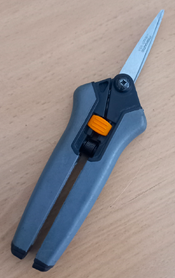
While I am not involved in darkroom practice, I do have a lot of positives (transparency) to cut on the lightbox before sleeving. To that end I've used, for around 17 years now, Fiskars Point shears — you won't find them in school supplies, but more generally in specialist craft stores; extremely sharp (and pointy!), they maintain their tack cutting into the often-narrow rebate between frames. Never had a mishap. Would not recommend these for kids because the point is very easily able to puncture fingers, and woe betide you if the shears should fall off the floor and onto your foot — easily able to penetrate the top of a shoe!! A scalpel is also handy sometimes when positioning a tranny into a mask prior to taping down.
 

Attachments

  • Fiskars_shears.png
    Fiskars_shears.png
    1.3 MB · Views: 79
Those children's scissors work for a couple limited uses in my darkroom. They come in handy. I have some old but in good service, dressmaker shears I use to cut negatives.
 
Those children's scissors work for a couple limited uses in my darkroom. They come in handy. I have some old but in good service, dressmaker shears I use to cut negatives.

I carry a pair of them in my LAB-BOX. never hurts to be safe in the dark
 
When I was a kid, the school scissors were cast metal and poor quality.

When I was a kid, school scissors were those solid black things you could stab a horse with and then use to cut off its legs. Heavy and pointy.

I have school scissors (and some others) in my darkroom. They sometimes have a bit of a problem cutting thin PET film, though.
 
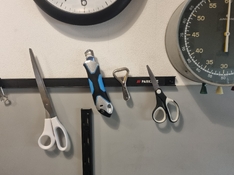
Had these forever.

signal-2026-01-15-065431.jpeg
 
I would suggest that you don't need to use scissors inside a changing bag, because when you loaded the camera you probably wasted 2 or 3 frames when winding on after you have shut the camera back to avoid exposing over the fogged area during loading. So all you need do is cut off the leader and insert about an inch of film into the spiral, before you put it in the bag. If you have rewound all the film into the cassette and don't have a leader, use a leader extraction tool. However, if you are rewinding manually and put the camera near your ear, you can hear when it pops off the take-up spool.
 
I have been using some old fashioned school scissors for the past 20 years or so in the darkroom.
They had about 1 inch broken off both parts.
 
I would suggest that you don't need to use scissors inside a changing bag, because when you loaded the camera you probably wasted 2 or 3 frames when winding on after you have shut the camera back to avoid exposing over the fogged area during loading. So all you need do is cut off the leader and insert about an inch of film into the spiral, before you put it in the bag. If you have rewound all the film into the cassette and don't have a leader, use a leader extraction tool. However, if you are rewinding manually and put the camera near your ear, you can hear when it pops off the take-up spool.

Yes but when you reach the end of the film as it enters the reel, you still need scissors to snip it off the spool.
Or so it seems to me unless I'm missing something from your post v🤷🏻‍♀️
 
Yes but when you reach the end of the film as it enters the reel, you still need scissors to snip it off the spool.
Or so it seems to me unless I'm missing something from your post v🤷🏻‍♀️

If you hold the edge of the film with your finger tips from both hands, you can rip it.
 
Do you really need scissors?

 
I'll stick with using scissors in the changing bag, thanks.
Attempting to rip the film from the spool does not sound like a good idea to me.
To each their own...
 
I'll stick with using scissors in the changing bag, thanks.
Attempting to rip the film from the spool does not sound like a good idea to me.
To each their own...

Perhaps I didn't explain it properly. You are not ripping the film off the spool, you are ripping accross the film and leaving about half an inch of film attached to the spool inside the cassette. The advantage of inserting the film into the start of the spiral in daylight allows you to cut the film with scissors between the perforations so you have a nice straight edge to wind in. But as you say each to their own.
 
While I am not involved in darkroom practice, I do have a lot of positives (transparency) to cut on the lightbox before sleeving. To that end I've used, for around 17 years now, Fiskars Point shears — you won't find them in school supplies, but more generally in specialist craft stores; extremely sharp (and pointy!), they maintain their tack cutting into the often-narrow rebate between frames. Never had a mishap. Would not recommend these for kids because the point is very easily able to puncture fingers, and woe betide you if the shears should fall off the floor and onto your foot — easily able to penetrate the top of a shoe!! A scalpel is also handy sometimes when positioning a tranny into a mask prior to taping down.

I‘ve had a pair of these for many years, as well as a few Friskars full sized shears, including a pair bought a few weeks ago and they are all great, good for film and paper too,
 
Perhaps I didn't explain it properly. You are not ripping the film off the spool, you are ripping accross the film and leaving about half an inch of film attached to the spool inside the cassette. The advantage of inserting the film into the start of the spiral in daylight allows you to cut the film with scissors between the perforations so you have a nice straight edge to wind in. But as you say each to their own.
Not everybody uses stainless steel reels nor do they throw away the cannisters. I have a bunch of old "snap cap" cannisters that are easily damaged and almost impossible to replace, so I use the gentler cut the tail off method of loading. I am a bulk film loader. Taking cannisters apart is easy, but losing the parts is also easy. In college class darkrooms, they use stainless due to ease of breakage for plastic. But also in college class darkrooms, most of those stainless reels are bent due to droppage.

Anyway after the sidetrack, I really like my kiddie scissors. I have a pair in my camera bag, both sets of darkroom drawers, enlarger easle and I keep a pair inside my changing bag. Oh, and a pair inside the ziplock bag I keep my fancy LED backlit negatice slitter I bought in.
 
Kodak, uses plastic tape to secure the film to the spool. Not the good old paper tape. This is when I always use my small scissors to cut rather than trying to tear the film.

If you are tearing the film outside of the cassette, it doesn't matter how it is attached to the spool. Also the method of loading the spiral while still attached to the cassette means you can wind it all back in if something goes wrong.
 
Perhaps I didn't explain it properly. You are not ripping the film off the spool, you are ripping accross the film and leaving about half an inch of film attached to the spool inside the cassette. The advantage of inserting the film into the start of the spiral in daylight allows you to cut the film with scissors between the perforations so you have a nice straight edge to wind in. But as you say each to their own.

I've trimmed the film leader in daylight for decades, & in fact, leave it sticking out. Then load the reel by pulling the film from the cassette.

As a result when I come to the end of the roll, it is simple and safe to cut across the edge of the film using the cassette as a guide for the scissors.

I understand the ripping across the film, and might try it on a scrap bit just to gauge how compliant the film is, simply because humidity in the changing bag leads to the film being ornery under the best conditions.
 
If you hold the edge of the film with your finger tips from both hands, you can rip it.

Only with the film on acetate base. As the films move to Estar or other PET bases, there are fewer and fewer of them that are easily "tearable".
 
I like the Hewes reels with the fingers. Never needed scissors with these I just rip the film and load.
Hewes.jpeg
 
Photrio.com contains affiliate links to products. We may receive a commission for purchases made through these links.
To read our full affiliate disclosure statement please click Here.

PHOTRIO PARTNERS EQUALLY FUNDING OUR COMMUNITY:


Ilford ADOX Freestyle Photographic Stearman Press Weldon Color Lab Blue Moon Camera & Machine
Top Bottom