
• Welcome to Photrio!
    Registration is fast and free. Join today to unlock search, see fewer ads, and access all forum features.
    Click here to sign up

A question about developers that raise or lower the ISO

Recent Classifieds

Forum statistics

Threads
201,850
Messages
2,831,125
Members
100,984
Latest member
Larrygaga00
Recent bookmarks
0

Sirius Glass

Subscriber
Joined
Jan 18, 2007
Messages
50,835
Location
Southern California
Format
Multi Format
"Developer A lowers the film speed of film X."
"Developer B raises the film speed of film Y."

The problem is not that the speed of the film is raised or lowered, rather that the developer's manufacturer is less than honest.

If the developer lowers the film speed, then correct the development time so that the film is developed so that the developed film speed is the film speed that the film manufacture had designated.

If the developer raises the film speed, then correct the development time so that the film is developed so that the developed film speed is the film speed that the film manufacture had designated.

The film manufacture knows what it is doing, so the developer manufacture should RTFM and publish the correct development times. This is not so complicated that the developer's manufacturers should have problems figuring that out.
 

Old-N-Feeble

Member
Allowing Ads
Joined
Feb 22, 2012
Messages
6,805
Location
South Texas
Format
Multi Format
Nah... it's just their subjective choice of EI. :D
 

removed account4

Subscriber
Allowing Ads
Joined
Jun 21, 2003
Messages
29,832
Format
Hybrid
some developers require more exposure to give the same density
and it has to do with the user doing film tests with developers
to see what works well for them
it has nothing to do with film makers being dishonest.
if they were dishonest about film speeds, they wouldn't go through
the trouble of doing film tests themselves in their lab to determine what they rate the film at.
 

MattKing

Moderator
Moderator
Allowing Ads
Joined
Apr 24, 2005
Messages
55,200
Location
Delta, BC Canada
Format
Medium Format
Changing the development time doesn't change the film's speed. It just changes the contrast.
 

Anon Ymous

Member
Allowing Ads
Joined
Feb 7, 2008
Messages
3,679
Location
Greece
Format
35mm
No, there are speed increasing as well as speed decreasing developers, it's not just a matter of providing a correct development time.

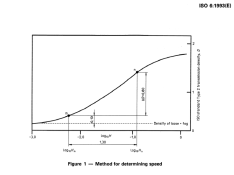
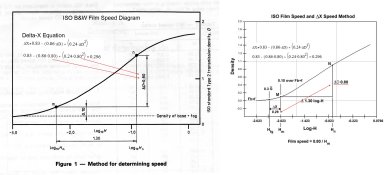
According to the ISO standard, film speed is calculated according to certain criteria. The characteristic curve of the film in developer X must have two points at specific places. One is the point at which the density of the characteristic curve is 0,1 units above film base plus fog. The other is 0,8 above the previous point (0,9 above fb+f). These two points must be 1,3 exposure units apart (in the x axis), so 4,33 f stops apart. So we also get a specific contrast that the characteristic curve must have. This means that another development time will give something different, so there is only one ISO film speed with a specific developer + film combination.
 
Joined
Jan 7, 2005
Messages
2,739
Location
Los Angeles
Format
4x5 Format
"Developer A lowers the film speed of film X."
"Developer B raises the film speed of film Y."

The problem is not that the speed of the film is raised or lowered, rather that the developer's manufacturer is less than honest.

If the developer lowers the film speed, then correct the development time so that the film is developed so that the developed film speed is the film speed that the film manufacture had designated.

If the developer raises the film speed, then correct the development time so that the film is developed so that the developed film speed is the film speed that the film manufacture had designated.

The film manufacture knows what it is doing, so the developer manufacture should RTFM and publish the correct development times. This is not so complicated that the developer's manufacturers should have problems figuring that out.

At fist I thought you were talking about film speed determination. Got a strongly worded post all ready to go before I caught myself. I think it would help if you had some examples.
 

Photo Engineer

Subscriber
Allowing Ads
Joined
Apr 19, 2005
Messages
29,018
Location
Rochester, NY
Format
Multi Format
Every emulsion has a fixed speed measured by a term called "Threshold Speed", and it cannot be changed. How that speed is applied leads to the determination of ISO or ASA speed. All of the above is true, but there is one additional factor.

If you look at any film curve, the threshold speed is the point at which the straight line of "fog" or "Dmin" deviates and begins to turn upwards to form the bulk of the curve of the product. By changing the contrast in this toe region, you can increase or decrease the overall speed of the product. The mid scale contrast can be kept the same.

In any case, you can only get 2 out of 3, grain, sharpness or speed.

PE
 

Ian Grant

Subscriber
Allowing Ads
Joined
Aug 2, 2004
Messages
23,409
Location
West Midland
Format
Multi Format
As usual Michael you assume that people think in terms of 0.1 & shifts. The vast majority of photographers aren't remotely interested so you need to explain in lay-mans terms.


Changing the development time doesn't change the film's speed. It just changes the contrast.

Changing the development time does change the EI(effective films speed). It's not significant with very slight changes but very significant when pushing or pull processing films, or N-2. N+2 development with the zone System.

Ian
 

Bill Burk

Subscriber
Allowing Ads
Joined
Feb 9, 2010
Messages
9,469
Format
4x5 Format
A speed increasing developer would be one which shifts the reference characteristic curve to the left when the ISO criteria are satisfied

A speed decreasing developer would be one which shifts the reference characteristic curve to the right when the ISO criteria are satisfied.

That is the usual definition, which I'd say applies to developers normally used. The Perceptol developer speed loss for example, would fall into this category.

Meet the ASA Critieria and you gained or lost speed if you find the speed point falls left or right of the same film in a standard developer when it met the Criteria.

But you have proven that speed isn't always that simple.

You have your own developer which causes a straight line to zero with a very low gradient. Here you are able to use exposure far to the left of what you would be able to use with a standard developer normally developed. Possibly even more speed than you would get with normal pushing.

So for film developed in special purpose developers, following corresponding special instructions, may have speed gain or loss due to the special treatment.

POTA, your developer and reversal developers would fall into this category.
 
OP
OP
Sirius Glass

Sirius Glass

Subscriber
Joined
Jan 18, 2007
Messages
50,835
Location
Southern California
Format
Multi Format
some developers require more exposure to give the same density
and it has to do with the user doing film tests with developers
to see what works well for them
it has nothing to do with film makers being dishonest.
if they were dishonest about film speeds, they wouldn't go through
the trouble of doing film tests themselves in their lab to determine what they rate the film at.

This is a good short non technical explanation.
 
OP
OP
Sirius Glass

Sirius Glass

Subscriber
Joined
Jan 18, 2007
Messages
50,835
Location
Southern California
Format
Multi Format
Changing the development time doesn't change the film's speed. It just changes the contrast.

As usual Michael you assume that people think in terms of 0.1 & shifts. The vast majority of photographers aren't remotely interested so you need to explain in lay-mans terms.

Changing the development time doesn't change the film's speed. It just changes the contrast.


Changing the development time does change the EI(effective films speed). It's not significant with very slight changes but very significant when pushing or pull processing films, or N-2. N+2 development with the zone System.

Ian

I'm not assuming people think that way. I'm just saying whatever speed or EI method you choose, you need some sort of way to evaluate how that EI or speed does or doesn't change with different developers.

Regarding changes in personal EIs and Zone System EIs with changes in contrast (N-2, N+2 etc.), yes the EI changes if the speed criterion is a fixed density speed point. That's why I'm saying there needs to be some sort of objective criterion in any formalized system, whether it's ISO, Zone System or Grant System. It isn't necessary to use any formalized system of course, but how else can you answer the question posed by OP?

This is the origin of the question. If one raises or lowers the film speed via N-1, N-2 then the result is lengthen or shorten the develop meant time.
 
OP
OP
Sirius Glass

Sirius Glass

Subscriber
Joined
Jan 18, 2007
Messages
50,835
Location
Southern California
Format
Multi Format
No, there are speed increasing as well as speed decreasing developers, it's not just a matter of providing a correct development time.

According to the ISO standard, film speed is calculated according to certain criteria. The characteristic curve of the film in developer X must have two points at specific places. One is the point at which the density of the characteristic curve is 0,1 units above film base plus fog. The other is 0,8 above the previous point (0,9 above fb+f). These two points must be 1,3 exposure units apart (in the x axis), so 4,33 f stops apart. So we also get a specific contrast that the characteristic curve must have. This means that another development time will give something different, so there is only one ISO film speed with a specific developer + film combination.

I'll take the bait and people can have at it. :whistling:

There are speed increasing and speed increasing developers, but you first need a reference point.

For example if the reference point is ISO speed, which has a specified gradient over a specific exposure range:

A speed increasing developer would be one which shifts the reference characteristic curve to the left when the ISO criteria are satisfied

A speed decreasing developer would be one which shifts the reference characteristic curve to the right when the ISO criteria are satisfied

If a different reference is chosen the definition changes somewhat. If you define speed as your working EI under a Zone System criterion for example, the reference point is your EI for the film developed in a normal developer to whatever contrast/density range you choose to use for the analysis. In this case, when developed to this chosen contrast level:

A speed increasing developer would be one which shifts the EI speed point (eg 0.1 above B+F) to the left

A speed decreasing developer would be one which shifts the EI speed point (eg 0.1 above B+F) to the right

There are other ways of measuring speed so these are just two examples.

Assuming a standard developer such as D-76 gives full emulsion speed (however you define it), some general purpose solvent PQ formulas such as Kodak TMax or Ilford DDX will tend to increase speed slightly. There are also some old "compensating" formulas which may or may not increase speed slightly. The film is an important variable. Some highly solvent, extra fine grain developers can generally be expected to decease speed slightly, though this effect is not limited to extra fine grain formulas since there are additional variables.

Every emulsion has a fixed speed measured by a term called "Threshold Speed", and it cannot be changed. How that speed is applied leads to the determination of ISO or ASA speed. All of the above is true, but there is one additional factor.

If you look at any film curve, the threshold speed is the point at which the straight line of "fog" or "Dmin" deviates and begins to turn upwards to form the bulk of the curve of the product. By changing the contrast in this toe region, you can increase or decrease the overall speed of the product. The mid scale contrast can be kept the same.

In any case, you can only get 2 out of 3, grain, sharpness or speed.

PE

Thank you, these give the technical explanation. I understand the explanation, however in general I do not walk around taking photographs think about 0.1 above Base and Fog. That aside, I will take this explanation and use it.
 
OP
OP
Sirius Glass

Sirius Glass

Subscriber
Joined
Jan 18, 2007
Messages
50,835
Location
Southern California
Format
Multi Format

Bill Burk

Subscriber
Allowing Ads
Joined
Feb 9, 2010
Messages
9,469
Format
4x5 Format
This is the origin of the question. If one raises or lowers the film speed via N-1, N-2 then the result is lengthen or shorten the development time.

I hope you are not saying... the solution to speed loss with N-1 development is to develop longer. Because that's not logical.

This might make sense: If you pick N-1 or N-2 for the process... by definition you have planned to develop less than Normal N.

So you should not say that to compensate for speed loss with N-1 development you should increase the development time. It's a contradiction in terms. N-1 in Zone System parlance means you plan to develop a certain amount less. (You want to develop so much less that highlights in your scene that are one stop higher than Normal will come down in density on the negative to where you like highlights to be when the scene is Normal.) You are saying you want to develop less to avoid blowing out your highlights.

So you don't develop more to solve the problem because if you develop more then you will blow out the highlights which is what you didn't want in the first place.
 

MattKing

Moderator
Moderator
Allowing Ads
Joined
Apr 24, 2005
Messages
55,200
Location
Delta, BC Canada
Format
Medium Format
This really does highlight the problem surrounding the term "film speed". There are several useful definitions (ISO, film base + fog + 0.1, whatever) for "film speed" and each of them incorporates contrast in slightly different ways.

In addition, as films and developers vary with respect to their curve shape, an adjustment of development time may have either very little or a lot of effect on the parts of the curve which have the most influence on "film speed" determinations.

So the answer to the question really is: "it depends".
 

georg16nik

Member
Allowing Ads
Joined
Aug 3, 2010
Messages
1,101
Format
Multi Format
...

For example if the reference point is ISO speed, which has a specified gradient over a specific exposure range:

A speed increasing developer would be one which shifts the reference characteristic curve to the left when the ISO criteria are satisfied

A speed decreasing developer would be one which shifts the reference characteristic curve to the right when the ISO criteria are satisfied....

The ISO determination of Hm e.g. “Point m is located on the curve at a density of 0,10 above base plus fog density.” disregards the fact that different films have different toe curve shapes; and in some cases, Point m happens to sit on the part of the curve that is beginning to toe out, resulting in loss of shadow detail in the print, so these films benefit from 1/2 extra exposure.

attachment.php
 

Attachments

  • iso61993.png
    iso61993.png
    71.8 KB · Views: 157
Joined
Jan 7, 2005
Messages
2,739
Location
Los Angeles
Format
4x5 Format
The ISO determination of Hm e.g. “Point m is located on the curve at a density of 0,10 above base plus fog density.” disregards the fact that different films have different toe curve shapes;

Actually it does take into account the toe shapes. The ISO contrast criteria comes from the Delta-X criterion which is a short hand version of the fractional gradient method. Jones found that quality prints resulted when the shadow gradient was no less than 0.3x the average gradient. If you'd read the papers I recommended, you would know this.

ISO Diagram.jpg
 

georg16nik

Member
Allowing Ads
Joined
Aug 3, 2010
Messages
1,101
Format
Multi Format
Actually it does take into account the toe shapes. The ISO contrast criteria comes from the Delta-X criterion which is a short hand version of the fractional gradient method. Jones found that quality prints resulted when the shadow gradient was no less than 0.3x the average gradient. If you'd read the papers I recommended, you would know this.

attachment.php

There is no (underexposure) safety factor since 1960, the papers you refer to does not change the fact, just finesse it further.
The underexposure issue is pretty obvious in some films and less so in others and developers that raise or lower the ISO can hardly workaround that.
As PE said above,
...In any case, you can only get 2 out of 3, grain, sharpness or speed...
 
Joined
Jan 7, 2005
Messages
2,739
Location
Los Angeles
Format
4x5 Format
There is no (underexposure) safety factor since 1960, the papers you refer to does not change the fact, just finesse it further.

You're just moving the goal post. You wrote that the ISO standard does not take into consideration the toe of the curve. I showed it did. You've now changed to saying there is no safety factor with the post 1960 standard, and there is one. It's smaller, about 1/3 stop. Also explained in the recommended papers.
 
Last edited by a moderator:

georg16nik

Member
Allowing Ads
Joined
Aug 3, 2010
Messages
1,101
Format
Multi Format
You're just moving the goal post. You wrote that the ISO standard does not take into consideration the toe of the curve. I showed it did. You've now changed to saying there is no safety factor with the post 1960 standard, and there is one. It's smaller, about 1/3 stop. Also explained in the recommended papers.

yeah, sure.
yet, when we place the useful zones on the straight line portion of the H&D curve, the “box speed” as per ISO becomes meaningless and some reach out for ISO raising developers.

btw: the B&W safety factor pre-1960 used to be... bigger.
 

Anon Ymous

Member
Allowing Ads
Joined
Feb 7, 2008
Messages
3,679
Location
Greece
Format
35mm
Thank you, these give the technical explanation. I understand the explanation, however in general I do not walk around taking photographs think about 0.1 above Base and Fog. That aside, I will take this explanation and use it.

The good thing is... you don't have to think about density above fb+f! You can simply follow the manufacturer's instructions and you will get at least a good result to rely on, provided that the manufacturer explicitly mentions ISO speeds on the box/datasheet. Not all films do and I'm not talking about TMax/Delta 3200, nor Kodak/Ilford/Fuji in general. That said, there's no substitute for proper metering. IMHO, many of the bad results can be attributed to underexposure when relying on reflected light metering.

EDIT: Oh, and i wish people could take the time and rtfm. The manufacturers supply a vast amount of information, but far too many people get development times from the massive Dev Chart and take them as gospel.
 
Last edited by a moderator:
Photrio.com contains affiliate links to products. We may receive a commission for purchases made through these links.
To read our full affiliate disclosure statement please click Here.

PHOTRIO PARTNERS EQUALLY FUNDING OUR COMMUNITY:


Ilford ADOX Freestyle Photographic Stearman Press Weldon Color Lab Blue Moon Camera & Machine
Top Bottom