


• Welcome to Photrio!
    Registration is fast and free. Join today to unlock search, see fewer ads, and access all forum features.
    Click here to sign up

A peek under the hood

Somewhere...

D
Somewhere...

  • 3
  • 1
  • 71
Iriana

H
Iriana

  • 6
  • 1
  • 137

Recent Classifieds

Forum statistics

Threads
202,745
Messages
2,844,975
Members
101,494
Latest member
FlyingDutchman
Recent bookmarks
0

Photo Engineer

Subscriber
Allowing Ads
Joined
Apr 19, 2005
Messages
29,017
Location
Rochester, NY
Format
Multi Format
I was minding my own business when the doorbell rang and there was this kindly old gentleman with a pushcart on the porch. He asked me if I needed any knives sharpened or umbrellas fixed, and I didn't but I did ask him if he could do electron micrographs.

Lo and behold, he whipped an EM out of his pushcart and said let me at it, so I did.

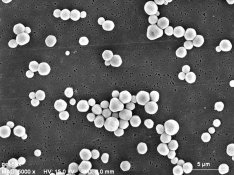
Here is the result. It is a PM of my SRAD camera speed emulsion, mentioned elsewhere. It is a variant that I'm developing for high speed fine grain applications.

As you see, it is about a 1 micron grain, rather monodisperse and consists of what I would describe as "rounded octahedra". It is just what I wanted to make and now I know exactly where I am and where I have been. I also know where to go next.

So thanks to this kindly guy for doing it for me. He got away before I could get him to do more, but hopefully he will be back someday. :D

My wife said that this looks like a convention of marshmallows.

PE
 

Attachments

  • Electron  micrograph - BrI SRAD.jpg
    Electron micrograph - BrI SRAD.jpg
    86.9 KB · Views: 322
Must be me then because I can see 6 angles round the edge which gives six faces and what looks like a top face which gives 7 faces on the visible side and assuming that is mirrored on the non visible side, then that would give 14 faces. An Octahedron only has 8 faces.
On the other hand you may just be having another senior moment.

Nice pic though...
 
PE,

This is very interesting. We can use photos like these as an example of what we could expect when building our emulsions.

Thanks,

Bob M.
 
Yes, but was the EM also made on film? :wink:
 
Dip, brush-on or spray-on?
 
The data was in a .jpg file when I got it. The old way was on film, but I guess they do it electronically now days.

The emulsion itself was raw out of the can stuff, never coated. That gives the most reliable data. The sample preparation process is long and tedious to insure you see the grains clearly.

PE
 
I was just thinking how cool a mise en abyme it would be to have an EM photo of film that is printed on film, and then make an EM of that photo in turn, ad infinitum...
 
Perhaps not on reflection...

Well, the 14 sided figure can be looked at in two ways if that is your concern.

If you start with an octahedron or a cube and etch off the corners to be flat, either way you end up with 14 sides. Now, further round off the remaining corners and you get what you see. Continuing the ripening and digestion will eventually result in nearly spherical grains which is also not a bad condition.

PE
 
Maybe this would be a good place to talk about what the different crystal shapes are, and what the advantages of one over the other would be.
 
Well, the 14 sided figure can be looked at in two ways if that is your concern.

If you start with an octahedron or a cube and etch off the corners to be flat, either way you end up with 14 sides. Now, further round off the remaining corners and you get what you see. Continuing the ripening and digestion will eventually result in nearly spherical grains which is also not a bad condition.

PE

I think that if you visualise your truncated octahedron from one direction, that it has a lot more corners than the ones in the photo. They are different from what I can see. But you are the researcher so you tell me.
 
Cutting the corner's off the cubes sounds like a good start, but how does one get the flat T-grains like you see in the SEM images Kodak publishes?

Ron, you say sherical is not bad (which it seems like you've got some tending in that direction as well), but don't we want to maximize the surface area of the grain to it's volume to make the most efficient use of our silver?
 
Well, the answers to all of the questions is that a particular grain is used for a particular purpose. The cross section (roughly diameter to light) is the main thing you want to consider. Second is halide content, and then the dispersity (variance in grain size / unit grain count) and on and on. So, cubes may be as good as octahedra depending on purpose.

T-grains mainly have the advantage in cross section. They have a huge diameter wrt light per unit volume as they are very thin. So, you can stack a lot of them and get fine grain and high speed both (in a sense).

Grain shape is determined by starting vAg and growth vAg. I have published that chart and discussed it in another thread, so I didn't repost it here with the electron micrograph. You may make a cube and yet end up with what I showed above simply as a function of digestion and ripending. The ripening dissolves fine crystals and deposits the AgX on the larger crystals growing them even larger and 'softening' the outlines. Digestion directly acts on the crystals as a whole, dissolving them and reforming them as the process continues. An ammonia digest then, carried to completion will yield what looks like a soccer ball by virtue of changing all crystals into one type.

The aim, whatever shape, is to get either a uniformly polydisperse emulsion, or a very monodisperse emulsions. In the first case, it could be used directly as a single component film emulsion with rather low contrast, and in the latter case it would be used in a paper. A monodispersed emulsion blended with several different emulsions will give a low contrast film emulsion. Thus a monodisperse 800, 400 and 200 emulsion set would each be too high in contrast for a film but blended will give a good low contrast film. This is true of any crystal habit.

All of the above is an approximate generalization. :D

PE
 
Thanks.

There is an Agfa site that shows a slide show of the cascade coater in action. This, the addition of active chemicals, and making exotic emulsions, is presently out of reach of the home darkroom worker.

I am approaching this in several stages:

1. What can be done in an inexpensive home darkroom.
2. What can be done by an advanced emulsion maker.
3. What is the most that can be expected in the home darkroom making emulsions.

I have dabbled in all 3, but am presently stuck at 1.0 for the benefit of the average user. The picture above is beyond the average user in availability and expense, I would think. So, it falls into 3. I just wanted to show what is possible using the methods in 1. :D

PE
 
Photrio.com contains affiliate links to products. We may receive a commission for purchases made through these links.
To read our full affiliate disclosure statement please click Here.

PHOTRIO PARTNERS EQUALLY FUNDING OUR COMMUNITY:


Ilford ADOX Freestyle Photographic Stearman Press Weldon Color Lab Blue Moon Camera & Machine
Top Bottom
