Here's the old thread that I was active in during my monobath experiments that Ian mentions above:
https://www.photrio.com/forum/threads/monobath-developers.10935/
I did it for a few reasons, one being that I was living in an apartment without much space to set up trays or tanks or store chemicals, and also I was looking to see if I could get the local contrast and edge effects characteristic of the Polaroid Type 55 look from a slow or medium speed film processed in a monobath. For those purposes, it was good.
The main downsides of monobath processing are--short life of the solution after the first use without expensive and exotic sequestering agents and the need for a lot of developing agent to balance the fixer, and also inability to change development time without mixing a new batch of the formula. These also tend to be strongly alkaline solutions, meaning extra precautions to avoid skin or eye contact, plus having to work with sodium hydroxide which has become increasingly more difficult to obtain in many places.
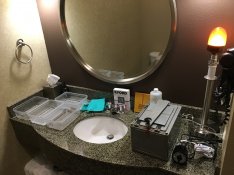
I wouldn't recommend it for processing while traveling, due to the short life and the hazards of dealing with a chemical that's like drain cleaner in an unfamiliar location in the dark, and I definitely don't want that stuff in my backpack, if I'm camping. I've done a cross country road trip with 4x5" TXP and Efke PL100, a bottle of Acufine and a bottle of TF-4 and a Nikor daylight sheet film tank. That kept the processing kit compact and simple, and I could pour the solutions back into the bottles after use. Any reusable developer and fixer will do, or you could go one-shot with a little more mixing (and measuring vessels and stock bottles to carry). I processed in motel bathrooms at night.