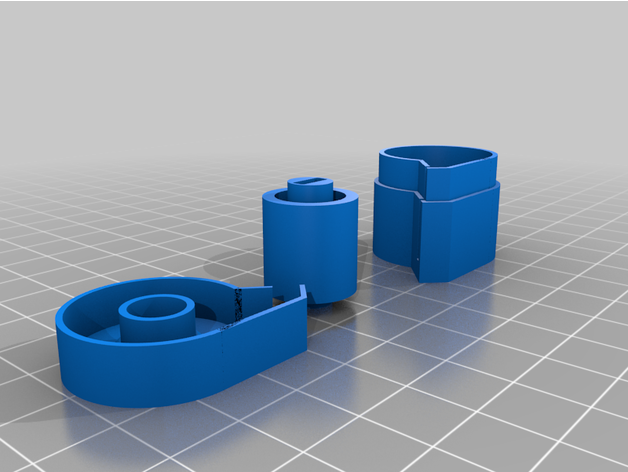
These are the same types of issues I've encountered when printing various submini cassettes. The tolerances are so tight that extensive 'finishing' or tweaks to the model geometry are generally required.
That said, anything that will get a Viscawide shooting again is a good thing so congrats on the print. 16mm cameras have way too much character with modern films to be languishing in a box due to lack of cassettes.
If you have a knack for modeling you could convert the design to one using a dedicated feed & take-up cassettes. The feed side doesn't need a spindle at all and the take-up only needs the spindle exposed on one side. Simplifies printing and probably helps with light-tightness.
Edit: eliminating the spool on the feed side could theoretically lead to film flatness problems due to less tension but who knows.
I haven't really learned enough or gained enough experience on how to tweak existing models in CAD, but I hope to someday.
For now, I will just scrape and sand to fit. I would have to assume that small things like Z axis "squish" would impact tolerances, not to mention the other dozen or so adjustments that can be fine tuned in Cura or whatever slicing program you choose to use.
I bought 2 non-functional Viscawide cameras for a reasonable price and have fixed one, so I am looking forward to shooting with it. They are fairly simple cameras, but the rubber covering on the lens pivot disc can deteriorate and cause 1/60th of a second exposure problems engaging the slow speed escapement.
Otherwise, as long as the lens is clear, just clean and re-lube the moving parts. If the lens has serious issues, it's not worth repairing in my book; simply too complicated to remove.
The point on eliminating the spool is well taken. I am surprised and leery of how the film takes a sharp turn after entering the film cassette on the take-up side cassette. The only thing I can guess is that it is also related to film tension across the gate, as there is nothing to keep it in place other than tension between the cassettes. Going to try to find some real fine-grained felt to put on the cassettes, as it looks like a real scratch hazard there.
Maybe once I learn CAD, I can mock-up a pressure plate to fit in the back of the camera and keep the film flat against the curved aperture plate. That should eliminate the need for a spool on the feed side, I would think...



 www.thingiverse.com


