• Welcome to Photrio!
    Registration is fast and free. Join today to unlock search, see fewer ads, and access all forum features.
    Click here to sign up

35mm or 50mm, which is your main lens?

MIT. 25:35

MIT. 25:35

  • 0
  • 0
  • 27
Lutheran Cemetery Angel

H
Lutheran Cemetery Angel

  • 0
  • 0
  • 33

Recent Classifieds

Forum statistics

Threads
202,948
Messages
2,848,002
Members
101,552
Latest member
rbaltman409
Recent bookmarks
0
F1.2 is too cool!

I can't imagine how shallow the DOF would be on an 85mm!

Just got my hands on a 55mm1.2 Nikkor and was VERY surprized at the difference in DOF from a 50/1.4!
 
My Canon FD (new) 35mm F/2 gets used more often for "general" photography -- at the same time, offering more DOF -- my favorite all-round lens. My 50mm F/1.2L gets used more for intimate work (informal portraits -- and the like -- with more shallow DOF). They're both "normal", for me; I like using both for different reasons.

Although not in direct response to your question, I'll just toss in that I also have a 100mm f/2 used exclusively for portrait work.
 
I have had similar thoughts in regard to the perspective offered in wide-angle lenses (that they tend to distort perspective). In my experience, I have noticed it more with focal lengths shorter than 35mm. The 35mm lens seems to offer a decent perspective (for a wide-angle lens). Likewise, I have noticed a certain lack of perspective, or "flattening" of the scene or subject, as the focal length gets longer (i.e. telephoto focal lengths). Thus, the 45mm, 50mm, and 55mm lengths are the most ideal I have come across.
 
I sort of like both focal lengths. The 35 is nice because it's wide but no so wide as to be obvious.

The 50 is sometimes derided, but it's really a good general-purpose focal length.

A well-designed 50 can cover a lot of territory.

For example, the Carl Zeiss Planar for the Contarex has a close-focus ability that is simply outstanding. The lens' design has served as the basis for nearly all 50mm lenses out of Japan since the 1970s.

It's a decent portrait lens, although not the first choice, and there probably are millions of family photos -- group shots, as well as shots of fathers, mothers, aunts, uncles, grandchildren, dogs, cats, cars, houses and summer vegetable gardens -- taken with a 50mm lens.

The 50mm length (or in that range, give or take 5-8mm) was found on the humblest of cameras, such as the Argus C3 (Cintar), as well as some of the most expensive, Alpa Reflex (Macro Switar).

As a user, I probably have shot with the 50mm lens more than any other focal length, and that's because most cameras that I've bought have that lens attached to it.
 
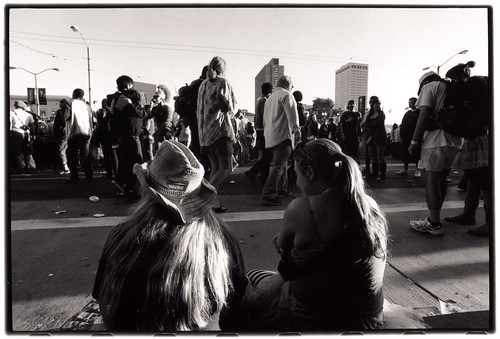
I tend to think it's about how the lens is used, not necessarily the focal length itself (within reason). Recent one I shot w/ 20mm:


I feel it works better here than a 35 or 50 would as it conveys perspective from the subjects outwards...
 
My favorite Canon FD 35mm f2 was getting a little stiff to focus and is in the shop at the moment for a CLA, and I feel lost without it.
 
If using an SLR I mostly use a 28 - 80mm zoom (on F80), if using my Bessa R3M mostly I use a 40mm or a 90mm.

I have a tripod that cost about $1000, and I often use considerably less expensive cameras on it. I've got the tripod, so I might as well use it.

That may explain the gentleman I spotted earlier in the summer...

NiceTripod.jpg
 
Last edited by a moderator:
Good morning;

While there are obvious differences in what each person uses as their "normal" lens, there can be actual optical characteristics that may influence that decision.

For me, I use a 58 mm focal length lens.

Why? Because I have found that particular focal length to match my own perspective with my eyes.

With a 58 mm lens, if I look through the camera view finder and note "where things are," when I look up at the scene with my eyes, nothing moves. Everything stays in the same place. If I put a 50 mm lens on the camera and repeat the process, things move when I shift my eye. This is especially noticeable on the sides of the viewfinder. When I look up, things on the side of the frame move out even more with a 50 mm lens. No, they do not move out as much as with a 35 mm lens, but they do move. With a 58 mm lens, everything stays in the same place. To me, that is "true perspective."

If you have access to these focal lengths, try it on your camera and see what you get.

Back when Nippon Kogaku came out with their Nikon F, their first fast standard lens for the F was the Nikkor-S Auto 1:1.4 f=5.8 cm. When Minolta came out with their first serious 35 mm SLR lens, it was also a 58 mm; the Auto Rokkor-PF f=58 mm 1:1.4. I believe that the optical engineers in both of the two companies in Japan who made their own optical glass had a reason for choosing 58 mm for their first serious professional low light level lens for a single lens reflex camera. I believe that reason is the true perspective this focal length provides in comparison with the vision of the human eye.

Some people think another reason for the early high-speed normal lenses to have a slightly longer focal length than 50mm is that it is much easier to design a slightly higher than 50mm high speed lens without touching the mirror (due to the large number of lenses) in a 35mm SLR, than a 50mm one.

Please correct me if I'm wrong.
 
Maybe I'm an amateur. Ok, I am an amateur. I just got my SLR today and was switching lenses fairly frequently. According to all of you, should I feel silly for walking around with a 70-210? I should probably get a 35 or 28. Maybe instead of my 135 that seemed least used.
 
should I feel silly for walking around with a 70-210?

Fireguy,

There is one thing that determines my choice of lens.

The plan for the print.

Try this experiment.

1 - Pick the spot in your house (or at the gallery) where you want to put a nice big print and mark the wall with some masking tape the exact size you want the print. Frame and mat do not count.

2 - Now use the masking tape to put an "X" on the floor where you will normally view the print from.

3 - Stand on the "X" and zoom or switch lenses until what you can see in the viewfinder is the exact size of the spot you marked on the wall.

Whatever focal length you end up with will give you a result that I call the "veiwers normal perspective". This assumes no cropping.

I try to shoot very close to that norm unless I want to compress or expand that perspective or when there is absolutely no other choice.
 
Last edited by a moderator:
My primes are 20, 50 and 85. I love all of them, 50 and 85 are both great for portraits, but when it comes to portraits I lean toward the 85. The 50 is the best all round lens in my opinion.

In landscapes/buildings I switch between the 20 and tokina 12-24 (on digital - I shoot both analog and digital). When I need magnification I have an excellent 70-300 nikon vr lens (considered cheaping out in a professionals point of view, but it's actually quite good considering its price) which works perfectly with mostly all AF and VR functionality on the F65.

My manual focus slr only has a 50, but works quite fine that way.

So I say 50, if you're not too concerned with convenience and you don't need the largest field of view or magnification (which is a more rare occasion than I thought it would be) it's really the only lens you need.
 
Fireguy,

There is one thing that determines my choice of lens.

The plan for the print.

Try this experiment.

1 - Pick the spot in your house (or at the gallery) where you want to put a nice big print and mark the wall with some masking tape the exact size you want the print. Frame and mat do not count.

2 - Now use the masking tape to put an "X" on the floor where you will normally view the print from.

3 - Stand on the "X" and zoom or switch lenses until what you can see in the viewfinder is the exact size of the spot you marked on the wall.

Whatever focal length you end up with will give you a result that I call the "veiwers normal perspective". This assumes no cropping.

I try to shoot very close to that norm unless I want to compress or expand that perspective or when there is absolutely no other choice.

That is pretty cool. Thanks for that.

MolBasser
 
I use the Minolta MD Rokkor 45mm f/2 a lot
 
Mark,

I just tried your method and it works. I was looking at my favourite painting from the distance I normally view it, then looked at it through my 55 mm lens. Spot on.

An interesting thing. For a long time I was using only an 50 mm normal lens. When I changed to a 55 mm lens, I noticed I started to step back just a little when taking informal portraits indoors. I wouldn't have expected such a little difference to be so akin to the photographer, but I'm happy it is.
 
I only have four lenses. I use my Nikkor 20mm and 50mm about equally, followed by the 60mm macro and 180mm 2.8. I don't own a 35mm lens and maybe never will.
 
Photrio.com contains affiliate links to products. We may receive a commission for purchases made through these links.
To read our full affiliate disclosure statement please click Here.

PHOTRIO PARTNERS EQUALLY FUNDING OUR COMMUNITY:


Ilford ADOX Freestyle Photographic Stearman Press Weldon Color Lab Blue Moon Camera & Machine
Top Bottom