
Hello all,
I am having a problem that I think is not due to typical user error. I have been using Flic Film's Black White and Green film developer for about six months, mainly with Kentmere 400 at published dilution (1:49) and times (both from Flic's documents and the Massive Development Chart of 16min 15 seconds with good/expectable results of a straightline showing a nearly .65 gamma. I recently started shooting and developing Kentmere 100, shooting it at box speed, and using the corresponding dilution and times published by both Flic and the MDC, 13 minutes and 30 seconds at dilution 1:49. The stouffer's tests I have been doing have both show a nearly 1.0 gamma, and negatives that I have found way too contrasty to reliably print the highlights from. I have tried to reduce agitation from a 1 minute initial agitation scheme and 5 seconds every 30 seconds down to a 30 second initial agitation and 5 seconds per minute. I have closely monitored the temperature and dilution, wondering if I had messed something up there. I was at the bottom of a bottle of Flic BWG developer and opened a new bottle, after having read someone else having a similar experience with Kentmere 100 and a different developer (HC110?).
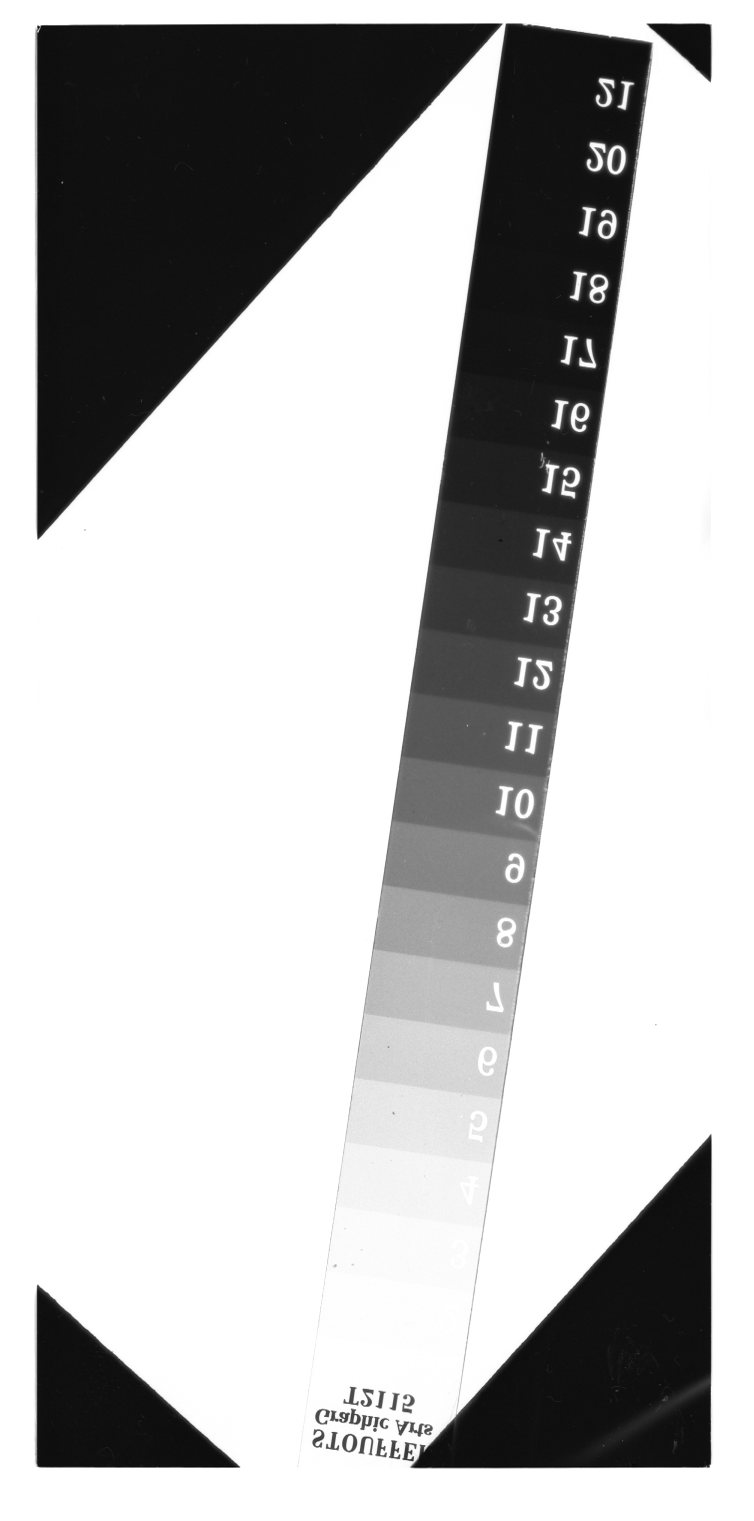
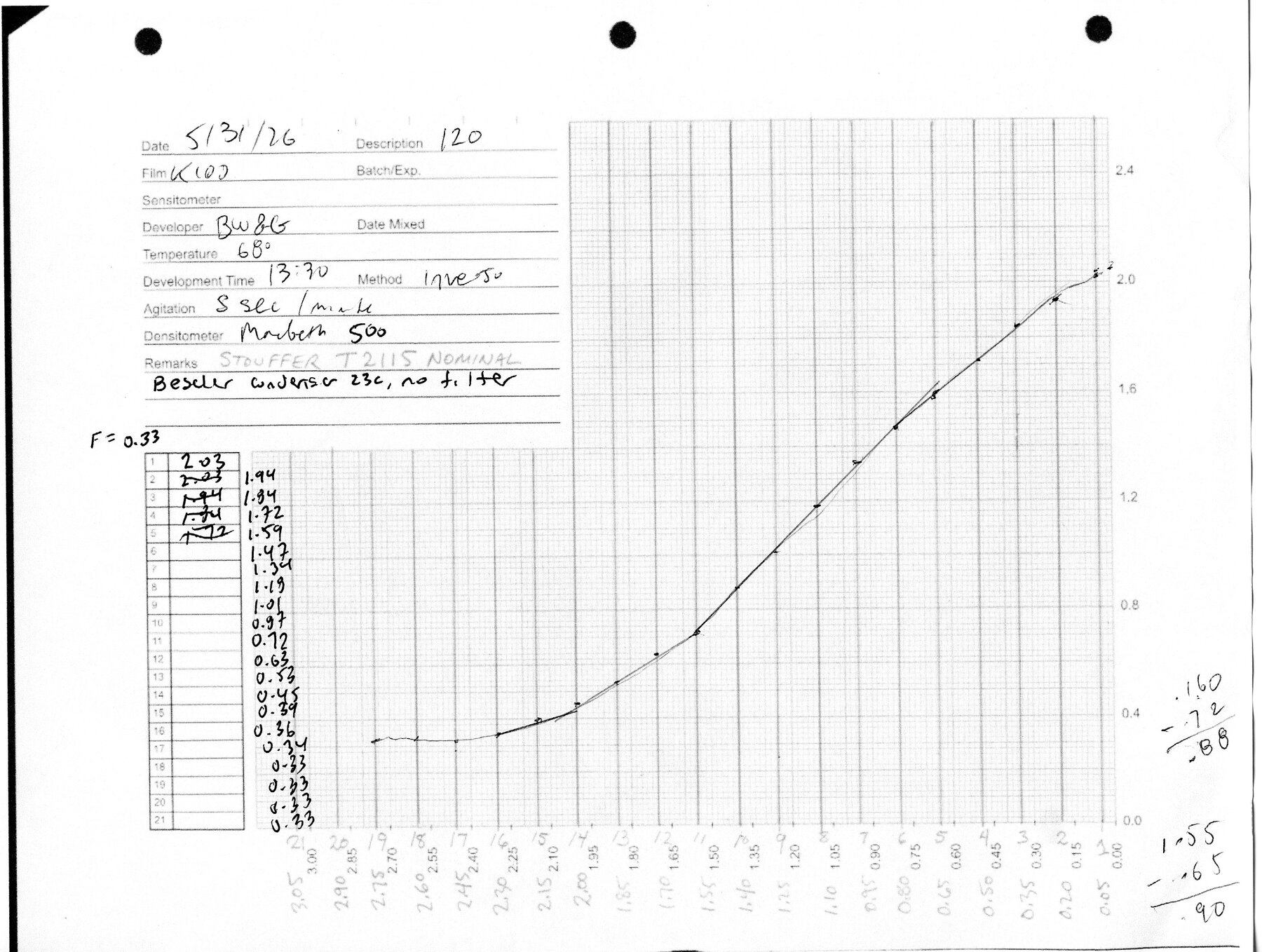
I am still aware that it may be my error, and hope that some of you may be able to identify a problem either in my description or assessment of the testing. I am attaching the scans of the most recent Stouffer step wedge and the chart I made using a Macbeth 500, which gives readings more reliably than, but still close to those of an X-rite 331 transmission densitometer.
Is it possible that the published times by both Flic and the MDC may be in error?
I am considering changing to a different developer. Ideally I should be able to adjust my time and/or dilution to get better development with this developer, right? What can anyone suggest as starting/adjustment times/dilutions? I have considered semi-stand development, but don't want the problem of bromide drag that seems to come with it. Is there a highly recommended developer for Kentmere 100? Has anyone else encountered the same problem with this film developer combination?
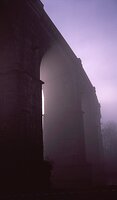
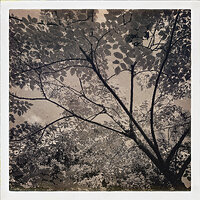
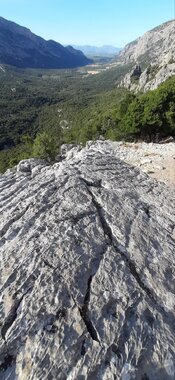
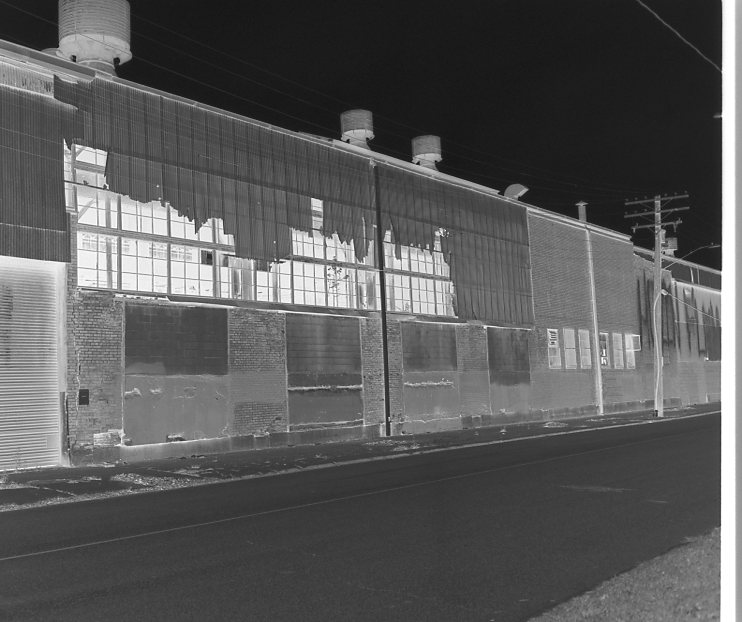
I have included scans of the stepwedge, H&D chart, and shot exposed using a Pentax 67ii set at box speed, for illustration.
Thanks for all of your comments, in advance!
I am having a problem that I think is not due to typical user error. I have been using Flic Film's Black White and Green film developer for about six months, mainly with Kentmere 400 at published dilution (1:49) and times (both from Flic's documents and the Massive Development Chart of 16min 15 seconds with good/expectable results of a straightline showing a nearly .65 gamma. I recently started shooting and developing Kentmere 100, shooting it at box speed, and using the corresponding dilution and times published by both Flic and the MDC, 13 minutes and 30 seconds at dilution 1:49. The stouffer's tests I have been doing have both show a nearly 1.0 gamma, and negatives that I have found way too contrasty to reliably print the highlights from. I have tried to reduce agitation from a 1 minute initial agitation scheme and 5 seconds every 30 seconds down to a 30 second initial agitation and 5 seconds per minute. I have closely monitored the temperature and dilution, wondering if I had messed something up there. I was at the bottom of a bottle of Flic BWG developer and opened a new bottle, after having read someone else having a similar experience with Kentmere 100 and a different developer (HC110?).
I am still aware that it may be my error, and hope that some of you may be able to identify a problem either in my description or assessment of the testing. I am attaching the scans of the most recent Stouffer step wedge and the chart I made using a Macbeth 500, which gives readings more reliably than, but still close to those of an X-rite 331 transmission densitometer.
Is it possible that the published times by both Flic and the MDC may be in error?
I am considering changing to a different developer. Ideally I should be able to adjust my time and/or dilution to get better development with this developer, right? What can anyone suggest as starting/adjustment times/dilutions? I have considered semi-stand development, but don't want the problem of bromide drag that seems to come with it. Is there a highly recommended developer for Kentmere 100? Has anyone else encountered the same problem with this film developer combination?
I have included scans of the stepwedge, H&D chart, and shot exposed using a Pentax 67ii set at box speed, for illustration.
Thanks for all of your comments, in advance!


