



• Welcome to Photrio!
    Registration is fast and free. Join today to unlock search, see fewer ads, and access all forum features.
    Click here to sign up

Minor Repairs On Nikon L35AF

The Hot Waters showers

A
The Hot Waters showers

  • 2
  • 0
  • 24
Self-Portrait: Hands

H
Self-Portrait: Hands

  • 12
  • 6
  • 92

Forum statistics

Threads
204,399
Messages
2,867,987
Members
102,253
Latest member
Iris_Wang
Recent bookmarks
0

ic-racer

Member
Joined
Feb 25, 2007
Messages
17,008
Location
USA
Format
Multi Format
First off, check out Richard Haw's pages on the L35AF, I did before I started this repair.


Like Richard, I didn't pay the going rate for these, I got my L35AF as "non-functional, for parts." Mine was probably listed that way to protect the seller from return-scams. In my case the camera seemed to function just fine, but needs some cleaning.
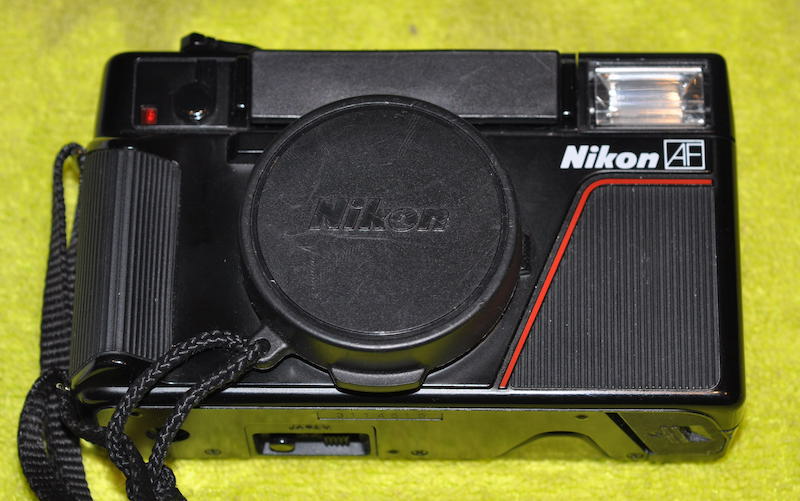
DSC_0959.JPG
 
Here is the major issue, the viewfinder is hazy.

Curious that it is just the center, but I have seen that center pattern on lenses before.

I will disassemble the viewfinder and try to clean it.

DSC_0960.JPG
 
Check the link in the first post for details on disassembly.

Many of the screws are different lengths, so keep good notes.

DSC_0964.JPG
DSC_0962.JPG
 
I took the strap off and, as I usually do with used straps, I soaked it in some warm soapy water.

DSC_0970.JPG
 
Don't forget this screw to release the front plastic shell.

DSC_0969.JPG
 
Another minor issue, this strap lug is bent.

DSC_0971.JPG
 
While removing the front shell, the glass protector for the viewfinder/focus unit fell out. The glue holding it in place had failed.


DSC_0973.JPG
 
No issues with the front cover, other than the glass had fallen out.

DSC_0976.JPG
 
I used needle-nose pliers with flat, non-marring jaws to straighten the bent strap lug.


DSC_0977.JPG
 
With the camera apart, the problem was now evident. The loose front 'protector' glass had rubbed against the optical element of the viewfinder. The front surface is somewhat convex, thus explaining the central location of the damage.


DSC_0979.JPG
 
Initial cleaning removed the 'dust' but there was still some damage to the front of the viewfinder lens.

DSC_0980.JPG
 
I used some plastic cleaner to polish out the defect and it worked very well.


DSC_0991.JPG
DSC_0992.JPG
 
The inside of the viewfinder was very dusty. Access to the viewfinder assembly can be obtained by removing this screw and lifting the cap off the assembly. The lens elements are glued in place.

DSC_0982.JPG
DSC_0984.JPG
 
Careful cleaning with a brush, cotton swab and compressed air made it look like new again.

DSC_0985.JPG
DSC_0986.JPG
 
There was a small crack in the outer shell, on the opposite side of the the bent strap lug. This was glued with some CA cement.

DSC_0987.JPG
 
Last edited:
The front protector window (thin glass) was thoroughly cleaned and re-glued to the front shell. Make sure the orientation is correct; the rectangle for the viewfinder is toward the cutout for the flash. The focus sensor circular windows are toward the shutter release.


DSC_0990.JPG
DSC_0993.JPG
 
IMG_6147.jpeg


I took the liberty of cropping and annotating your photo.

I see a solenoid here (arrow)—does that mean the L35AF uses the same technology for shutter release as a modern SLR? Would a motor also need to be installed for the AF?

Fascinating technology packed into such a small space. Thanks for the informative post!

As you’ve shown, we should also focus more on compact cameras. There are many models out there, but virtually no repair reports. The SPT Journal covers some of them, so the chances of a successful repair are excellent. And the purchase price is low compared to SLRs.
 
Thank you for following along.

Since these L35AF are hard to find, I only have the one. So I did not try to fire it with the shell removed. I think that one you show with the arrow is for the focus.

In terms of focus, I believe it is spring loaded like the L35AF-3 which I have more familiarity. The shutter button triggers the focus sensors, they estimate the focus and show it with an indicator in the viewfinder. Then, when the button is pressed farther, the lens unwinds under spring tension until its position sensor matches the electronic signal saved for the estimated distance. At that point, the solenoid stops the lens from unwinding farther.

I think it is similar to the way the aperture lever in the mirrorbox stops at a certain exact distance on the modern electronic Nikons.
 
Last edited:
Ready for testing. Wow, nice to have such a clear and clean viewfinder!

DSC_0995.JPG
 
With a bright source, it over exposes a little. But, good enough for me.

Subsequent to these tests, I did locate the service manual at the "Learn Camera Repair" site.

It indicates the shutter will go up to 1/400 or so with EV17 (my tester only goes to EV16).

With the dim light source EV5 it was under-exposing about 1 stop. That should be correct as it is from limitations of the shutter and lens. It can't expose longer than about 1/8 second at 2.8 (EV 6).

Overall I give it a high "PASS."


DSC_0996.JPG
DSC_0997.JPG
DSC_0998.JPG
Screen Shot 2026-05-23 at 8.01.01 PM.png
 
Last edited:
Good to see the photoflash capacitor has what appears to be an ordinary sort of form factor: I've encountered particularly long and narrow types which none of the usual suppliers stocks. Minimum special order quantity is typically 1000 pieces!
 
Yes, I think a working flash for this type of camera is important. As the shutter only goes to 1/8 sec.

Too bad, as even the Minox LX (1978) would go all the way to 15 seconds.

Here is a Minox LX image that would be impossible with the L35AF:

highway at night minox.jpg
 
Photrio.com contains affiliate links to products. We may receive a commission for purchases made through these links.
To read our full affiliate disclosure statement please click Here.

PHOTRIO PARTNERS EQUALLY FUNDING OUR COMMUNITY:


Ilford ADOX Freestyle Photographic Stearman Press Weldon Color Lab Blue Moon Camera & Machine
Top Bottom
