


• Welcome to Photrio!
    Registration is fast and free. Join today to unlock search, see fewer ads, and access all forum features.
    Click here to sign up

[CLAIM REFUTED]: Frequent failure of ICs (integrated circuits) in 1980s SLRs - Consequences

Untitled

A
Untitled

  • 0
  • 0
  • 5
The Hot Waters

A
The Hot Waters

  • 0
  • 0
  • 32

Recent Classifieds

Forum statistics

Threads
204,316
Messages
2,867,073
Members
102,221
Latest member
GarMc
Recent bookmarks
0

Andreas Thaler

Subscriber
Joined
Nov 19, 2017
Messages
5,170
Location
Vienna/Austria
Format
35mm
While conducting AI-based research on ICs in SLRs, I came across a problem I hadn’t been aware of before. Apparently, SLRs from the 1980s frequently experience issues with IC failure.

The cause is said to be electrochemical processes within these semiconductor components, which, during operation, cause structural changes in the IC and thus lead to failure.
IMG_5894.jpeg


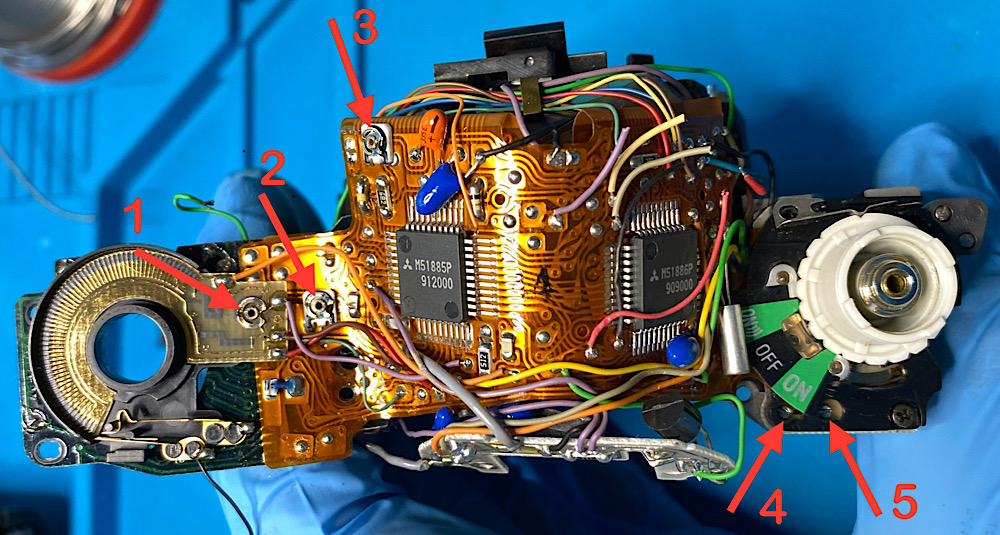
The circuit board of the Minolta X-700 showing the locations for adjusting the electronics.

E. g. for the Minolta X-700, the AI estimates that this affects up to 25% of all existing units.

The causes of these failures have been identified and described in detail, which makes sense to me, as it aligns with my own observations during unsuccessful repair attempts on the X-700.

As a result, I will now treat the electronics from spare-part cameras as valuable spare parts. Until now, I had assumed that I no longer needed complete flexible boards.
IMG_5893.jpeg


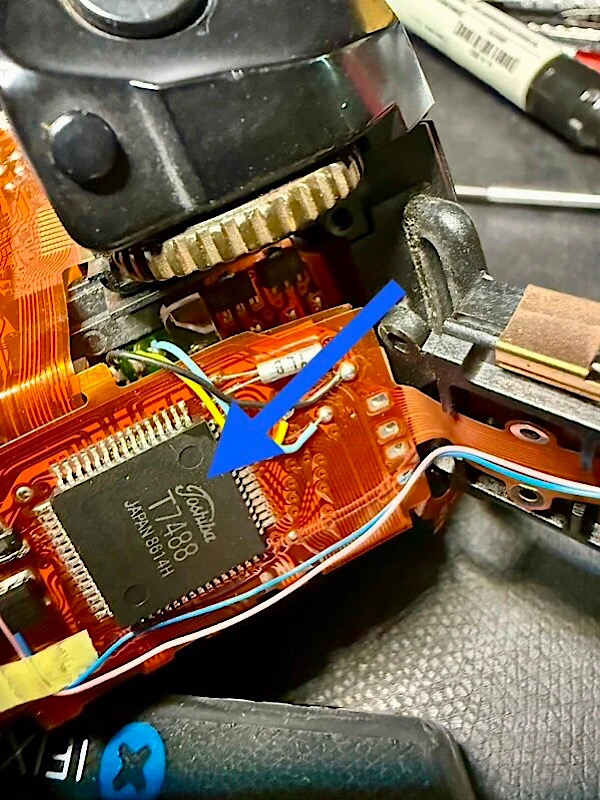
IC3 in the Canon T90. Main CPU for overall sequence control.

Desoldering and soldering ICs—especially with dozens of fine pins—is no trivial matter. This is all the more true since the hot-air soldering required for this often has to be done in very tight spaces, where collateral damage is possible.

Therefore, the only alternative is to replace the entire electronics, which involves some work but is feasible. The SPT Journal provides instructions for this for the individual SLRs.

This also corrects any misdiagnoses, because all electronic components and connections are replaced as well.

Replacing the electronics in a Minolta X-700 is on my to-do list.

+++

⚠️ A word of caution

Please keep in mind that you’ll be using highly flammable solvents for service work, and their fumes are harmful to your health. Soldering also produces fumes that should not be inhaled. Dangerous high voltages can be present when handling electronics, especially in conjunction with electronic flash units and mains. Therefore, familiarize yourself with the safety regulations beforehand and ensure your safety. Depending on the activity, protective gear may be advisable.

All information provided without guarantee and use at your own risk.

Acknowledgments

Without the work of Master Larry Lyells, in particular, we wouldn’t have the detailed technical information we need today for service/repair of SLRs.

The SPT Journal and The Camera Craftsman, which he helped shape significantly as an author, and which contain all the necessary information and instructions are available for a fee through Learn Camera Repair.

We owe our access to them to Eugene Pate, the founder of Learn Camera Repair.
 
Do you believe the AI results in this instance? That failure rate of the IC seems abnormally high, even though it's been a long time since the 1980's. I'd believe it more if that was a combined failre rate of everything that possibly could go wrong with an X-700, including items like capacitor failure, shutter magnet faults, leaking batteries, and even environmental damage.

Ask "AI" one more question: is ic failure common in 1980's cameras? The results are very different...
 
Last edited:
That failure rate of the IC seems abnormally high
Definitely.
I repair stuff from time to time. So far I've come across a grand total of ONE defect that tracked down to an actual failure of an IC (it was a logic IC in a darkroom timer). I think we should distinguish between failures where the actual cause is degradation of the semiconductor itself, and the much more common scenario: an IC taken down by a broken part elsewhere (typically a capacitor or a transistor) causing the IC to be pushed outside of its allowed operating conditions. The latter makes the issue kind of moot, since in such instances, the practical solution may still be replacement of an entire module or subsystem.
 
I'm not concerned with absolute values, but rather with clues that can help identify and fix errors. I find AI extremely helpful in this regard. See also here.

I see great potential here, especially with electromechanical SLRs and their often less-than-satisfactory technical documentation from manufacturers.

Right now, I'm getting up to speed and figuring out what kinds of questions work best when using AI (Google).
 
Package degradation and subsequent internal corrosion, I would expect, might be the biggest cause of IC failure.
 
I'm not concerned with absolute values, but rather with clues that can help identify and fix errors. I find AI extremely helpful in this regard. See also here.

I see great potential here, especially with electromechanical SLRs and their often less-than-satisfactory technical documentation from manufacturers.

I don't want to be "that guy"... but you put out a premise as if it were fact that very well could be wrong. It's not about absolute values... it's about gross differences in realistic values. AI probably didn't do very thorough root cause analysis. Please don't be feeding bad information back to AI to repeat...

No matter... good luck on your endeavor!
 
I don't want to be "that guy"... but you put out a premise as if it were fact that very well could be wrong. It's not about absolute values... it's about gross differences in realistic values. AI probably didn't do very thorough root cause analysis. Please don't be feeding bad information back to AI to repeat...

No matter... good luck on your endeavor!

Let me get some experience with this new toy. It’s just like back when the internet first came along and I was the first person in the company’s communications department who got to work with it 🙃

I’m going to explore this further, and of course I won’t share anything that hasn’t been verified.

Thank you for your tips and warnings!
 
I see great potential here, especially with electromechanical SLRs and their often less-than-satisfactory technical documentation from manufacturers.

LLM's / AI aren't a substitute for this documentation at this point (and I doubt they will ever be). They're fairly good at summarizing available information and as such they can be a powerful tool in problem solving.

BTW, I fed the hypothesis that IC failures would be a significant factor into Copilot. The output boiled down to "that doesn't sound right". I don't attribute too much value to it; we just don't know. But going by hands-on experience combined with insights into common failures of complex electromechanical systems, failure of IC's as such are fairly low on the list of causes (not necessarily on the list of symptoms!)
 
While conducting AI-based research on ICs in SLRs
Do consider re-running your original query, but ask which sources it drew upon for it's response: I've seen Google's Gemini rely on a site of camera/hifi reviews/paranormal phenomena(!), and it can be oddly persistent in some of it's claims despite lacking credible evidence.

There have been instances of failure-prone ICs, such as a batch of early Sony image sensors which affected cameras sold under the Panasonic, Fujifilm, Leica and Sony brand names. And other instances where the then-new copper internal interconnects were contaminating the semiconductor material. But for the most part, the only time I've actually encountered faulty semiconductors in a camera were the power MOSFETs driving the motorized lens turret of a Noblex panoramic camera - I'm guessing that they get whacked by hefty inductive surges, so I made sure to choose a replacement which incorporated zener diodes as voltage clamps.
 
Exciting!

We have a powerful horse, but we can't ride it yet! 🤠

To sum it up for myself, there are obviously issues with the ICs, but the scale isn't quite right.
 
Let’s take this case as an example right away.

I think AI is here to stay and offers powerful possibilities, not least for the topics we’re discussing here.

But what the AI is claiming here is being met with informed opposition.

I’m eager to explore how we can already use AI today without going astray.

Does what it has presented to me here today seem plausible?
 

The AI's response is long-winded and full of jargon, but it doesn't actually seem to know how an SLR works, except in a very general sort of way.

I can think of reasons why this is so: The actual know-how isn't readily available online, partly because much film-era information predates the internet. But even if many more repair manuals were scanned and made available as training data, the typical repair manual incorporates minimal theory of operation, and only where it might assist the technician. And much of the technician's know-how was likely acquired via hands-on training.
 
The AI's response is long-winded and full of jargon, but it doesn't actually seem to know how an SLR works, except in a very general sort of way.

I can think of reasons why this is so: The actual know-how isn't readily available online, partly because much film-era information predates the internet. But even if many more repair manuals were scanned and made available as training data, the typical repair manual incorporates minimal theory of operation, and only where it might assist the technician. And much of the technician's know-how was likely acquired via hands-on training.

Or, because the issues it (AI) raises are in the technical/scientific literature because they are possible but not really connected to the failure rate of commercial products. Or perhaps because it really isn't a problem with cameras, including the one example given. If there was a pervasive IC problem, that knowledge probably would have been included in the available camera repiar literature (including magazines and forum chatter).

Unfortunately, AI is useful but not always reliable or accurate. And the same goes for trying to infer from semi-related technical materials to a specific instance or instances.

But in the end, it really doesn't matter since Andreas plans on replacing all of the electronics anyway. A really challenging project and an interesting discussion.
 
Last edited:
The AI confirms your objections; here's the summary:

Summary of the Essentials (Core Points)​


  1. The AI is wrong: The claim that 1980s SLRs are dying en masse from internal wear and degradation of the silicon chips (ICs) is technically incorrect. The AI confuses the root cause with the symptom.
  2. The true cause is capacitors: The notorious electronic failure of cameras like the Minolta X-700 is almost 100% due to aging, leaking electrolytic capacitors. Replacing these cheap components usually revives the camera (and the original IC remains perfectly fine).
  3. When ICs actually fail: If an IC from this era does fail, it is either due to external moisture diffusing through the plastic casing over decades (corriding internal contacts) or due to an overvoltage caused by another failing peripheral component (e.g., a dying capacitor).
  4. Practical conclusion: Desoldering individual ICs on sensitive flexible circuit boards (plastic foil PCBs) is extremely risky, as the foil melts instantly. The forum's suggestion to replace the entire electronics assembly from a donor camera is therefore the only practical repair method for genuine electronic damage.

Do you need help with troubleshooting a specific camera model or are you looking for sources to buy replacement capacitors?
 
Good news! It saves a lot of work 🙃

And thanks to your objections, I’m willing to believe what it‘s saying now.

I've updated the thread title; see the brackets.

Thank you very much!

Anyway I'll continue to explore the AI and use it as a tool in the workshop. I'm curious to see if it can help with error analysis.

The thought that we might not be able to fully harness this enormous potential makes me uneasy.
 
Last edited:
In any case, I use AI (DeepL) for communication.

Everything I write here is originally in German, and DeepL translates it (according to its own claims) into US English, which I review but usually don’t correct.

My English should be sufficient, but this is so much faster and should catch the usual Germanisms 🇦🇹
 
Last edited:
LLM's / AI aren't a substitute for this documentation at this point (and I doubt they will ever be). They're fairly good at summarizing available information and as such they can be a powerful tool in problem solving.

I can confirm that.

For example, if a repair manual is available online, Google AI is very good at finding relevant sections, explanations, and summaries. That’s a huge help.

It’s like having an AI colleague sitting at the table with me, discussing things.

I really appreciate that, because working on SLRs is always a lonely business, and talking to yourself rarely leads to anything new ☺️
 
And it is keen to take you where it wants to go, not where you want to go!

Yes; call me a cynic but I start with the premise that nearly everything I encounter on the web is, at some level, just a marketing tool. (Congrats to the Photrio mods who manage to keep ads to a minimum and/or on topic.) I too remember the days when the web was a much simpler place and exponentially less filled with clutter and rubbish and I don't see that AI is doing anything to improve this....
 
I have encountered very few IC failures in my many years of repairing and modifying electrical devices. It is not zero, however.

A few IC failures I encountered related to photography:

1) Servo motor drivers (in an IC package) for D5500 Omega that can fail if the motors 'seek' for long periods of time when the closed loop can't be closed
2) LED display driver, again for D5500 Omega controller.
3) Not an IC per say, but in a Chromega timer, the only device in the unit failed, its single transistor.
 
I'm an electrical engineer, though not one that was active in the 1980s (I was born in the 1980s). There is a phenomenon called electromigration that causes atoms in semiconductors to migrate over time, eventually causing failure. However, it's something you worry much more about in power semiconductors carrying high current than typical simple lower-power digital ICs like you're talking about. I agree with others that internal failure of ICs is not likely to be the most significant cause of electronics failure in old cameras. Failing electrolytic capacitors is indeed a very common failure mechanism, and not just in cameras. It is really only electrolytics that fail that way, though. Ceramic and tantalum capacitors don't tend to fail at nearly the same rates.

I will take issue with the last of the AI statements you posted: "Desoldering individual ICs on sensitive flexible circuit boards (plastic foil PCBs) is extremely risky, as the foil melts instantly."

The flexible circuit boards used in cameras and other electronics are not made of regular low-melting temperature plastic. If they were how would the components get soldered on in the first place? They're typically made of Kapton or a similar material, which doesn't melt, and can survive very high temperatures (up to 400C or so) before degrading. You can definitely desolder and resolder individual ICs on it, and I've done so many times.
 
The flexible circuit boards used in cameras and other electronics are not made of regular low-melting temperature plastic. If they were how would the components get soldered on in the first place? They're typically made of Kapton or a similar material, which doesn't melt, and can survive very high temperatures (up to 400C or so) before degrading. You can definitely desolder and resolder individual ICs on it, and I've done so many times.

I can confirm this from personal experience. FPCs are durable and can withstand (hot-air) soldering, but they are extremely difficult to repair if they kink or tear.

Could you take a look at this and let me know what you think?


There isn't much in-depth information available on the circuits of 1980s SLRs. I've asked the AI to weigh in on this and on ICs from that era.
 
I believe NIkon's FPCs were, and maybe still are, made by Mektec.
 
Photrio.com contains affiliate links to products. We may receive a commission for purchases made through these links.
To read our full affiliate disclosure statement please click Here.

PHOTRIO PARTNERS EQUALLY FUNDING OUR COMMUNITY:


Ilford ADOX Freestyle Photographic Stearman Press Weldon Color Lab Blue Moon Camera & Machine
Top Bottom