• Welcome to Photrio!
    Registration is fast and free. Join today to unlock search, see fewer ads, and access all forum features.
    Click here to sign up

116 onto spiral insanity prevention

Recent Classifieds

Forum statistics

Threads
204,274
Messages
2,866,513
Members
102,207
Latest member
gustavocf
Recent bookmarks
1

LargishFormat

Member
Joined
Feb 22, 2025
Messages
11
Location
Edinburgh
Format
Analog
Right then lets get the shame oit of the way. I am a failure 🙂

I have a found roll of 116 in quite an interesting camera. I would like to try and see of there is anything on the roll.

But try as i might i cannot get the bloody film on. Its tightly curled and very floppy.

I am using a paterson spiral double up with a second spiral to create the 70mm as required and well documented. I have used the playing card trick but the film just flops when ratcheting.

I don't want to buy a different spiral unless its a. Cheap and b fits into a paterson tank.

I want to stand develop it to give me a best chance, but are there any other options than just slowly finger printing the entire surface of the emulsion in ever more frantic attempts to load it.
 
You may have the spiral halves too close together. The film needs a slight amount of clearance either side, and it's best if you trim the front corners of the film at about 30 degrees to prevent catching the spiral as it's going through. Not much of a trim is needed. Feeling in the dark, just bring the scissors to the corner of the film and start snipping till you've cut a just a little off.

Have you got the nylon locking ring that locks the spiral on the center spindle? If you have, use it to position the spiral halves exactly the width of the film + a slight amount of clearance so the film can easily move in the spiral. If the film is hard to start, cut a thin piece of cardboard and lay it in the spiral about 1/2" in, and start pushing the film through over the cardboard guide. The guide must be the width of the film, no less, and thin enough to allow the film to pass over it and into the spiral. Pull the guide out once the film is past the steel non-return balls.
 
I have a found roll of 116 in quite an interesting camera. I would like to try and see of there is anything on the roll.
So it's not your prize-winning pictures. Develop them with the see-saw method. Even more expedient, the bucket method. Names should be self-explanatory. Of course you-ll have to stay in the dark for a few minutes. After ~30s in an acidic stop bath light on is safe. No need to stay in the dark during fixing.
 
If you had a 616/116 Kodak developing apron and the associated tank I would recommend that.
Pulling the first few inches of the film into the reel sometimes works with the Yankee 616/116 reel and tank I have.
But the see-saw method is probably the best choice.
That is what 11 year old me used when I developed my first film - coincidentally 616 film, but fresh and within date, so much less curly.
Good luck.
 
1779120173958.jpeg
 
I use similar methodology as @film4Me when processing 616/116 and even wider film in Paterson reels and tank. The two reel solution need to be adjusted properly in daylight with a spare film strip. I also use rubber bands to make sure the reels will not move out of alignment during agitation.

Even then, it might take a few trials and errors and lots of cursing to get very curly old grumpy film onto the reels. Trust me, 116/616 film (70mm) is not all that bad compared to 122 film (3.5 inches). But once it is on, it should stay on even with moderate agitation.

 
I think I would try it in a deep tray or bucket by hand, just moving it around enough to keep it from touching adjacent layers. You only need to do it once and you probably run more chance of kinks and scratches trying to get it onto a reel.

I did a roll of 122 this way in HC110 iirc and development was satisfactory and not noticeably uneven.
 
If you had a 616/116 Kodak developing apron and the associated tank I would recommend that.
Pulling the first few inches of the film into the reel sometimes works with the Yankee 616/116 reel and tank I have.
But the see-saw method is probably the best choice.
That is what 11 year old me used when I developed my first film - coincidentally 616 film, but fresh and within date, so much less curly.
Good luck.

I recently acquired some film aprons aka film lasagna for 120 and 135 film, and they are by far the easiest developing tool I have loaded film onto. It is pretty much foolproof and idiot proof. And I can attach them to the center rod in my paterson tank.
 
Well after two days of trying on and off trying i just sat down and did it first go 🤣

The biggest help was a much more gentle corner cut than i usually make. And putting the dog in another room. Normally i just sort of throw 120 and 35mm film on first time every time so this struggle was particularly frustrating.

I don't have a film suitable darkroom at the moment which was why i wanted to keep it reel...

The reason i wanted to see this film is the camera has been modified and heavily repaired and i am curious what the user may have been up to. Hoping for an insight into the last user... Expecting nothing.
 
OK, I feel your pain. I have recently gone down the rabbit hole of shooting "panoramic" shots with old 616 cameras. There are two common approaches: (1) shooting outdated 616 film, which is 70mm wide, like 116 film; (2) using 120-to-616 adapters, in order to shoot 120 film. Both options have their own set of challenges.

When it comes to the first option, I immediately encountered the trial of trying to get the 616 film onto any kind of a reel that would work smoothly for processing. Most of the outdated film I obtained was thin (due to a thinner base); moreover, due to age, the film was subject to extreme curling. I have been processing film on metal reels for over 5 decades, but suddenly I felt like I was back in high school, struggling to learn how to feed those first rolls of film onto reels in total darkness -- and plastic reels, no less.

I looked for a stainless 116/616 reel. Nikor/Honeywell sold such reels back in the 1970s, but the only one I saw listed on eBay had sold a month earlier, so they are obviously in short supply.

I initially resorted to an old adjustable plastic reel, but that was a sore fight. First, I was unaccustomed to shoving film into a reel from the outside inwards. Further, the flimsy nature of the 616 film, and friction from the reel, made it difficult to keep the film moving, even after the initial struggle to get it started properly.

Next, I learned the art of constructing a 70mm reel from two Paterson 35mm reels. Ah! but the curl of the flimsy film again worked against me, first making it difficult to keep it in place to advance past the bearings, in order to start ratcheting of the reels; but then, after fighting to get the initial alignment, the film had the tendency to pop out of the grooves, even when it was started properly.

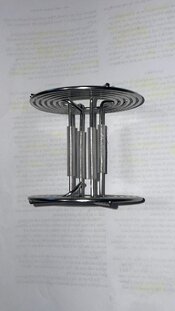
Totally exasperated, I was recently rescued by an ingenious solution offered by a fellow photographer who has more problem-solving skills that I do. His solution was to take a 120 reel, cut it in half, and extend the posts with hard plastic sleeves. (See attached image.) I can happily report that my initial tests with this prototype have been successful. I have been able to get the film loaded on the reel in about the same time as an ordinary 120 roll of film -- working in my preferred direction from the center to the outside edge of the reel.

There is one caveat with this prototype. The 616 film was designed to shoot images at are 6.5 x 11 cm ("panoramic"). That makes the length of the film on the roll a bit longer than a standard 120 roll. Some 616 film extends beyond the outside edge of the reel -- not by much, but enough to consider an enhanced prototype. We have obtained some old 220 reels (that fit in a standard tank); and he is going to construct a prototype from a 220 reel. That may ensure greater flexibility with the length of the film, as well as compatibility with the 70mm width of 616/116 film.

If everything works well, this also raises the potential of hand-spooling fresh 70mm film onto recycled backing paper. There are limited options for 70mm film; and since many 70mm film stocks seem to be designed for surveillance, it often comes on a thinner base -- all the more reason to use a metal reel that can be loaded more easily for processing than any of the plastic reels.

A related project for 616 cameras is for option no. 2: using other film formats with a 616 camera. We have detected common problems trying to use stock 120 film, even with adapters, because the spools are fatter than 616 spools. Users often begin by clipping the rim of the 120 reels, so that the film can fit in the film compartment of a 616 camera. But even if this obstacle is overcome, we have experienced various film transport problems. Our working goal is to produce a 620 to 616 adapter. Like 616 spools, the 620 spools are thinner. With prototype adapters, 620 film moves more cleanly through a 616 camera. Yes, you lose part of the frame width; but this allows us to use modern film stocks, rather than being limited to outdated 616 film. There are still 620 film stocks on the market, or 120 film can be respooled onto 620 spools.

Anybody else in this rabbit hole?

 

Attachments

  • IMG_4838.jpg
    IMG_4838.jpg
    237 KB · Views: 21
A related project for 616 cameras is for option no. 2: using other film formats with a 616 camera. We have detected common problems trying to use stock 120 film, even with adapters, because the spools are fatter than 616 spools. Users often begin by clipping the rim of the 120 reels, so that the film can fit in the film compartment of a 616 camera

Good point.

So far I've only used 120 in a 116 camera. The flanges on 116 spools are much larger than 616, so 120 just falls into the 116 film chamber. Now you've got me thinking that I'll need 620 spools for 616 cameras - thanks for that information.

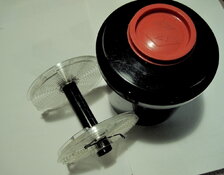
For processing all my 70mm film, I use an adjustable Nebro reel, they are few and far between, very scarce, and at the time when I bought it, I didn't know that, I just bought it because it accepted larger film than 120. It was only later I realized I'd bought a rare piece of equipment that is very handy. Slots can be filed into the center spindle for any size film from 16mm up to 70mm. There's a locking spring that fits in the grooves.

IMG_0048.JPG

There is of course other ways to process large size roll films, for example, the apron idea that I never knew about until MattKing mentioned it, which seems easy enough to do, but where do you get them for 70mm film?

The method I'd really like to get into is long narrow tray processing. It will take a fair bit of design and construction skills to make it, but I'm already working on it - wish me luck.
 
Look in the drywall/film development area of your local home improvement store. They have long and narrow trays for “mud”, I have used them for very large prints. Or cut and seal roof gutters to whatever length.
 
Perhaps plastic guttering would be ideal, if there is such a thing. Other than that, some PVC pipe might lend itself to being useful for the job also. It'll be a temporary measure because the number of films I'll be processing will be limited to about 5 films, all larger than 122.
 
I have seen big stainless tanks (made by Fairchilds?) with hand cranks for processing long roll of 70mm film. It does not look super complicated, and might be doable for handy person.
 
I use similar methodology as @film4Me when processing 616/116 and even wider film in Paterson reels and tank. The two reel solution need to be adjusted properly in daylight with a spare film strip. I also use rubber bands to make sure the reels will not move out of alignment during agitation.

Even then, it might take a few trials and errors and lots of cursing to get very curly old grumpy film onto the reels. Trust me, 116/616 film (70mm) is not all that bad compared to 122 film (3.5 inches). But once it is on, it should stay on even with moderate agitation.


Yeah that the technique i used but for 116 film you don't need the gap, you just but the two halves together and its good to go.

Unfortunately the film produced nothing, just a hazy mess of fog. An interesting experience none the less.

Now to the 130 and 122 films...
 
116 and 616 are wider than 120 or 620, I am fairly sure.

They are the width of 70mm film, so the solutions that people have devised for that film work with 116/616.
And vice versa.
But a lot of people make the decision instead to add adapters and put 120 film between them.
 
They are the width of 70mm film, so the solutions that people have devised for that film work with 116/616.
And vice versa.
But a lot of people make the decision instead to add adapters and put 120 film between them.

Thats what I ended up doing for my Kodak Monitor 616. Have to finagle the 120 spools in, but its a tight fit to get the spools in (at least for the monitor, not sure about other 616 cameras). Gonna have to clip the edges a smidge on a couple spools to see if that helps putting them in/taking them out a bit better.
 
There is an ancient Paterson Major series - perhaps close to a hundred years old by now. The reels can be adjusted for 127, 120/620, or 116/616 film formats. It is a very nice-looking, highly compact developing tank. Perhaps a bit inconvenient to use, but it has deep grooves and, because it is compact, the reel diameter is smaller. Maybe that would help a little with these old curved films, although I do not expect it to be particularly easy.
They are extremely inexpensive, and there are quite a lot of well-preserved examples around.
 
Photrio.com contains affiliate links to products. We may receive a commission for purchases made through these links.
To read our full affiliate disclosure statement please click Here.

PHOTRIO PARTNERS EQUALLY FUNDING OUR COMMUNITY:


Ilford ADOX Freestyle Photographic Stearman Press Weldon Color Lab Blue Moon Camera & Machine
Top Bottom